Why Advisor Selection Matters More Than Most Sellers Realise
Choose an M&A advisor by testing the proposed buyer map, the senior team doing the work, confidentiality controls and the full written fee terms. A local broker may suit a smaller owner-operated sale; a structured process can suit a business with credible strategic, private-equity, family-office or cross-border buyers. Lyndon Advisory can review fit before an owner commits to a mandate.
| Seller Situation | Best-Fit Advisor | What to Verify |
|---|---|---|
| Small local business with a nearby buyer | Business broker or accountant | Local buyer access, speed, simple documentation |
| Business with several credible buyer types | Boutique M&A advisor | Relevant transactions, buyer rationale, senior execution |
| Singapore, Malaysia, Australia, or Hong Kong company with cross-border buyer logic | Regional M&A advisor | APAC relationships, regulatory awareness, multi-country process discipline |
| Large-cap or public-company transaction | Investment bank | Capital markets access, global institutional coverage |
The advisor’s proposed process determines which buyers are approached, what they learn, when offers are compared and who manages negotiations. It cannot guarantee a sale price or closing. Australian Government guidance on selling a business advises owners to check a broker’s credentials and decide what is included in the sale before going to market.
An owner may start with a referral or a persuasive pitch, but should compare the actual lead advisor, category experience, buyer-screening plan and engagement terms before signing. Ask how the team would handle a buyer who requests sensitive information or exclusivity early.
This guide provides a structured framework for evaluating and selecting an M&A advisor before selling a business. For country-specific owner routes, see Singapore, Malaysia, Australia, and Hong Kong.
If you are choosing an advisor because a buyer has already appeared, start with the trigger-event playbook for what to do when private equity approaches your company. The first decision is whether to stay bilateral or create a controlled market check.
Choose the Right M&A Advisor Selection Path
| Owner situation | What Lyndon should understand first | Best next step |
|---|---|---|
| You are shortlisting M&A advisors before launching a sale | Revenue, EBITDA, sector, geography, shareholder objectives, buyer universe, and expected transaction size | Submit an advisor-fit inquiry |
| A buyer, PE fund, competitor, or strategic acquirer has already approached | Buyer motive, offer logic, information requested, exclusivity pressure, and whether alternatives should be created before responding | Review the buyer approach |
| You are comparing a broker, boutique advisor, or investment bank | Enterprise value, deal complexity, buyer reach needed, proposed retainer, success fee, minimum fee, tail period, and fee cap | Compare advisory economics |
| You are not ready to launch but want to prepare | Financial readiness, management depth, customer concentration, data-room gaps, owner dependency, and likely buyer universe | Benchmark exit readiness |
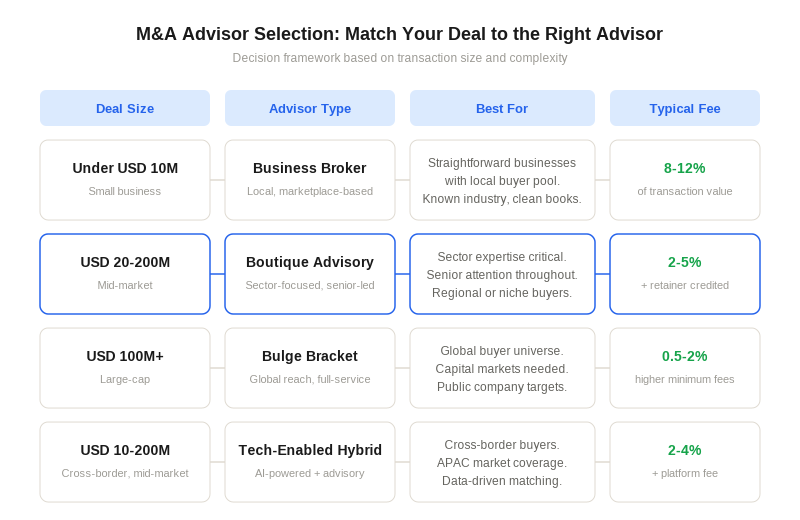
The Four Types of M&A Advisors
Not all advisors serve the same market. The M&A advisory landscape spans four distinct categories, and choosing the wrong type is a common and expensive mistake.
Large investment banks can bring capital-markets capability and broad institutional coverage. Ask whether they accept a mandate at your scale, who would run it day to day and whether that team has relevant buyer relationships.
Boutique advisory firms may focus on particular sectors, regions or company sizes. Verify who owns the mandate through closing, how the team builds its buyer map and whether its relevant transaction evidence is current. A boutique label alone does not establish senior attention or stronger buyer access.
Business brokers may be well suited to a smaller local or owner-operated business whose likely buyers are nearby operators. Some use listings and others use targeted introductions. Check credentials, the disclosure plan, how enquiries will be screened and whether the broker’s process fits the company. Australian Government sale guidance identifies brokers alongside accountants and lawyers as possible professional support; it does not set a size cutoff.
Regional specialist advisors combine senior M&A judgement with structured buyer identification, disciplined outreach tracking, and local partner networks. This model is useful when the buyer universe crosses more than one market, especially in fragmented APAC sectors where the best buyer may be in Singapore, Malaysia, Australia, Hong Kong, Japan, or Greater China rather than the seller’s home city.
Five Criteria That Actually Matter
Advisor pitches are polished, credentials are carefully curated, and every firm claims deep sector expertise. The challenge is distinguishing genuine capability from effective marketing. These five criteria, evaluated rigorously, separate advisors who will add value from those who will not.
1. Recent, Relevant Deal Experience
Ask for verifiable completed transactions relevant to your sector, company size, geography and proposed buyer types. Then ask which named team members worked on each deal and what they personally did. Experience in another sector may still help, but the advisor should explain how its process transfers to your business. Review Daniel Bae’s role and selected career transactions, then test their relevance to your mandate; those pages do not imply that every cited transaction was a Lyndon mandate.
For a consumer brand, use the consumer M&A advisor selection checklist to test category evidence, buyer mapping and the actual team. Ask how an advisor would verify trademark and product-right ownership: WIPO’s IP-audit guidance recommends checking ownership and agreement transferability before working with an acquirer. Food and beverage owners can use the F&B advisor guide to ask about food-safety diligence, supplier risk and staged disclosure. Both are narrower decisions than this general selection framework.
2. Buyer Network Quality
The advisor’s buyer relationships determine the competitive dynamics of your process. The right advisor does not just send emails to a list — they have relationships with the specific acquirers, private equity firms, and strategic buyers active in your sector.
Ask specifically: Which buyers in my space have you transacted with? Which PE firms have you completed deals with recently? How many of the buyers on your target list have you personally introduced deals to before?
A broad but shallow buyer list matters less than a focused network of qualified, active acquirers. In Asia Pacific, where many markets are relationship-dependent, an advisor’s personal connections to decision-makers can be the difference between a buyer engaging seriously or passing on the opportunity.
3. Senior Team Continuity
Owners can be disappointed when the senior person who pitches the mandate is not involved in execution. Get the proposed staffing and decision responsibilities in writing before engaging.
Before engaging, confirm: Who will lead my process day to day? Will the senior person I am meeting be involved through closing? How many active mandates does the lead advisor currently have, and how will status be reported?
4. Process Design and Discipline
A credible advisor should articulate a clear process before you sign the engagement letter — timeline, buyer targeting strategy, marketing approach, milestone checkpoints, and contingency plans. If the advisor cannot describe how they will run your process with specificity, they are improvising.
Ask about their typical timeline from engagement to close. Ask what happens when a lead buyer drops out at the LOI stage. Ask how they maintain competitive tension with two bidders versus four. Process discipline separates experienced advisors from those who are still learning at your expense.
5. Fee Structure Alignment
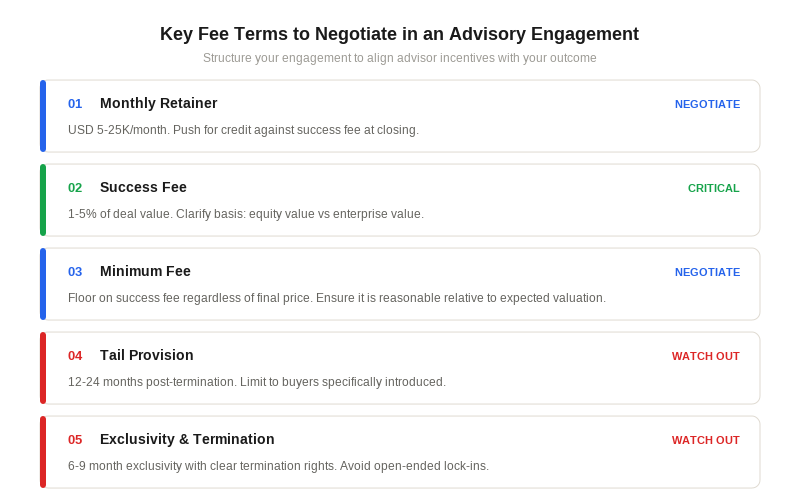
Advisory fees are negotiable, but the full structure matters more than the headline percentage. Retainers, success fees, caps and expenses shift cost and incentives in different ways. Compare the written economics and expected net proceeds, including what is owed if the process does not close. Lyndon’s published fee terms are a 2.5% success fee on enterprise value capped at US$750,000, with no retainer, monthly fee or expense recharge; submitting a valuation inquiry creates no mandate.
Key terms to negotiate in the engagement letter:
| Term | What to Push For | Why It Matters |
|---|---|---|
| Retainer credit | Whether any retainer is credited against the success fee | Avoids assuming that upfront payments reduce the closing fee |
| Success fee basis | Clear definition (equity value vs enterprise value) | Can differ by millions on leveraged businesses |
| Minimum fee or cap | State whether either applies and how it is calculated | Avoids confusing a fee cap with a minimum |
| Tail provision | Named buyers, clear trigger and a proportionate duration | Limits disputes after the mandate ends |
| Exclusivity period | Clear scope, review points and termination rights | Preserves a way to address an underperforming engagement |
The Interview: Questions That Reveal the Truth
Pitch meetings are rehearsed. The real evaluation happens when you ask questions the advisor has not prepared for. These ten questions, asked directly, will reveal more than any credentials deck.
- How many deals in my sector and size range have you closed in the past 24 months? Not “worked on” — closed. Failed processes do not count.
- Can I speak with your two most recent clients? Not hand-picked references from five years ago. Recent clients. If they hesitate, that tells you something.
- Who exactly will run my deal day-to-day, and how many other mandates will they be managing? Get names, not titles. Get commitments, not reassurances.
- What is your buyer list methodology? How do they build the target list? Do they start from a database, or from relationships? How do they identify non-obvious buyers?
- Walk me through a deal that did not close. Every experienced advisor has had deals fail. Their analysis of why — and how they managed the client through it — reveals their judgement and integrity.
- What is your process when the lead bidder drops out after due diligence? This tests whether they have real contingency planning or just optimism.
- How do you handle cross-border buyers? Particularly relevant in Asia Pacific. Do they have local presence, partner coverage, direct buyer relationships, or structured research to reach buyers across jurisdictions?
- What is the most common reason deals at my size fail to close? Their answer tells you what they worry about — and whether those concerns are relevant to your situation.
- What do you think my business is worth, and how did you arrive at that range? A credible advisor gives a range with clear methodology. An advisor who quotes a high number to win the mandate is a red flag. Expect references to EBITDA multiples, comparable company analysis, and precedent transactions — not vague assurances.
- What would make you decline this engagement? An advisor willing to turn down work has standards. An advisor who takes every mandate regardless of fit is volume-driven, not outcome-driven.
Red Flags That Should Disqualify an Advisor
These warning signs deserve direct questions and written clarification before an owner signs an engagement letter.
Guaranteed valuations. No honest advisor promises a specific price before running a process. Markets set prices, not advisors. A firm that quotes an aggressive number to win the mandate is likely to manage your expectations downward once the engagement is signed.
Reluctance to provide references. Ask for relevant recent clients who have consented to speak. Confidentiality may limit named references, so also request verifiable public transactions and a precise account of the team’s role.
The “bait and switch.” The senior partner dominates the pitch meeting, then you never see them again. The actual team running your deal is junior, overworked, and learning on the job. Confirm team continuity in writing before signing.
Unclear cost if a deal fails. Ask which retainers, monthly charges or expenses remain payable if no transaction closes, and whether any upfront amount is credited at closing. Lyndon charges none of those upfront costs and is paid only if a deal completes.
No clear process milestones. Ask how the advisor will approve the buyer list, prepare the teaser, screen responses and request IOIs. Dates should fit the company and agreed disclosure controls; a fixed timetable is not evidence of discipline.
Conflicts of interest. Ask whether the advisor represents, is paid by, or has a material relationship with a potential buyer. Require a clear conflict process before outreach; Lyndon does not advise both parties in the same transaction.
APAC Considerations: What Is Different in Asia Pacific
Cross-border mandates require country-specific buyer research, language capability and a plan for legal and regulatory questions. Ask each team to show who handles those tasks in the markets relevant to your business.
Market differences. APAC buyers face different languages, regulations, buyer pools and deal practices. Ask how the advisor would research and approach a buyer in each relevant country and which local specialists would be involved.
Buyer access. A claimed relationship is not proof of current appetite. Ask for a current rationale, decision-maker, contact path and qualification plan for each proposed buyer, including any local introduction needed.
Regulatory complexity. A cross-border buyer may face investment screening or sector-specific approvals. Australia’s foreign-investment guidance on business acquisitions illustrates how review can depend on the buyer, target, interest acquired and transaction structure; current requirements need transaction-specific legal advice. Ask who will identify approval questions before a buyer receives exclusivity.
Succession-driven decisions. A family owner without an internal successor may care about staff, brand and continuity as well as price. Ask how the advisor would test those priorities with buyers and coordinate the succession plan with the owner’s legal and tax advisers.
Boutique vs. Bulge-Bracket: Which Is Right for Your Deal?
Compare the actual teams and transaction scope. Company size and buyer universe matter, alongside sector complexity, cross-border needs and capital-markets requirements.
| Factor | Boutique Advisory Firm | Bulge-Bracket Bank |
|---|---|---|
| Mandate fit | Confirm the specific sector, company scale and buyer universe | Confirm the transaction warrants the bank’s team and coverage |
| Sector focus | Ask for relevant completed transactions | Ask for relevant completed transactions |
| Senior attention | Name the lead and execution team | Name the lead and execution team |
| Buyer network | Test relevant relationships and current buyer fit | Test relevant relationships and current buyer fit |
| APAC cross-border | Ask how local partners and regulatory questions are handled | Ask how local partners and regulatory questions are handled |
| Fee structure | Compare written scope, fee basis, cap, retainer, expenses and tail | Compare written scope, fee basis, cap, retainer, expenses and tail |
| Process speed | Request company-specific milestones | Request company-specific milestones |
Choose the team whose named people, buyer map and process fit the mandate. A boutique may offer a focused senior team; a larger bank may be needed for capital-markets access or a dual-track process. Neither label establishes an outcome. Compare relevant experience, actual staffing, conflict checks and total fees before appointing either.
M&A Advisor vs. Business Broker: Which Do You Need?
The route should fit the credible buyer universe, confidentiality needs and transaction complexity. Changing advisors mid-process may require restarting outreach, so agree the mandate scope and exit rights before signing.
Consider a business broker if:
- The likely buyer universe is local and the business is owner-operated
- You have an obvious buyer (a competitor, a family member, an employee)
- The transaction structure is straightforward (asset sale, no earnouts, no cross-border complexity)
- The broker can explain its buyer-screening and confidentiality process
Consider an M&A advisor if:
- Several credible buyer categories need a controlled comparison
- You want to test competing offers on price, certainty and terms
- The buyer universe includes private equity, strategic acquirers, or cross-border buyers
- You need institutional-quality due diligence preparation and data room management
- The transaction involves complexity: earnouts, rollover equity, regulatory approvals, or cross-border structure
Compare the offers an advisor could credibly pursue with the total cost and confidentiality work of the proposed process. No universal sale-price uplift or fee offset can be promised for an individual company. A local broker may be the better fit for a smaller local sale; a qualified advisor can help an owner test a wider buyer universe when the business warrants it.
A Practical Checklist for Selecting Your M&A Advisor
Use this checklist during the evaluation process:
Before the pitch meeting:
- Define your deal parameters: target price, acceptable structures, timeline, buyer type preference
- Research the advisor’s recent transactions in your sector and size range
- Review their team on LinkedIn — confirm seniority of who will actually work the deal
During the pitch meeting:
- Ask for closed transactions in your sector from the past 24 months (request names, not just counts)
- Confirm which team member runs day-to-day execution
- Ask to see a sample buyer list or process timeline from a comparable transaction
- Ask what they would do if the lead buyer drops out post-LOI
- Request two recent client references
Evaluating the engagement letter:
- Any retainer and its treatment at closing are stated explicitly; Lyndon charges no retainer
- Success fee basis is defined explicitly (equity value, enterprise value, or gross proceeds)
- Tail provision names covered buyers, the fee trigger and an agreed duration
- Termination rights are clear — you can exit the engagement with reasonable notice
- Expense reimbursement has a cap or requires pre-approval above a threshold
After signing:
- Agreed milestone schedule (buyer list by week X, teaser distribution by week Y)
- Weekly update cadence defined
- Clear escalation path if the process stalls
Comparing M&A advisors for a business sale? Submit a confidential advisor-fit inquiry with your sector, geography and likely buyer types. Lyndon Advisory can explain a proposed buyer map, senior execution and disclosure plan before any mandate is signed. Its published fee is 2.5% of enterprise value capped at US$750,000, with no retainer, monthly fee or expense recharge; nothing is payable unless a transaction closes. Submitting the form creates no mandate.
Related Guide
For the broader framework behind this topic, see Lyndon Advisory’s guide to selling a business.
About the Author

Daniel Bae
Co-founder & CEO, Lyndon Advisory
Daniel is an investment banker with 15+ years of experience in M&A, having advised on deals worth over US$30 billion. His career spans Citi, Moelis, Nomura, and ANZ across London, Hong Kong, and Sydney. He holds a combined Commerce/Law degree from the University of New South Wales. Daniel founded Lyndon Advisory to solve the pain points in M&A, enabling bankers to focus on what matters most — delivering trusted advice to clients.
About Lyndon Advisory
Lyndon Advisory is an M&A advisory firm built for Asia Pacific. We help business owners sell their companies and investors make strategic acquisitions with senior-led execution, disciplined process management, and structured buyer research. For owners, the first step is a confidential review of valuation range, likely buyer universe, and whether a structured sell-side process is justified.
Request a confidential seller reviewTopic cluster