Most M&A advisors charge a success fee of 3–6% of enterprise value plus a monthly retainer of USD 5,000–25,000. For a USD 25 million sale, the all-in cost typically runs USD 750,000–1.5 million under a standard model. Lyndon Advisory charges a 2.5% success fee capped at US$750,000, with no retainer, no monthly fee, and no expense recharges.
What Does an M&A Advisor Charge?
Most M&A advisors charge a success fee of 3–6% of enterprise value for SME and lower-mid-market transactions, paid only when a transaction closes, plus a monthly retainer of USD 5,000–25,000. For a USD 25 million sale, the success fee is usually USD 500,000–1.25 million. For a USD 50 million sale, it is often USD 750,000–2.0 million. The final cost depends on deal size, advisor type, market, complexity, and whether the fee is calculated on enterprise value or equity value.
For sellers comparing advisors, the practical question is not just “what percentage do they charge?” It is the total economics of the mandate: retainer, success fee, fee cap, expense reimbursement, tail provision, and whether the advisor is likely to reach the right buyers. Lyndon Advisory’s model is deliberately simple: 2.5% of enterprise value, capped at US$750,000, with no retainer, no monthly charges, and no expense recharges. Owners can calculate advisory fees, then submit a valuation inquiry before committing to an advisory mandate.
For a downloadable scenario table that converts capped success fees and modified Lehman formulas into dollars, see Lyndon’s M&A Advisory Fee Comparison Scenarios 2026 and CSV dataset.
| Deal Size (EV) | Typical Success Fee | Monthly Retainer | Lyndon Advisory |
|---|---|---|---|
| Under $25M | 3–6% | $5,000–$15,000 | 2.5% success fee capped at US$750,000 |
| $25–50M | 2–4% | $10,000–$20,000 | 2.5% success fee capped at US$750,000 |
| $50–100M | 1.5–3% | $15,000–$25,000 | 2.5% success fee capped at US$750,000 |
| $100M+ | 1–2% | $20,000–$50,000 | 2.5% success fee capped at US$750,000 |
Choose the Right Advisory Fee Next Step
| Situation | What Lyndon should understand first | Best next step |
|---|---|---|
| You are comparing fee proposals before appointing an advisor | Expected enterprise value, revenue, EBITDA, sector, proposed retainer, success fee, minimum fee, expense reimbursement, and tail period | Compare advisory economics |
| You want to know if Lyndon’s capped fee model fits your sale | Revenue, EBITDA, sector, geography, buyer universe, shareholder objectives, and expected transaction size | Submit a fee-fit valuation inquiry |
| A buyer has approached and you are weighing advisory cost against process value | Buyer motive, offer logic, exclusivity request, information requested, and whether other buyers may pay more | Review the buyer approach |
| You are an investor or corporate buyer comparing buy-side advisory support | Sector thesis, target countries, target size, control preference, active timeline, and internal sourcing capacity | Register on MergerMatch |
Fee Questions Sellers Should Ask Upfront
The most expensive advisory fee problems are usually not the headline percentage. They sit in the engagement letter: retainer credit, expense reimbursement, milestone payments, success-fee trigger, tail provision, and whether the advisor is actually responsible for buyer outreach.
| Seller concern | Contract point to check | Lyndon Advisory model |
|---|---|---|
| Paying before value is proven | Upfront work fee, monthly retainer, listing fee, milestone payments | No retainer, no monthly fee, no upfront charge |
| Paying twice for the same work | Whether retainers credit against the success fee | Not applicable; no retainer is charged |
| Hidden costs | Expense reimbursement, travel, data room, research, printing | No expense recharges from Lyndon; third-party advisers are engaged directly by the client |
| Fee after termination | Tail length and which buyers are covered | Any mandate terms should be narrow and tied to real buyer engagement |
| Fee before closing | Whether signing, LOI, or definitive agreement triggers payment | Lyndon’s success fee is payable only if a transaction closes |
| Paying for weak execution | Who runs buyer mapping, outreach, diligence, and negotiation | Senior-led process with targeted buyer mapping and seller approval before disclosure |
According to PitchBook’s 2025 Annual M&A Report, advisory fees on mid-market transactions averaged 2.8% of enterprise value globally in 2025. The difference between a well-negotiated and poorly-negotiated fee arrangement can run into hundreds of thousands of dollars on a single deal.
“Fee transparency is the most underrated factor in advisor selection. I’ve seen sellers sign engagement letters without understanding whether the success fee applies to enterprise value or equity value — a distinction that can mean a six-figure difference on a leveraged business. At Lyndon Advisory, we publish our fees openly because sellers deserve to know exactly what they’re paying before they commit.”
— Daniel Bae, Founder & CEO, Lyndon Advisory
The advisory relationship is formalised in an engagement letter, which defines the scope of work, fee structure, duration, and termination rights. Before signing, sellers should understand what each fee component covers and how the total cost varies with deal size, advisor type, and market.
This guide breaks down what sellers actually pay in Singapore, Malaysia, Australia, Hong Kong, and the broader APAC mid-market — based on current market practice, not theoretical fee schedules.
The Four Components of Advisory Fees
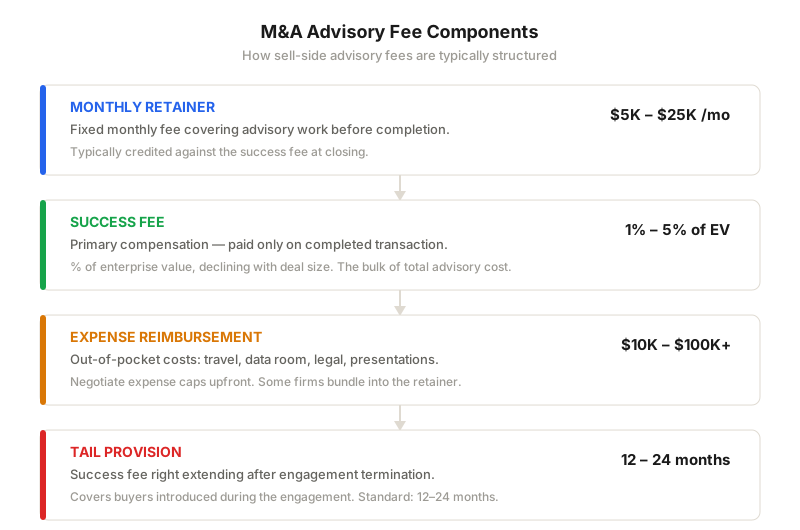
Advisory fees are not a single number. They consist of four distinct components, each of which is negotiable.
Monthly Retainer
The retainer is a fixed payment — typically USD 5,000 to USD 25,000 per month for mid-market transactions — that compensates the advisor for work performed before any transaction closes. This covers initial preparation: building the CIM, preparing the teaser, identifying buyers through deal sourcing, and running the outreach process.
The retainer serves a dual purpose. It provides cash-flow cover for the advisor’s upfront investment, and it demonstrates the seller’s commitment to proceeding with the sale. Advisors are wary of mandates where the seller has no financial stake in the process.
Key point: The retainer should be credited against the success fee upon completion. This is standard practice — if the deal closes, the retainer payments reduce the total success fee, meaning the seller does not pay twice for the same work. Insist on this provision.
Success Fee
The success fee is the primary advisory compensation and is paid only when a transaction completes. It is calculated as a percentage of enterprise value — or occasionally equity value — and represents the bulk of the total advisory cost.
Success fee percentages decline as deal size increases. According to the Association for Corporate Growth, mid-market transactions (USD 10 million to USD 250 million) typically command success fees between 1.5% and 5% of enterprise value. Smaller transactions carry higher percentages to ensure the advisor is adequately compensated for the time invested.
Fee basis matters. Whether the success fee is calculated on enterprise value or equity value can make a material difference for leveraged businesses. A company with USD 50 million in enterprise value but USD 15 million in debt has an equity value of USD 35 million — a 3% fee on enterprise value is USD 1.5 million, versus USD 1.05 million on equity value. Clarify this in the engagement letter before signing.
Expense Reimbursement
Advisory engagements generate out-of-pocket costs: travel for management meetings and site visits, data room setup and hosting, third-party research, printing and presentation materials, and legal review costs. These are typically passed through to the seller at cost.
Negotiate an expense cap upfront. Without one, expenses on a cross-border APAC transaction — where the buyer universe spans multiple countries — can escalate beyond expectations. A cap of USD 25,000 to USD 50,000 is reasonable for most mid-market transactions.
Tail Provision
The tail provision entitles the advisor to a success fee if the business is sold to a buyer the advisor introduced during the engagement — even after the engagement ends. Standard tail periods run 12 to 24 months.
Tail provisions exist for a legitimate reason: without them, a seller could terminate the engagement just before closing and complete the transaction without paying the fee. However, broadly worded tail clauses create problems — particularly if the seller changes advisors or sells the business years later to a buyer who was on a long list the first advisor compiled.
Negotiate for a tail that covers only buyers with whom the advisor had substantive contact (not just a name on a list), and cap the period at 12 months unless the advisor can justify a longer window.
The Lehman Formula and Its Variants
The most widely referenced fee structure in M&A is the Lehman formula, originally developed by Lehman Brothers in the 1960s. As Investopedia’s analysis of the Lehman Formula notes, the original structure was designed when a USD 10 million deal was considered large — and has been adapted repeatedly to reflect modern deal sizes. Sellers comparing a tiered formula with a capped quote should also read Lehman Formula vs Capped Success Fee.
Original Lehman Formula
| Transaction Value Tier | Fee Percentage |
|---|---|
| First USD 1 million | 5% |
| Second USD 1 million | 4% |
| Third USD 1 million | 3% |
| Fourth USD 1 million | 2% |
| Everything above USD 4 million | 1% |
Worked example: On a USD 10 million transaction, the original Lehman formula yields: (1M × 5%) + (1M × 4%) + (1M × 3%) + (1M × 2%) + (6M × 1%) = USD 200,000 — a 2.0% effective rate.
The original Lehman formula was designed when a USD 10 million deal was considered large. At current deal sizes, it produces fees that are often too low to compensate a sell-side advisor adequately.
Modified Lehman (Mid-Market Standard)
The modified Lehman applies the same tiered logic but scales each bracket to USD 10 million increments:
| Transaction Value Tier | Fee Percentage |
|---|---|
| First USD 10 million | 5% |
| USD 10–20 million | 4% |
| USD 20–30 million | 3% |
| USD 30–40 million | 2% |
| Everything above USD 40 million | 1% |
Worked example: On a USD 50 million transaction: (10M × 5%) + (10M × 4%) + (10M × 3%) + (10M × 2%) + (10M × 1%) = USD 1.5 million — a 3.0% effective rate.
The modified Lehman is the most common fee structure for mid-market sell-side mandates in the USD 15 million to USD 100 million range, according to Corporate Finance Institute.
Double Lehman
The double Lehman doubles each tier’s percentage from the original formula:
| Transaction Value Tier | Fee Percentage |
|---|---|
| First USD 1 million | 10% |
| Second USD 1 million | 8% |
| Third USD 1 million | 6% |
| Fourth USD 1 million | 4% |
| Everything above USD 4 million | 2% |
Worked example: On a USD 10 million transaction: (1M × 10%) + (1M × 8%) + (1M × 6%) + (1M × 4%) + (6M × 2%) = USD 400,000 — a 4.0% effective rate.
Double Lehman is typical for lower mid-market transactions (under USD 15 million) where the work required is comparable to a larger deal but the absolute fee at standard rates would not justify the advisor’s time.
Most sellers are better off comparing total fee as a percentage of expected deal value rather than fixating on formula mechanics. A 3% flat fee and a modified Lehman that works out to 3% are economically identical.
Fee Benchmarks by Deal Size
Market practice varies, but these ranges reflect current mid-market norms across APAC and globally:
| Enterprise Value | Monthly Retainer | Success Fee | Minimum Fee |
|---|---|---|---|
| Under USD 10M | USD 0–5,000 | 4–6% | USD 150,000–250,000 |
| USD 10–25M | USD 5,000–10,000 | 3–5% | USD 250,000–400,000 |
| USD 25–100M | USD 10,000–20,000 | 2–4% | USD 400,000–750,000 |
| USD 100–500M | USD 15,000–25,000 | 1–2.5% | Rarely applies |
| Above USD 500M | USD 20,000–50,000 | 0.5–1.5% | Rarely applies |
These are starting points, not fixed rates. Complexity (regulatory approvals, carve-out structures), sector specialisation, and competitive dynamics all influence where a given engagement falls within these ranges.
The minimum fee is a floor below which the success fee cannot fall, regardless of the formula. This protects the advisor on smaller transactions where a straight percentage might produce an inadequate fee relative to the work required. Minimum fees typically range from USD 150,000 to USD 500,000.
How Advisory Fees Differ Across Asia Pacific
Fee structures in APAC broadly mirror global conventions, but regional nuances are worth understanding.
Hong Kong and Singapore — advisory fees in these markets are closest to US and European practice. Success fees in the 2–4% range for mid-market transactions (USD 25–100 million) are standard. The advisory community is mature and competitive, which provides sellers with genuine negotiating leverage.
Japan — advisory mandates in Japan often involve longer pre-transaction advisory periods, reflecting the relationship-driven business culture and the time required to build consensus among stakeholders. Retainers may be higher relative to the success fee component, compensating advisors for the extended timeline. Cross-border transactions involving Japanese targets or acquirers may carry fee premiums of 10–20% due to language, regulatory, and cultural complexity.
“Advisory fees in APAC need to reflect the actual work required — and in markets like Japan, the pre-deal advisory period can be twice as long as a comparable US transaction,” says Daniel Bae, Founder & CEO of Lyndon Advisory and former M&A advisor with over US$30 billion in transaction experience. “Sellers should evaluate total value delivered, not just the headline fee percentage.”
Australia — the Australian mid-market is well-served by both global and domestic advisory firms. Fees are competitive. The Foreign Investment Review Board (FIRB) approval process for foreign acquirers can add complexity and cost, which may be reflected in advisory fees for transactions likely to attract foreign interest.
India — advisory fees in the Indian market tend to be lower in absolute terms, reflecting domestic deal sizes and competitive dynamics. Fees for cross-border transactions involving Indian targets — particularly outbound acquisitions by Indian corporates — are closer to global benchmarks.
At Lyndon Advisory, we took a different approach entirely: a single success fee with no retainer, no monthly charges, and no expense recharges. Our fee is 2.5% of enterprise value, capped at US$750,000. On a $10 million deal, that is $250,000. On a $50 million deal, an uncapped 2.5% would be $1.25 million and a traditional boutique on modified Lehman rates would charge $1.5–2 million — our fee stays capped at $750,000. You can model those economics in the M&A advisory fee calculator. You pay nothing unless a deal completes.
Negotiating Advisory Fees: What Actually Works
The best time to negotiate fees is before signing the engagement letter — not after. Once the engagement is underway, the advisor’s leverage increases and the seller’s willingness to switch diminishes.
Engage multiple advisors. Request proposals from two or three advisors before committing. This is not about playing firms against each other — it is about understanding market rates and identifying which advisor’s approach and fee structure best fit your situation.
Negotiate the fee basis, not just the percentage. A 3% success fee on enterprise value is very different from 3% on equity value if your business carries debt. Clarify the basis in writing and ensure it aligns with how value will be measured — typically enterprise value on a cash-free, debt-free basis with a working capital adjustment.
Insist on retainer credit. The retainer should be fully credited against the success fee at closing. Any advisor who resists this is prioritising upfront revenue over alignment with your outcome.
Cap expenses. Agree on a maximum expense reimbursement — particularly for cross-border mandates where travel and multi-jurisdictional costs accumulate. USD 25,000 to USD 50,000 is reasonable for most mid-market transactions.
Narrow the tail. Push for a 12-month tail (rather than 24) covering only buyers with whom the advisor had direct, substantive engagement — not every name on a screening list. The tail should explicitly exclude buyers the seller independently identifies.
Consider incentive alignment. Some fee structures include a kicker — a higher success fee percentage for value above a minimum threshold. For example, 2% on the first USD 30 million and 4% on any value above USD 30 million. This rewards the advisor for negotiating a higher price and aligns incentives with the seller’s outcome.
Fee Traps That Cost Sellers Money
Certain fee provisions look standard but can be costly if sellers do not scrutinise them.
Broad transaction definitions. Some engagement letters define “transaction” broadly enough to include joint ventures, minority investments, recapitalisations, and other structures that the seller may not intend to compensate at the same rate as a full sale. Narrow the definition to the specific transaction type being pursued.
Uncapped tail clauses. A tail provision that covers “any buyer contacted during the engagement” — without specifying substantive contact — can entitle the advisor to a fee on a transaction with a buyer the advisor merely emailed once. The tail should cover buyers who progressed to a meaningful stage: signed an NDA, received the CIM, or submitted an indication of interest.
No retainer credit. If the retainer is not credited against the success fee, the seller pays both — the monthly retainers throughout the process plus the full success fee at closing. On a 12-month engagement with USD 15,000 monthly retainers, that is USD 180,000 in additional cost.
Ambiguous fee triggers. The engagement letter should be clear about what constitutes “completion” for success fee purposes — typically the closing of the transaction, not the signing of a definitive agreement. If the deal signs but never closes due to closing conditions failure, the success fee should not be payable.
Hidden additional fees. Some advisors charge separately for fairness opinions, valuations, or due diligence coordination. These may be reasonable, but they should be disclosed upfront — not presented as add-ons after the engagement is underway.
Types of M&A Advisors and Their Fee Structures
Not all M&A advisors are the same. The right type of advisor for your transaction depends on deal size, sector, buyer universe, and how much process management you need. Understanding the landscape helps sellers identify who to approach — and calibrate what they will pay.
| Advisor Type | Typical Deal Size | Success Fee Range | Key Characteristics |
|---|---|---|---|
| Bulge-bracket investment banks | USD 500M+ | 0.5–1.5% | Global buyer reach, deep capital markets access; minimum deal sizes typically above USD 100M |
| Mid-tier independents (Lazard, Houlihan Lokey, Rothschild, Evercore) | USD 100M–1B | 1–2.5% | Strong sector specialisation, high-calibre execution; rarely engaged below USD 50M |
| Regional boutique advisors | USD 20M–200M | 2–4% | Deep regional buyer networks, senior-led execution, sector expertise |
| Big Four transaction advisory | USD 10M–200M | 1.5–3.5% | Strong financial analysis capability, broad service integration; variable buyer origination strength |
| Business brokers | Under USD 10M | 8–12% | List-based approach, appropriate for small asset sales; limited structured process capability |
| Lyndon Advisory | USD 10M–200M+ | 2.5% success fee capped at US$750,000 | Success fee only, no retainer, no expense recharges; APAC sell-side focus |
The most important fee consideration is not the headline percentage — it is value delivered relative to total cost. An advisor who charges 3% and runs a competitive auction process that drives 15% more value creates far more economic benefit than one charging 1.5% on a bilateral negotiation. According to Bain & Company’s Global M&A Report, seller-side processes with three or more bidders achieve an average 12-18% price premium over bilateral negotiations. That premium typically exceeds the advisory fee many times over.
For owners comparing fee structures as part of a broader sale decision, see Lyndon’s selling a business guide.
For sellers in the USD 10–100 million range, boutiques and specialist advisors typically provide more senior attention, stronger local buyer relationships, and more aligned incentives than larger banks where these deals are non-core mandates.
Buy-Side M&A Advisory Fees: What Acquirers Pay
Sellers focus on their own advisory fees, but the buyer is also paying an advisor — and understanding the buy-side fee dynamic provides useful context for transaction economics.
Buy-side advisory fees differ from sell-side in three important ways:
Fees are typically lower. Buy-side success fees generally run 1–3% for mid-market transactions, versus 2–5% on the sell side. This is because the sell-side advisor does more process work: preparing the CIM, managing the data room, running buyer outreach, and coordinating due diligence. The buy-side advisor’s role — reviewing materials, running buyer-side diligence, negotiating terms — is more focused.
| Deal Size (EV) | Buy-Side Advisory Fee | Sell-Side Advisory Fee |
|---|---|---|
| Under USD 25M | 1.5–4% | 3–6% |
| USD 25–100M | 1–2.5% | 2–4% |
| USD 100–500M | 0.5–1.5% | 1–2.5% |
| USD 500M+ | 0.25–0.75% | 0.5–1.5% |
Strategic acquirers often use in-house teams. Large corporate acquirers typically have internal M&A teams that handle deal evaluation and execution. External advisors are engaged selectively — for fairness opinions, specialist sector advice, or transactions outside the team’s geographic coverage. In these cases, fees are often project-based rather than success-fee-linked.
PE firms pay for sourcing. Private equity sponsors typically pay buy-side advisors a completion fee of 0.5–1% when an external advisor sourced the acquisition target, identified the opportunity, or provided critical structuring support. If the deal was generated internally, the PE firm may pay only a small retainer or advisory fee.
For sellers, understanding the buyer’s advisory fee is useful negotiation context. If a buyer’s financial advisor is being paid a success fee contingent on closing, that advisor has an incentive to get the deal done — which can create pressure to close on reasonable terms.
If you are reviewing a broker or advisor proposal, start with the specific risk.
| Concern | Lyndon guide |
|---|---|
| The total fee feels too high | Business Broker Fees Too High? |
| The advisor wants an upfront retainer | Should I Pay a Business Broker Retainer? |
| The tail clause is broad | Business Broker Tail Clause |
| You are close to signing | Questions to Ask a Business Broker Before Signing |
Understand the full exit process. Advisory fees are one part of a structured sale. For a step-by-step walkthrough from preparation through to closing, see How to Exit a Business: A Guide for APAC Owners.
Want transparent, lower fees? Lyndon Advisory charges a success fee only — 2.5% of enterprise value, capped at US$750,000 — no retainers, no monthly charges, no expense recharges. You pay nothing unless a deal completes. Calculate your advisory fee, see our fee structure, or submit a valuation inquiry to discuss your business.
Related fee guides:
- Transparent M&A Advisor Fees
- Affordable M&A Advisor
- No-Upfront-Fee M&A Advisor
- How AI Lowers M&A Advisory Fees
- No-Retainer M&A Advisor
- Capped Success Fee M&A Advisor
- M&A Advisor Hidden Fees
- M&A Advisor Expense Reimbursement
- How to Negotiate M&A Advisor Fees
- M&A Advisor Engagement Letter Fee Terms
- What Is Included in an M&A Advisor Fee?
- M&A Advisor Fee Schedule
- M&A Advisor Success Fee Percentage
- Fixed Fee vs Success Fee M&A Advisor
- M&A Advisor Cost to Sell a Business
- M&A Advisor Fees and Seller Net Proceeds
- M&A Advisory Fee Comparison Scenarios 2026
- Targeted Buyer Outreach vs Listing a Business
- Investment Story for a Business Sale
About the Author

Daniel Bae
Co-founder & CEO, Lyndon Advisory
Daniel is an investment banker with 15+ years of experience in M&A, having advised on deals worth over US$30 billion. His career spans Citi, Moelis, Nomura, and ANZ across London, Hong Kong, and Sydney. He holds a combined Commerce/Law degree from the University of New South Wales. Daniel founded Lyndon Advisory to solve the pain points in M&A, enabling bankers to focus on what matters most — delivering trusted advice to clients.
About Lyndon Advisory
Lyndon Advisory is an M&A advisory firm built for Asia Pacific. We help business owners sell their companies and investors make strategic acquisitions with senior-led execution, disciplined process management, and structured buyer research. For owners, the first step is a confidential review of valuation range, likely buyer universe, and whether a structured sell-side process is justified.
Request a confidential seller reviewTopic cluster