An M&A funds flow statement is the closing schedule showing where the money comes from and who receives it. It reconciles buyer funding with seller proceeds, debt repayment, escrow and transaction expenses before wires are released. Lyndon Advisory helps sellers test how these deductions affect cash received at closing.
| Also known as | Funds flow memo, closing funds flow, funds flow schedule |
| Prepared by | Agreed by the deal team, often drafted by buyer’s counsel; buyer and seller review the final figures |
| When finalised | Before payment release, after closing adjustments and recipient details are reconciled |
| Two sections | Sources of funds (who provides the money) + Uses of funds (who receives it) |
| Must balance | Total sources = total uses, with non-cash entries identified separately |
| If it fails | A mismatch or rejected wire can delay payment or closing |
Simple example (US$ millions): a buyer contributes 10.0. The funds flow allocates 7.0 to selling shareholders, 2.0 to debt payoff, 0.7 to escrow and 0.3 to transaction expenses. Sources and uses each total 10.0. The figures are illustrative; actual proceeds depend on the signed agreement and closing calculations. For an owner, the key question is how much cash reaches shareholders at closing, rather than the headline enterprise value alone. The American Bar Association’s purchase-price guide explains why debt and escrow can reduce the wire the seller receives.
What Is a Funds Flow Statement?
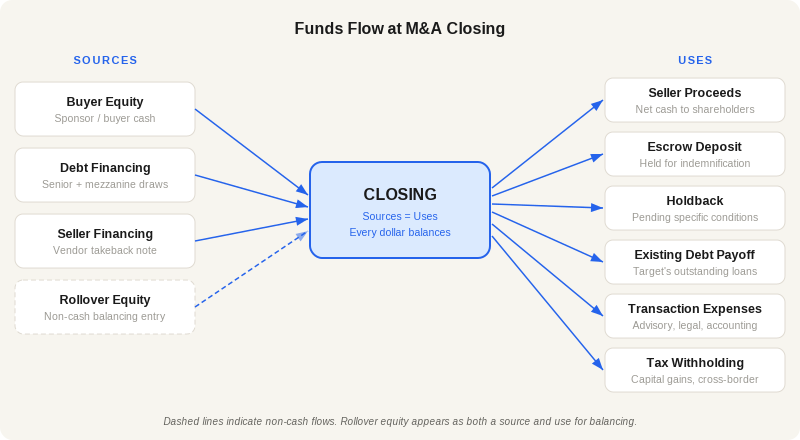
Read the sources column first to see who is funding the deal. Then follow the uses column to see who receives cash and what is withheld from the shareholder payment. Check the totals and match each deduction to the purchase agreement; keep non-cash items such as rollover equity distinct from wire transfers.
In a straightforward acquisition, the funds flow may be short: buyer funding is allocated among the seller and any escrow. A leveraged transaction with rollover equity, working capital adjustments, holdbacks and transaction expenses needs more entries and careful reconciliation.
The memo is a working closing schedule. Total sources must equal total uses, and the relevant parties should agree on amounts and recipient details before payments are released. A mismatch can delay closing or reveal that the purchase agreement and payment instructions have not been reconciled.
Why Funds Flow Matters
Most of the attention in an M&A transaction goes to negotiating the definitive agreement — the purchase price, reps and warranties, indemnification provisions, and closing conditions. But the funds flow is where those negotiated terms translate into actual money movement. It is the last major workstream before closing, and the one most likely to surface errors that should have been caught earlier.
Three things make funds flow critical:
Closing certainty. Circulating the draft while there is time to check payoffs, escrow and expenses gives both sides a chance to resolve differences before the closing call.
Fraud prevention. The FBI’s 2023 Internet Crime Report recorded 21,489 business email compromise complaints and more than US$2.9 billion in adjusted losses across reported cases; that is not an M&A-specific total. The report recommends verifying payment requests outside email through a known, independently verified number. The funds flow review should include that control for each recipient.
Treat any last-minute change to wire instructions as unverified until the recipient confirms it through a pre-agreed contact route. A phone number supplied in the same change request is not independent verification.
Cross-border coordination. In cross-border M&A, the deal team must check each payment leg against applicable bank cutoffs, currency conversion, withholding and local requirements with the relevant advisers before closing.
Anatomy of a Funds Flow Memo
A standard funds flow memo has two sections: sources and uses. These must balance exactly.
Sources of Funds
Sources identify where the money originates. In a simple cash acquisition, there may be a single source. In a leveraged transaction, there are typically several:
| Source | Description |
|---|---|
| Buyer equity | Cash contributed by the buyer (or its sponsor) from available capital |
| Debt financing | Senior secured loans, drawn on closing day per the credit agreement |
| Mezzanine financing | Subordinated debt or preferred equity, drawn at closing |
| Seller financing | Vendor takeback notes — the seller effectively lends part of the purchase price |
| Rollover equity | Existing shareholders who retain equity in the new structure (no cash changes hands, but it appears as a non-cash source and use for balancing) |
In an LBO, the memo should identify the credit facilities being drawn, the amounts and any lender conditions affecting payment sequence. The financing documents control the order; there is no universal debt share or wire sequence.
Uses of Funds
Uses identify every recipient and the amount they receive:
| Use | Description |
|---|---|
| Seller proceeds | Net cash to the selling shareholders after all deductions |
| Escrow deposit | Funds held by an escrow agent to cover post-closing indemnification claims |
| Holdback | Amounts retained by the buyer pending satisfaction of specific conditions |
| Transaction expenses (seller) | Seller’s advisory fees, legal fees, accounting fees, transfer taxes |
| Transaction expenses (buyer) | Buyer’s advisory fees, legal fees, financing costs |
| Existing debt payoff | Repayment of the target’s outstanding debt at closing |
| Working capital adjustment | Estimated adjustment if closing working capital differs from the agreed peg |
| Tax withholding | Amounts withheld for applicable taxes (capital gains, withholding on cross-border payments) |
| Rollover equity (non-cash) | Balancing entry for shareholders rolling over their equity |
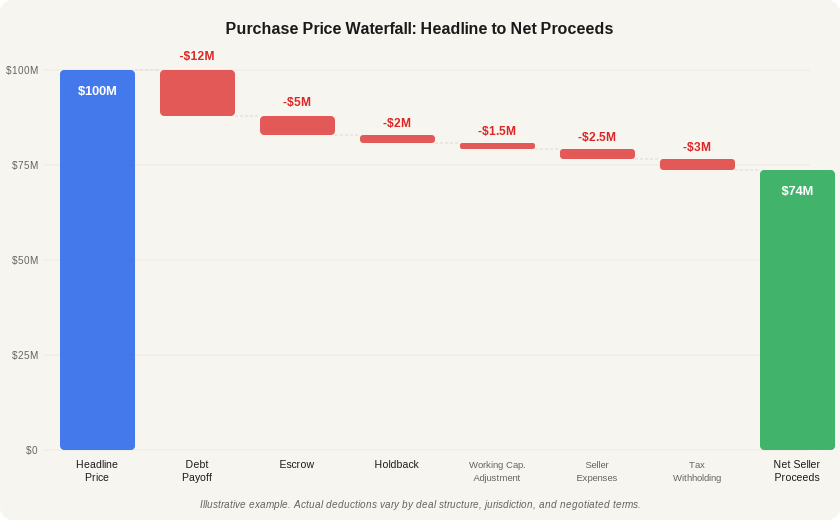
For an owner, the critical review is the waterfall from enterprise value to cash at closing: debt repayment, escrow, holdbacks, working capital adjustments and transaction expenses can reduce the initial shareholder wire. Reconcile each deduction to the signed agreement before approving the memo. For the broader fee question, see what an M&A advisor charges.
Advisory fees sit inside that waterfall, so compare proposals by expected net proceeds rather than headline percentage alone. The fee calculator can illustrate Lyndon’s published fee against a proposed sale value.
The Funds Flow Process: Step by Step
1. Start Early
Begin a working funds flow while the SPA economics are being settled. Purchase price adjustments, debt payoff, escrow and expenses must match the signed agreement, so waiting until the last closing call leaves little time to resolve discrepancies.
2. Map the Transaction Structure
Before drafting amounts, map the structural flow: Where are the entities? Which entity is the buyer? Which is the target? Are there intermediate holding companies or special purpose vehicles? In a cross-border deal, funds may need to flow through multiple entities in different jurisdictions to comply with foreign exchange regulations and optimise tax treatment.
3. Calculate the Numbers
The funds flow amounts depend on final calculations that are often not available until days before closing:
- Estimated working capital adjustment: Derived from the target’s most recent financial data, compared against the working capital peg agreed in the SPA
- Net debt calculation: Outstanding borrowings minus cash on hand as of the closing date
- Transaction expense tallies: Final invoices from advisors and legal counsel on both sides
- Tax computations: Withholding amounts, transfer taxes, stamp duties
4. Collect and Verify Wire Instructions
Every recipient provides wire instructions: bank name, account number, routing number (or SWIFT code for international transfers), and account holder name. These must be verified independently — not by replying to the email that delivered them, but through a separate channel (phone callback to a known number).
Use a contact number established before the payment request. The FBI’s business email compromise guidance warns against relying on contact details supplied in the email requesting payment.
5. Circulate, Review, Reconcile
The draft goes to buyer, seller and the relevant counsel, escrow agent and lenders. Each team checks the amounts that concern it. The relevant parties approve the final version before payments are released; timing depends on closing calculations and lender conditions.
6. Execute on Closing Day
On closing day, the agreed sequence matters. Lenders may require evidence that all conditions precedent are satisfied before funding. The parties follow the signed documents and bank instructions, confirm receipt of the required payments, and complete the remaining closing deliveries with counsel.
Working Capital Adjustments and True-Ups
Most mid-market and larger transactions use a working capital peg mechanism to ensure the buyer receives a business with a “normal” level of working capital at closing. The funds flow incorporates an estimated working capital adjustment based on the most recent available data.
The actual working capital may be calculated after closing using completion accounts. The agreement sets the timetable and dispute mechanism. Depending on the calculation, a true-up payment may run from buyer to seller or seller to buyer.
A later true-up is separate from the closing-day wire, but the estimated adjustment can change what shareholders receive initially. Both sides should review the calculation method and post-close recourse before signing.
An alternative is a locked box, where the price refers to an agreed historical balance sheet date and the agreement controls permitted or prohibited leakage before closing. The memo still needs to reconcile actual payments and any deal-specific adjustments.
For the full transaction sequence around SPA signing, completion accounts, settlement mechanics, and closing deliverables, see Lyndon’s M&A process guide.
Cross-Border Funds Flow in Asia Pacific
Cross-border transactions can add payment timing, currency and local approval questions. Lyndon Advisory helps owners coordinate those issues with counsel, tax advisers and banks as part of a seller-led process:
Foreign exchange and approvals. Local advisers should identify any transaction-specific filing, consent or payment restriction in each jurisdiction before the memo assumes that a wire can be sent. Requirements depend on the parties, structure and destination.
Withholding and taxes. Tax advisers should establish whether any payment requires withholding or transaction tax. Where it does, the schedule should distinguish gross consideration, the amount withheld and the net recipient payment.
Currency conversion timing. Where the purchase price and funding currencies differ, agree the rate source, conversion time and party bearing exchange movement in the transaction documents.
Multi-entity structures. Trace each payment from the funding entity through any intermediate company to the final recipient, and have local advisers check the requirements for each leg.
Common Pitfalls and How to Avoid Them
Late preparation
Starting the memo only after closing figures arrive can leave too little time to verify debt payoff, escrow and recipient details. Circulate a working draft early, label estimates and agree who will confirm each final amount.
Wire instruction fraud
Business email compromise targeting M&A closings is a real and growing threat. Criminals intercept email chains, impersonate parties, and substitute fraudulent wire instructions. Prevention requires out-of-band verification — confirming wire details by phone to a known number, not a number provided in the same email.
Forgetting deductions
Sellers frequently underestimate the gap between headline price and net proceeds. The funds flow must include every deduction: existing debt payoff, transaction expenses, escrow, holdbacks, estimated working capital adjustment, and tax withholding. Presenting the full waterfall early — ideally before signing — avoids closing-day disputes.
Sequencing errors
In leveraged transactions, lenders may require that their funds are the last to flow (or the first), with specific conditions precedent satisfied before they release capital. If the funds flow sequence does not match the credit agreement requirements, the lender may refuse to fund — and the closing stalls.
Ignoring time zones
In cross-border APAC transactions, closing parties may be in Tokyo, Singapore, Sydney, and New York. Wire transfer cut-off times vary by bank and jurisdiction. A wire initiated at 4 PM Singapore time may not settle in New York until the next business day. The funds flow schedule must account for time zones and bank processing windows.
Choose the Right Closing-Risk Path
| If this is why you searched | What matters most | Next step |
|---|---|---|
| You are selling a business and want to understand net proceeds after debt, escrow, holdbacks, and expenses | Sale valuation, purchase price mechanics, buyer certainty, and closing-day proceeds | Submit a confidential valuation inquiry |
| A buyer has sent a draft purchase agreement, funds flow, escrow, or completion-accounts proposal | Whether the economics match the headline price and whether closing mechanics transfer risk to the seller | Review the buyer proposal |
| You are early in sale preparation and want to reduce closing risk before going to market | Clean financials, working-capital discipline, debt schedules, tax preparation, data-room organisation, and transparent advisor economics | Compare transparent M&A advisor fees |
For the wider sale process, read Lyndon’s seller advisory approach and published fee terms. The article template provides the closing seller inquiry path.
About the Author

Daniel Bae
Co-founder & CEO, Lyndon Advisory
Daniel is an investment banker with 15+ years of experience in M&A, having advised on deals worth over US$30 billion. His career spans Citi, Moelis, Nomura, and ANZ across London, Hong Kong, and Sydney. He holds a combined Commerce/Law degree from the University of New South Wales. Daniel founded Lyndon Advisory to solve the pain points in M&A, enabling bankers to focus on what matters most — delivering trusted advice to clients.
About Lyndon Advisory
Lyndon Advisory is an M&A advisory firm built for Asia Pacific. We help business owners sell their companies and investors make strategic acquisitions with senior-led execution, disciplined process management, and structured buyer research. For owners, the first step is a confidential review of valuation range, likely buyer universe, and whether a structured sell-side process is justified.
Request a confidential seller reviewTopic cluster