Construction and M&A sit at an unusual intersection: a sector characterised by project-based revenue, thin margins, and significant working capital requirements has nonetheless become one of the most active categories for private equity consolidation globally. Specialty trades businesses — electrical contractors, mechanical services, HVAC installers — are being assembled into scaled platforms across the United States and Australia at a pace that surprises owners who assume their sector is too fragmented or operationally complex to attract institutional capital.
Understanding how buyers value construction and engineering businesses, who the active acquirers are, and what separates a premium transaction from a discounted one is the starting point for any business owner contemplating a sale.
What Makes Construction M&A Different
Construction M&A carries a distinct set of analytical challenges that distinguish it from most other sectors. Buyers do not simply apply a revenue or EBITDA multiple to the trailing financials and move on. They interrogate the business in ways that catch underprepared owners off guard.
Project backlog and WIP accounting are scrutinised harder than almost any other financial metric. A construction business’s forward order book is its most important asset — but the quality of that backlog matters as much as its size. Buyers want to understand contract types (fixed-price vs cost-plus), margin profiles by project, variation and claims history, and the degree to which reported work-in-progress reflects conservative or aggressive accounting. Disputed or at-risk WIP that inflates stated EBITDA is one of the most common value reduction events in construction transactions.
Bonding and surety capacity is often poorly understood by owners but carefully reviewed by acquirers. Performance bonds, bid bonds, and payment bonds represent contingent liabilities — and a business whose bonding capacity is concentrated on a single surety relationship, or whose bond lines are fully drawn, is a more complex acquisition than one with diversified, underutilised facilities.
Owner dependence is acute in construction. Client relationships, subcontractor networks, project management relationships, and regulatory prequalification status are frequently held personally by founders rather than embedded institutionally in the business. This creates key-person risk that directly reduces multiples — buyers price for the risk that revenue walks when the founder exits.
Environmental and liability tail — latent defects, warranty obligations, and WorkSafe/OSHA exposure from past projects — creates contingent liabilities that buyers seek to quantify and allocate via indemnification provisions and earnout structures.
Construction Sub-Sectors and Their Buyer Universes
The construction sector is not monolithic. Valuation multiples, buyer types, and deal dynamics vary significantly by sub-sector.
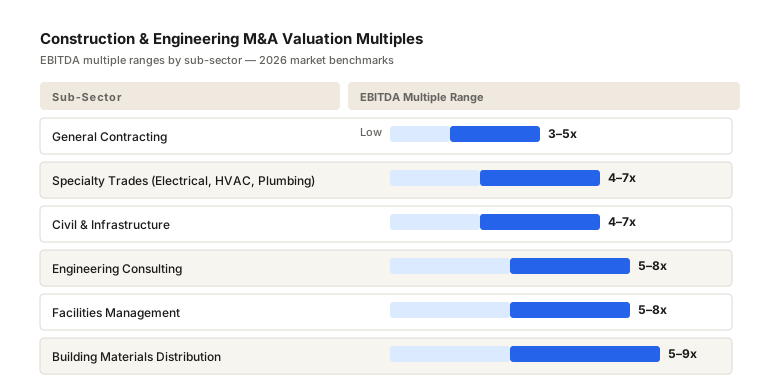
General contracting — building and civil construction delivering projects for third-party clients — trades at 3–5x EBITDA. Margins are thin, revenue is project-by-project, and the business is highly cyclical. Buyers are typically trade acquirers seeking capacity, capability, or geographic coverage rather than PE funds.
Specialty trades — electrical, mechanical, plumbing, HVAC, fire protection — are the most actively acquired sub-sector globally. Recurring maintenance and service revenue, licensing barriers (electricians and plumbers require individual certifications in most jurisdictions), and platform consolidation dynamics drive multiples of 4–7x EBITDA. US private equity has been extraordinarily active in specialty trades consolidation — companies such as Apex Service Partners, Wrench Group, and BrightSpring have assembled billions in revenue through serial acquisition. Australian PE has followed a similar playbook. This is the most competitive buyer environment in the sector.
Civil and infrastructure contractors — road, rail, water, utilities — command 4–7x EBITDA for businesses with government contracted revenue and specialist capability. Long contract durations and repeat client relationships are the key value drivers.
Engineering consulting — design, project management, environmental, geotechnical — trades at 5–8x EBITDA, reflecting the recurring nature of professional services revenue and the relative scalability of knowledge-based businesses. Acquirers include global engineering firms (WSP, Stantec, Arcadis) pursuing geographic or practice expansion, and PE funds building diversified infrastructure advisory platforms.
Facilities management and building services — ongoing maintenance, cleaning, security, asset management — trades at 5–8x EBITDA on the strength of multi-year contracted revenue. The contracted income stream is valued similarly to annuity revenue by PE and infrastructure fund buyers.
Building materials distribution — supplying roofing, insulation, plumbing products, structural materials — trades at 5–9x EBITDA, with premium multiples for businesses with proprietary supplier relationships or exclusive distribution arrangements.
Who Buys Construction and Engineering Businesses
The buyer universe for construction M&A is more varied than most owners anticipate.
Private equity consolidators are the most active buyer class in specialty trades globally. PE funds seek to build scaled platforms through serial bolt-on acquisitions, extracting synergies through shared purchasing, technology deployment, and brand consolidation. The return thesis is straightforward: buy fragmented owner-operated businesses at 4–6x, build a platform valued at 8–12x, and sell or list at scale. For specialist electrical, HVAC, or mechanical businesses, PE is often the reference buyer.
Listed construction and engineering groups — publicly traded companies such as John Holland, VINCI, Fluor, or Jacobs Engineering — acquire businesses to add capacity, enter new geographies, or acquire specialist capabilities that would take years to build organically. These buyers typically pay strategic premiums for businesses that genuinely fill a gap in their portfolio.
Infrastructure funds — Macquarie, Brookfield, IFM, and dozens of smaller managers — target construction businesses with long-duration contracted revenue that resembles infrastructure assets. Facilities management, utilities contracting, and asset maintenance businesses are the most natural fits.
Japanese and Korean construction conglomerates — Kajima, Obayashi, Shimizu, Samsung C&T, Hyundai E&C — are consistent cross-border acquirers of specialist APAC contractors, particularly in civil infrastructure, specialist building, and project management. These acquirers are relationship-driven and patient, but their internal approval processes extend timelines.
Management buyout teams backed by PE are a recurring buyer type for businesses where the founding owner is departing but a strong second tier exists. Rollover equity structures allow the management team to co-invest alongside the PE sponsor.
Valuation Benchmarks by Sub-Sector
Market practice across APAC and globally as of 2026:
| Sub-Sector | EBITDA Multiple | Key Value Drivers |
|---|---|---|
| General contracting | 3–5x | Backlog visibility, client diversification |
| Specialty trades | 4–7x | Recurring service revenue, licence barriers |
| Civil / infrastructure | 4–7x | Government contracts, specialist capability |
| Engineering consulting | 5–8x | Client retention, project pipeline depth |
| Facilities management | 5–8x | Contracted revenue duration, client quality |
| Building materials distribution | 5–9x | Supplier exclusivity, proprietary products |
According to PitchBook’s 2025 Construction and Engineering M&A report, specialty trades transactions in the US and Australia averaged 6.1x EBITDA in 2025, with platform-building PE transactions at the upper end of 7–9x for businesses with demonstrated service revenue mix.
“The businesses that consistently command premium multiples in construction M&A are those that have already made the transition from project dependency to service revenue,” says Daniel Bae, Founder & CEO of Lyndon Advisory and former M&A advisor with over US$30 billion in transaction experience. “An electrical contractor with 40% of revenue from recurring maintenance contracts is a fundamentally different business to one that is entirely project-driven — buyers price that distinction materially.”
Key Deal Considerations
Quality of earnings and EBITDA normalisation are the most consequential pre-sale steps. Construction financials frequently contain owner-related expenses (vehicles, insurance, family salaries, related-party rent) that depress reported EBITDA. A thorough QoE process restates earnings to reflect the true run-rate of the business under new ownership. Buyers conduct their own QoE — an owner-commissioned vendor due diligence report allows the seller to control the narrative and reduces the risk of surprises during buyer diligence.
Backlog quality over quantity. Buyers distinguish sharply between contracted backlog (signed contracts, purchase orders) and pipeline (verbal commitments, preferred tenderer status). Only contracted backlog carries weight in valuation. A business claiming a $50M pipeline when only $15M is contracted will be valued on the contracted figure.
Licensing and certification transfer. Trades licences, contractor licences, and regulatory prequalifications are often held by individuals rather than the company entity. Where the departing owner holds key licences personally, a transition plan — including the time required to transfer or reissue licences — must be addressed before transaction close.
Working capital intensity. Construction businesses carry significant working capital — progress billing cycles, retention amounts, and WIP balances create cash absorption that buyers scrutinise carefully. The working capital peg in the sale agreement defines what “normal” working capital means, and disputes over the peg are common in construction transactions. Engage advisors who understand construction-specific working capital dynamics before entering negotiations.
Warranty and defects liability tail. Most construction contracts carry 12–24 month defects liability periods. Buyers will seek representation and warranty coverage or escrow holdbacks to protect against post-completion claims arising from pre-acquisition projects.
APAC and US Market Context
Construction M&A dynamics differ meaningfully across geographies.
United States is the largest and most active construction M&A market globally. Specialty trades consolidation has been the dominant theme for a decade, driven by PE firms assembling HVAC, electrical, plumbing, and roofing platforms. The residential services category — home services, pest control, HVAC maintenance — has seen extraordinary valuation inflation as strategic and PE buyers compete for scalable platforms. US construction M&A deal value exceeded US$45 billion in 2024 according to Dodge Construction Network, with PE accounting for approximately 60% of transaction volume.
Asia Pacific construction M&A is driven by infrastructure investment cycles and cross-border strategic interest. Singapore’s urban redevelopment and data centre construction pipeline, India’s infrastructure buildout under the National Infrastructure Pipeline, Vietnam’s manufacturing-linked construction boom, and Australia’s aged care, defence, and renewable energy construction programmes all create active deal environments. Japanese and Korean construction conglomerates remain the most active cross-border acquirers in the region.
At Lyndon Advisory, we advise construction, engineering, and specialty trades businesses across Asia Pacific and the United States. Our team understands the sector’s specific dynamics — backlog valuation, bonding transfer, working capital mechanics — and how to position these businesses to attract the buyer universe most likely to pay premium multiples.
Choosing an M&A Advisor for Your Construction Business
Not all M&A advisors understand construction. The sector’s idiosyncrasies — WIP accounting, bonding, project backlog analysis, licence transfer — require advisors who have done construction deals, not generalists who have read about them.
The right advisor for a construction business exit should:
- Understand quality of earnings specifically in the construction context, including how to treat WIP, variations, and retentions in normalised EBITDA
- Have relationships with PE funds actively consolidating specialty trades and engineering businesses
- Know how to structure the auction process to create competitive tension between strategic and financial buyers
- Be able to advise on bonding, licensing, and warranty tail issues before they become buyer objections
The CIM for a construction business must tell a specific story: the quality of the order book, the depth of the management team, the recurrence of the revenue base, and the pathway to scale that the buyer is acquiring. Generic materials that do not address these questions will generate lower buyer interest.
Engaging an advisor on a success-fee-only basis — rather than paying a retainer irrespective of outcome — aligns incentives correctly. The advisor earns only when the deal closes at a price that justifies the engagement.
Choose the Right Construction M&A Advisory Path
| Situation | What Lyndon should understand first | Best next step |
|---|---|---|
| You are evaluating whether to sell a construction, contracting, engineering, or specialty trades business | Revenue, EBITDA, order book, WIP quality, licences, bonding, safety record, and buyer universe | Submit a construction valuation inquiry |
| A PE platform, listed group, competitor, customer, or overseas buyer has approached | Buyer motive, offer logic, WIP disclosure risk, exclusivity pressure, licence or bonding issues, and alternative buyer universe | Review the buyer approach |
| You are 6-18 months away from a possible sale | Order book documentation, WIP accounting, safety audit, licence records, management depth, and data-room gaps | Check construction exit readiness |
| You are comparing construction M&A advisors | Retainer exposure, fee cap, sector buyer reach, WIP/QoE process experience, tail period, and expected net proceeds | Compare advisory economics |
| You are an investor looking for construction or engineering targets | Sub-sector thesis, target geography, EBITDA range, licence requirements, backlog profile, and control preference | Register on MergerMatch |
Thinking about selling your construction or engineering business? Lyndon Advisory advises business owners across Asia Pacific and the United States on structured sell-side processes — senior dealmakers, no retainers, 2.5% success fee capped at US$750,000. Submit a confidential valuation inquiry to understand what your business is worth and who would buy it.
Related Guide
For the broader framework behind this topic, see Lyndon Advisory’s guide to selling a business.
About the Author

Daniel Bae
Co-founder & CEO, Lyndon Advisory
Daniel is an investment banker with 15+ years of experience in M&A, having advised on deals worth over US$30 billion. His career spans Citi, Moelis, Nomura, and ANZ across London, Hong Kong, and Sydney. He holds a combined Commerce/Law degree from the University of New South Wales. Daniel founded Lyndon Advisory to solve the pain points in M&A, enabling bankers to focus on what matters most — delivering trusted advice to clients.
About Lyndon Advisory
Lyndon Advisory is an M&A advisory firm built for Asia Pacific. We help business owners sell their companies and investors make strategic acquisitions with senior-led execution, disciplined process management, and structured buyer research. For owners, the first step is a confidential review of valuation range, likely buyer universe, and whether a structured sell-side process is justified.
Request a confidential seller reviewTopic cluster