Education and training business owners should treat advisor selection as a regulatory and buyer-access decision, not a generic corporate finance choice. A school, registered training organisation (RTO), tutoring chain, corporate training provider, or EdTech platform can attract very different buyers depending on licensing, enrolment quality, government funding exposure, and whether the buyer can complete change-of-control approvals.
Education businesses in Asia Pacific — private schools, RTOs, tutoring chains, corporate training providers, and EdTech platforms — regularly attract private equity consolidators and strategic acquirers, with EBITDA multiples ranging from 4x to 10x depending on sub-sector, enrolment quality, and regulatory standing. Selling one requires specialist M&A advisory because regulatory change-of-control approvals add 3–6 months to deal timelines that generalist advisors routinely underestimate. Lyndon Advisory works on education sector transactions across APAC and the United States.
Education M&A requires a different set of skills from general business advisory. The sector’s regulatory complexity — accreditation transfers, government funding approvals, change-of-control notifications — adds layers that trip up advisors without direct experience. Done right, education businesses attract a deep and motivated buyer universe, and premium valuations reflect the defensive, mission-critical nature of quality educational assets.
This guide covers the M&A advisory landscape for education businesses: who the buyers are, how businesses are valued by sub-sector, and the deal considerations that determine whether a transaction closes cleanly or stalls.
Quick Fit: Which Education M&A Path Makes Sense?
| Situation | Likely best route | Why |
|---|---|---|
| Small owner-operated tutoring centre with local students only | Local broker or local accountant | Buyer is likely another local operator; a broad process may not expand value |
| RTO, vocational training, or workforce development provider | Education M&A advisor | Accreditation, funding exposure, change of control, and buyer diligence drive outcome |
| Multi-campus school, premium tutoring chain, or international curriculum provider | Sector-focused M&A advisor | Strategic buyers and institutional investors care about enrolment quality, brand, and regulatory approvals |
| Corporate training or professional certification provider | Regional M&A advisor | Buyers may include B2B training platforms, PE-backed consolidators, and global education groups |
| EdTech SaaS or digital learning platform | M&A advisor with software and education buyer reach | ARR quality, churn, gross margin, content IP, and enterprise buyer access determine valuation |
For country context, start with selling a business in Singapore, selling a business in Malaysia, selling a business in Australia, or selling a business in Hong Kong. For the full sector framework, see the education M&A guide.
What Makes Education M&A Different
Education businesses are not sold the same way as general commercial enterprises, and the differences run deeper than branding.
Regulatory change of control is the defining feature. Unlike most industries where business ownership can transfer with contractual notifications, education businesses require proactive approval from licensing and accreditation bodies before a change of ownership can complete. In Australia, TEQSA must approve any change of control for higher education providers. In the UK, Ofsted and regional authorities require notification for independent schools. In the US, state education agencies and, for Title IV institutions, the Department of Education must review and approve changes of ownership.
These approvals add time — typically 3–6 months — and uncertainty. A buyer who fails to anticipate regulatory requirements can find themselves committed to a transaction that cannot complete without a lengthy approval process. Experienced M&A advisors map the regulatory pathway before marketing begins, not after an offer is signed.
Government funding exposure is the second major risk factor. Many education businesses derive a significant portion of revenue from government sources — VET Student Loans and state training contracts in Australia, Title IV funding in the US, Skills Bootcamp contracts in the UK. This funding is often non-transferable without approval, creates enrolment restrictions, and imposes compliance obligations that carry over to new owners. Buyers apply a discount for businesses with high government funding concentration; sellers who diversify revenue streams before going to market achieve better outcomes.
Enrolment seasonality and cohort risk create a third complexity. Unlike businesses with monthly recurring revenue, many education businesses operate on academic-year cycles. Revenue in any given year depends on enrolment decisions made 6–12 months earlier. Buyers stress-test enrolment trends carefully — declining enrolments in the 1–2 years prior to sale are a significant red flag that affects both valuation and deal structure.
Sub-Sectors and Their Dynamics
Private K-12 Schools — among the most defensive assets in education M&A. Well-regarded schools with strong waiting lists and established reputations attract sovereign wealth funds, infrastructure investors, and international schools groups as buyers. Valuations reflect land value optionality (many schools sit on premium urban land), enrolment quality, and EBITDA margins. Cross-border buyers from Asia are active acquirers of premium schools in Australia, the UK, and the US as feeders for their domestic networks.
Tutoring and Test Preparation — a fragmented sector undergoing rapid consolidation by private equity roll-up strategy platforms. The best tutoring businesses combine a recognised brand, proprietary curriculum, and a franchise or multi-site model that allows rapid scaling. Single-site operators with no systemised curriculum trade at modest multiples; branded chains with defensible content attract premium buyers.
Registered Training Organisations (RTOs) and Vocational Education — regulated in Australia by ASQA and TEQSA, with equivalents in other jurisdictions. RTOs range from lean, government-funded trade training providers to diversified higher education institutions. The sector has seen regulatory tightening following compliance failures, and buyers conduct thorough vendor due diligence on CRICOS registration, student outcomes data, and ASQA audit history. Clean compliance records command meaningful premium.
EdTech Platforms — valued differently from bricks-and-mortar education, with buyers applying revenue multiples based on ARR growth, net revenue retention, and gross margin rather than EBITDA. Strategic acquirers (Pearson, Chegg, Coursera) pursue EdTech acquisitions for content libraries, AI capabilities, and learner data. PE buyers focus on platform acquisition plays in fragmented categories — LMS, skills assessment, corporate learning.
Corporate Training and Workforce Development — serving enterprise clients on multi-year contracts with low churn. Businesses with government-agency or blue-chip corporate client concentration attract financial buyers seeking stable, predictable cash flows. Valuations of 5–8x EBITDA reflect the contract-backed revenue and low capital requirements of the model.
Who Buys Education Businesses
Private equity consolidators are the most active buyer class globally. PE roll-up platforms in tutoring, vocational training, allied health education, and corporate learning have become significant acquirers, using a bolt-on acquisition strategy to build scale in fragmented sectors. In the US, UK, and Australia, PE-backed education groups have consolidated hundreds of smaller operators over the past decade. These buyers move quickly, have established deal teams, and provide competitive tension in auction processes.
Listed education groups pursue acquisitions to extend geographic reach, add curriculum depth, or acquire an established brand. ASX-listed IDP Education, Navitas, and Study Group, alongside NYSE-listed Stride, Duolingo, and 2U, are representative of the strategic acquirer class. These buyers apply strategic logic to valuations — a target that fills a geographic gap or adds a capability they cannot build internally will command a premium beyond pure financial valuation.
Sovereign wealth funds and infrastructure investors treat premium schools and universities as defensive, inflation-linked assets. Capital from Singapore’s GIC, Abu Dhabi’s Mubadala, and Canadian pension funds has entered the education sector seeking yield-generating, non-cyclical returns. These buyers are patient, long-duration holders suited to assets with strong brand equity and limited near-term capex requirements.
International schools groups — particularly those with operations across Southeast Asia, the Middle East, and the UK — are active cross-border acquirers of premium schools. For APAC sellers, the buyer universe often includes education groups from China, Malaysia, and the Middle East seeking feeder relationships or geographic diversification.
At Lyndon Advisory, we run structured sale processes for education businesses across the full sub-sector spectrum — from single-site tutoring centres to multi-campus education groups. Our buyer outreach spans private equity consolidators, listed education groups, and international strategic acquirers across APAC and the United States.
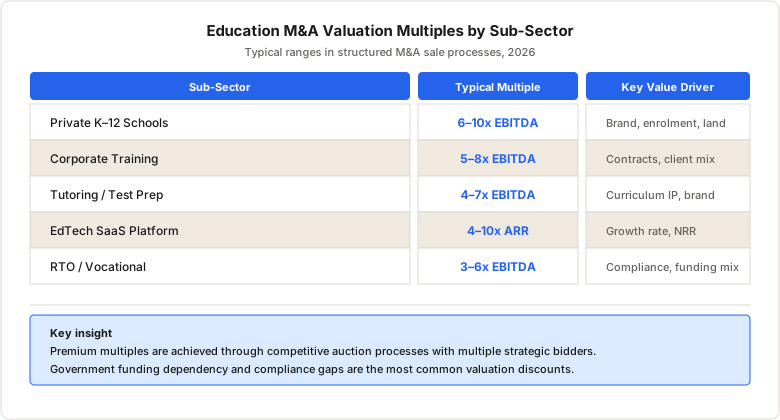
Valuation Multiples by Sub-Sector
Education enterprise value multiples vary more than most sectors, reflecting the spectrum from government-dependent vocational training to premium independent schools.
| Sub-Sector | Typical Multiple | Key Value Driver |
|---|---|---|
| Private K-12 Schools | 6–10x EBITDA | Enrolment quality, brand, land value |
| Tutoring / Test Prep | 4–7x EBITDA | Curriculum IP, brand, multi-site model |
| RTO / Vocational | 3–6x EBITDA | Compliance record, funding diversification |
| Corporate Training | 5–8x EBITDA | Contract duration, client concentration |
| EdTech SaaS | 4–10x ARR | Growth rate, NRR, gross margin |
| Higher Education | 6–12x EBITDA | Accreditation, student outcomes, research |
Precedent transactions are the most relevant valuation reference in education M&A. Comparable public company multiples are useful benchmarks but often reflect scale and liquidity premiums that private targets do not command. A competitive auction process with multiple strategic bidders is the most reliable mechanism for achieving the top of the valuation range.
Quality of earnings analysis is critical — EBITDA must be normalised for owner compensation above market rate, related-party transactions, and non-recurring items. For EdTech businesses, buyers also scrutinise ARR composition: is it contracted annual subscriptions or month-to-month? What is the net revenue retention rate? What is the gross margin after hosting and support costs?
Key Deal Considerations
Regulatory change of control — map the approval pathway before signing any agreement. Which bodies must be notified? What information do they require? What is the realistic timeline? Deals have collapsed because buyers did not adequately price regulatory approval risk into their deal structure.
Accreditation transfer — accreditation (CRICOS, TEQSA, Ofsted, AdvancED/Cognia in the US) does not automatically transfer to a new owner in all jurisdictions. Buyers must confirm whether accreditation follows the entity or the ownership, and whether re-application is required.
Government funding portability — for businesses receiving VET funding, Title IV, or equivalent government payments, buyers must confirm that funding approvals can be maintained through the change of control. Some funding relationships are not transferable and must be re-established by the buyer post-completion.
Teacher and staff retention — in schools and training providers, the quality of the faculty is the product. Key-person risk is a material deal consideration, and buyers typically include earnout structures or retention payments to ensure continuity of senior teaching staff through the transition period.
Succession planning for founder-operators — many education businesses are built around a founder whose relationships, pedagogy, and reputation are inseparable from the institution. Buyers assess succession risk carefully. Sellers who build management depth and systematise curriculum delivery before going to market achieve better outcomes and cleaner deal structures.
Enrolment data room — buyers will conduct detailed due diligence on enrolment trends, student outcomes, completion rates, and satisfaction data. Preparing a clean, auditable enrolment data set as part of the data room reduces friction and accelerates buyer confidence. A teaser and CIM that presents enrolment data transparently, with explanations for any year-on-year variance, builds credibility with sophisticated buyers.
APAC and US Market Context
Asia Pacific has an unusually high willingness-to-pay for quality education, driven by cultural emphasis on educational credentials and a growing middle class seeking differentiated schooling for their children. Singapore, Hong Kong, and Shanghai command some of the highest international school fees in the world, and buyers from these markets are active cross-border acquirers of premium education assets in Australia, the UK, and North America.
Australia’s RTO and higher education sectors have experienced a decade of regulatory tightening following compliance failures in the 2010s. The market has consolidated around larger, better-capitalised providers, and surviving operators with strong compliance records are attractive acquisition targets for both PE and international strategic buyers.
United States — PE investment in for-profit education and corporate training has been significant, with platforms like Vistria Group, Leeds Equity Partners, and Quad Partners actively consolidating fragmented categories. The US corporate training market exceeds USD 90 billion annually according to Training Industry’s 2025 Market Report, making it one of the largest addressable markets for B2B education consolidators globally.
In Australia, education M&A also needs regulatory diligence. ASQA is the national regulator for vocational education and training, and TEQSA’s change-of-ownership guidance explains why provider ownership transitions receive specific regulatory attention. In Singapore, Malaysia, and Hong Kong, buyer diligence similarly focuses on licensing, student contracts, brand transferability, curriculum IP, staff retention, and whether a buyer can preserve confidence with parents, students, regulators, and enterprise customers after completion.
“Education businesses that have invested in digital delivery, diversified revenue away from a single government funding stream, and built a management team that isn’t entirely dependent on the founder are the ones attracting the highest valuations and the broadest buyer interest. The sector is misunderstood by generalist advisors — the regulatory complexity is real, but so is the buyer appetite.”
— Daniel Bae, Founder & CEO, Lyndon Advisory
Choosing an Education M&A Advisor
Education M&A requires an advisor who understands the sector’s regulatory framework, has relationships with the active buyer universe, and can navigate the unique due diligence requirements of education transactions.
Key questions to ask a prospective advisor:
- Have they advised on education transactions specifically, or only adjacent sectors?
- Do they have relationships with the PE roll-up platforms and strategic acquirers active in your sub-sector?
- Can they map the regulatory change-of-control pathway for your specific business?
- How do they approach government funding due diligence?
The difference between an advisor with education experience and a generalist can be 3–4 months of deal timeline and significant valuation. Regulatory surprises discovered late in a process — an undisclosed compliance issue, an accreditation condition not flagged in the data room — can kill transactions that should have closed.
For the full sector framework, buyer universe, valuation drivers, and preparation steps, see Lyndon’s education M&A guide.
Choose the Right Education M&A Advisory Path
| Situation | What Lyndon should understand first | Best next step |
|---|---|---|
| You are evaluating whether to sell an education, training, tutoring, school, RTO, or EdTech business | Revenue, EBITDA, enrolment mix, licences, accreditation, funding exposure, management depth, and buyer universe | Submit an education valuation inquiry |
| A PE platform, school group, training provider, or overseas strategic has approached | Buyer motive, offer logic, regulatory approval path, student or parent disclosure risk, exclusivity pressure, and alternative buyer universe | Review the buyer approach |
| You are 6-18 months away from a possible sale | Licence status, accreditation transfer, enrolment data, curriculum IP, staff retention, and data-room gaps | Check education exit readiness |
| You are comparing education M&A advisors | Retainer exposure, fee cap, education buyer reach, regulatory process experience, tail period, and expected net proceeds | Compare advisory economics |
| You are an investor looking for education targets | Sub-sector thesis, target geography, EBITDA or ARR range, licence requirements, and control preference | Register on MergerMatch |
Considering selling your education business? Lyndon Advisory provides sector-specific M&A advisory for education businesses across APAC and the United States — success fee only, 2.5% success fee capped at US$750,000, no retainer, no upfront costs. Submit a confidential valuation inquiry to understand what your business is worth and who would buy it.
About the Author

Daniel Bae
Co-founder & CEO, Lyndon Advisory
Daniel is an investment banker with 15+ years of experience in M&A, having advised on deals worth over US$30 billion. His career spans Citi, Moelis, Nomura, and ANZ across London, Hong Kong, and Sydney. He holds a combined Commerce/Law degree from the University of New South Wales. Daniel founded Lyndon Advisory to solve the pain points in M&A, enabling bankers to focus on what matters most — delivering trusted advice to clients.
About Lyndon Advisory
Lyndon Advisory is an M&A advisory firm built for Asia Pacific. We help business owners sell their companies and investors make strategic acquisitions with senior-led execution, disciplined process management, and structured buyer research. For owners, the first step is a confidential review of valuation range, likely buyer universe, and whether a structured sell-side process is justified.
Request a confidential seller reviewTopic cluster