Healthcare is one of the most active and complex sectors in global M&A. Private equity investment in healthcare has surged over the past decade, driven by ageing demographics, post-pandemic infrastructure investment, and the fragmented ownership of clinical businesses that makes roll-up strategies viable at scale. For business owners in GP clinics, dental practices, allied health, veterinary, aged care, and diagnostics — the question is not whether buyers exist, but how to run a process that captures the full competitive interest.
This guide covers the healthcare M&A advisory landscape: who buys healthcare businesses, what they pay, what makes healthcare deals structurally complex, and what to look for in a sector-experienced advisor.
Why Healthcare M&A Is Different
Healthcare transactions operate under constraints that do not apply in most other sectors. Three structural features set healthcare M&A apart.
Regulatory transfer complexity. Licences, accreditations, and provider billing arrangements — Medicare and Medicaid in the US, bulk billing and AHPRA registrations in Australia, CQC registration in the UK — are held by individuals and entities that may or may not survive a change of ownership. A buyer acquiring a GP clinic is not acquiring the Medicare billing rights of the selling practitioner; those must be transferred, re-registered, or replaced. This creates a parallel regulatory process that runs alongside the financial transaction and often determines the deal timeline.
Owner-operator concentration. Most SME healthcare businesses have significant revenue and patient relationships tied to the founding clinician. A dentist who built a practice over twenty years carries patient loyalty, referral relationships, and clinical reputation that do not automatically transfer on completion. Buyers price this risk into deal structure — often via earnout provisions, practitioner service agreements, or deferred consideration tied to revenue continuity.
Payer mix sensitivity. The proportion of revenue derived from private insurance, public reimbursement schemes, and out-of-pocket patients directly affects a healthcare business’s valuation multiple and buyer universe. Practices heavily dependent on a single payer — government reimbursement, a single insurer contract, or bulk billing — carry concentration risk that buyers discount. Advisors conducting quality of earnings analysis in healthcare diligence always normalise for payer mix dynamics.
The Global Healthcare M&A Buyer Universe
Understanding who buys healthcare businesses globally shapes how a sale process should be structured and which buyers to approach.
Private equity roll-up platforms are the dominant buyer class for SME healthcare businesses worldwide. Dental consolidators — Pacific Smiles, Dental Corp, Colosseum Dental, Aspen Dental — have built multi-hundred-site platforms through acquisitive growth. Allied health roll-ups in physiotherapy, psychology, and occupational therapy have replicated this model. Veterinary consolidators (IVC Evidensia, Mars Petcare, National Veterinary Associates) have deployed tens of billions into fragmented veterinary markets globally. These PE-backed platform acquisitions are the highest-volume and often highest-multiple buyers in the market. They run structured processes for bolt-on acquisitions and have dedicated M&A teams that move quickly on suitable targets.
According to PitchBook’s 2025 Healthcare M&A Report, PE-backed healthcare deal count in the Asia-Pacific region increased 18% year-on-year in 2024, with dental, veterinary, and allied health accounting for the majority of transactions by volume.
Strategic buyers — listed hospital groups, insurance companies, pharmacy chains, diagnostic laboratory networks, and healthcare REITs — are active at the larger end of the SME market. They acquire for geographic expansion, service integration, or technology capability. Their valuation frameworks differ from PE: strategic buyers price synergies, which can produce premium offers for businesses that fit a specific gap in their existing footprint.
Family offices are consistent buyers of stable healthcare cash flows, particularly in aged care, specialist clinics with established referral networks, and diagnostic businesses with contracted hospital relationships.
Cross-border strategic acquirers from Japan, South Korea, and Singapore are active in APAC healthcare M&A. Japanese trading houses (Mitsui, Sumitomo, Marubeni) have built significant healthcare portfolios across Southeast Asia and Australia. Increasingly, APAC-based healthcare groups are looking at US and European acquisition targets as they internationalise.
“Healthcare buyers globally run more structured acquisition processes than in almost any other sector,” says Daniel Bae, Founder of Lyndon Advisory and former M&A advisor with over US$30 billion in transaction experience. “Dental and veterinary roll-ups in particular have professional M&A teams doing dozens of deals a year — which means the sellers who win are the ones who come to market with clean financials, a clear regulatory narrative, and an advisor who knows how those buyers evaluate deals.”
Valuation Multiples by Sub-Sector
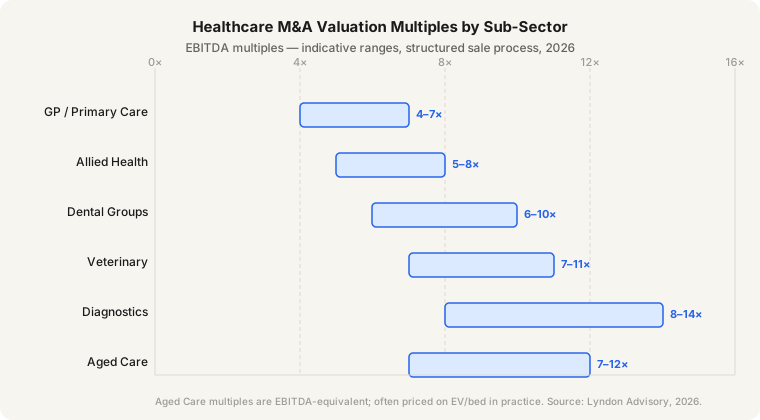
Healthcare valuation multiples vary materially by sub-sector, driven by growth profile, recurring revenue quality, regulatory risk, and PE buyer competition.
GP and primary care clinics typically transact at 4–7× EBITDA, with bulk-billing-heavy or single-practitioner practices at the lower end and mixed-billing multi-site groups with associate models at the higher end. Medicare/Medicaid dependency and practitioner concentration are the key discounting factors.
Allied health practices — physiotherapy, psychology, occupational therapy, speech pathology, dietetics — achieve 5–8× EBITDA in structured processes. Multi-disciplinary practices with diversified clinician teams and NDIS (in Australia) or insurance-contracted revenue command the upper end.
Dental groups are among the most competitively bid sub-sectors globally. Active PE roll-up demand has pushed multiples to 6–10× EBITDA for multi-site practices with strong associate models and low principal dependency. Single-site practices trade closer to 5–7×.
Veterinary practices have seen significant multiple expansion driven by aggressive global roll-up activity. Well-run companion animal practices with strong community positioning achieve 7–11× EBITDA. Mixed and large animal practices trade at lower multiples reflecting buyer pool depth.
Diagnostics and pathology businesses benefit from contracted hospital relationships, government scheme participation, and high revenue predictability. These characteristics support 8–14× EBITDA for established diagnostic networks with demonstrable volume growth.
Aged care and senior living businesses are often valued on an EV/bed basis (USD 80,000–200,000+ per licensed bed in developed APAC markets and the US), reflecting the capital-intensive, licensed nature of the sector. EBITDA multiples of 7–12× apply to operationally strong facilities; distressed assets or those with regulatory compliance issues trade at significant discounts.
Key Deal Considerations in Healthcare M&A
Buyers conducting due diligence on healthcare businesses focus on dimensions specific to the sector. Sellers who prepare for these in advance run materially faster and cleaner processes.
Licence and accreditation mapping. Every licence, registration, and accreditation the business holds — facility licences, practitioner registrations, billing provider numbers, accreditation body memberships — must be documented with transfer or re-registration requirements identified. Gaps discovered mid-diligence extend timelines and create price-chipping risk.
Clinical governance documentation. Buyers require evidence that the practice operates sound clinical governance: incident reporting, clinical auditing, infection control protocols, and complaints handling. Post-pandemic, this standard has risen significantly. Well-documented governance is a valuation premium; absence of documentation is a red flag.
Practitioner agreements. Employment or associate agreements with clinical staff — particularly key practitioners — need to be reviewed for change of control provisions, non-compete obligations, and continuity requirements. Buyers will often require principal practitioners to sign practitioner service agreements at completion, locking in their clinical presence for a transition period.
Revenue normalisation. Healthcare businesses frequently carry owner compensation structures (above-market salaries, personal expenses, related-party arrangements) that must be normalised to produce a clean enterprise value assessment. Quality of earnings analysis in healthcare also normalises for one-off billing items, locum costs, and irregular payer reimbursement cycles.
Vendor due diligence — commissioning diligence on your own business before going to market — is particularly valuable in healthcare. It surfaces regulatory and governance issues early, reduces the chance of surprises in buyer diligence, and signals to buyers that the seller is a credible, prepared counterparty.
Running a Healthcare Sale Process
A structured, advisor-run auction process produces meaningfully better outcomes in healthcare M&A than direct or off-market sales. The reason is straightforward: PE roll-up buyers have dedicated acquisition teams and standard deal structures. A seller who approaches one roll-up directly is negotiating against an experienced buyer without competitive tension. A seller who runs a structured process creates exactly that tension — and the multiple difference between a direct sale and a competitive process is typically 2–4× EBITDA.
The sale process for a healthcare business follows the same broad structure as any M&A transaction — preparation, marketing (via a CIM and teaser), buyer outreach, indicative offers, exclusivity, due diligence, and completion — but the regulatory transfer work runs in parallel and must be managed by an advisor who understands the healthcare-specific sequencing.
At Lyndon Advisory, we advise healthcare business owners across Asia Pacific and the United States. Our sector coverage spans GP clinics, dental groups, allied health platforms, aged care, diagnostics, and veterinary — with active buyer relationships across PE roll-up platforms, strategic acquirers, and cross-border healthcare investors. Our fee is a 2.5% success fee capped at US$750,000, with no retainer and no monthly charges.
Choosing a Healthcare M&A Advisor
Not all M&A advisors understand healthcare. The sector’s regulatory complexity, buyer-specific deal processes, and clinical governance requirements mean that generic advisory experience produces worse outcomes than sector-specific expertise.
When evaluating advisors, ask for evidence of completed healthcare transactions in your sub-sector, active relationships with the PE roll-up buyers who are most likely to be your highest bidders, and demonstrated ability to manage regulatory transfer processes in your jurisdiction. Ask specifically whether the advisor has managed Medicare/Medicaid billing transitions, AHPRA registration transfers, or CQC registration processes — as relevant to your market.
Fee structure is a meaningful signal of alignment. Advisors who charge a monthly retainer regardless of outcome have different incentives from advisors who succeed only when you do. A success-fee-only structure — where the advisor earns only on completion — aligns interests completely.
According to McKinsey’s 2025 Global M&A Review, healthcare remains one of the most active sectors for M&A globally, with deal volume sustained by demographic tailwinds, technology-enabled care models, and continued private equity interest in fragmented clinical services markets.
For healthcare business owners, the combination of high PE buyer demand, sector-specific valuation premiums, and complex regulatory requirements makes sector-experienced advisory essential — not optional.
Choose the Right Healthcare M&A Advisory Path
| Situation | What Lyndon should understand first | Best next step |
|---|---|---|
| You are evaluating whether to sell a healthcare practice or services business | Revenue, EBITDA, modality, site count, practitioner mix, licences, payer exposure, and likely buyer universe | Submit a healthcare valuation inquiry |
| A clinic group, PE platform, insurer, or strategic acquirer has approached | Buyer motive, offer logic, practitioner disclosure risk, exclusivity pressure, regulatory approvals, and alternative buyer universe | Review the buyer approach |
| You are 6-18 months away from a possible sale | Clinical governance, licence records, practitioner agreements, owner dependency, billing quality, and data-room gaps | Check healthcare exit readiness |
| You are comparing healthcare M&A advisors | Retainer exposure, fee cap, healthcare buyer reach, regulatory process experience, tail period, and expected net proceeds | Compare advisory economics |
| You are an investor looking for healthcare targets | Sub-sector thesis, target geography, EBITDA range, site-count preference, control preference, and licence requirements | Register on MergerMatch |
Considering a sale of your healthcare business? Lyndon Advisory advises healthcare business owners across Asia Pacific and the United States — GP clinics, dental groups, allied health practices, aged care facilities, veterinary clinics, and diagnostics businesses. Our fee is a 2.5% success fee capped at US$750,000 — no retainer, no upfront costs. Submit a confidential valuation inquiry to understand what your business is worth and who would buy it.
Related Guide
For the broader framework behind this topic, see Lyndon Advisory’s guide to selling a business.
About the Author

Daniel Bae
Co-founder & CEO, Lyndon Advisory
Daniel is an investment banker with 15+ years of experience in M&A, having advised on deals worth over US$30 billion. His career spans Citi, Moelis, Nomura, and ANZ across London, Hong Kong, and Sydney. He holds a combined Commerce/Law degree from the University of New South Wales. Daniel founded Lyndon Advisory to solve the pain points in M&A, enabling bankers to focus on what matters most — delivering trusted advice to clients.
About Lyndon Advisory
Lyndon Advisory is an M&A advisory firm built for Asia Pacific. We help business owners sell their companies and investors make strategic acquisitions with senior-led execution, disciplined process management, and structured buyer research. For owners, the first step is a confidential review of valuation range, likely buyer universe, and whether a structured sell-side process is justified.
Request a confidential seller reviewTopic cluster