France is one of Europe’s most active M&A markets, with over €130 billion in deal value recorded in 2025 (Refinitiv Global M&A Review 2025). Family business transitions, private equity succession, and international strategic acquisitions drive consistent deal flow across luxury, food and beverage, technology, and healthcare sectors. For business owners, navigating that market — and the regulatory and structural nuances that make French M&A distinct — requires an advisor who understands both the local deal environment and the international buyer universe.
The French M&A Market
France is the second-largest M&A market in Europe and among the top five globally in deal count for mid-market transactions. The market is characterised by a high concentration of family-owned businesses facing generational transition, a mature private equity ecosystem anchored by Ardian, PAI Partners, Eurazeo, and Bpifrance, and a stable inflow of international strategic acquirers drawn to French brand heritage, technology capability, and consumer market access.
Private equity has been the dominant buyer class in French mid-market M&A for the past decade, with buyout activity remaining resilient even in higher interest rate environments due to the quality of French family-owned businesses in niche industrial, consumer, and professional services categories. According to Bain & Company’s 2025 European PE Report, France accounted for roughly 18% of European PE deal value in 2024 — second only to the UK.
International buyers — from the United States, Japan, South Korea, and the Gulf — have been increasingly active in acquiring French businesses with global brand potential. French luxury, premium food and beverage, and high-specification industrial businesses are consistently sought after by APAC acquirers in particular, for whom French provenance carries meaningful premium positioning in consumer markets from Tokyo to Shanghai.
Most Active Sectors
Luxury and Premium Consumer. France remains the global capital of luxury goods, and the M&A market around LVMH, Kering, and Hermès ecosystems is consistently active — not just for trophy acquisitions but for mid-market brands in adjacent categories. Premium fragrance, skincare, fashion accessories, lifestyle brands, and art de vivre businesses attract some of the highest valuation multiples of any sector, with EBITDA multiples ranging 10–18x for businesses with defensible brand positioning and distribution.
Food and Beverage. French gastronomy carries global brand equity. Wine, spirits, specialty food producers, artisanal brands, and premium food distributors attract strong interest from both domestic consolidators and international strategic acquirers — particularly Japanese trading houses and Korean food conglomerates seeking French provenance assets. Cross-border M&A in French F&B has been consistently active, with valuations of 7–12x EBITDA for established brands with export credentials.
Technology and SaaS. The Paris tech ecosystem (Station F, Qonto, Doctolib, Ledger) has produced a generation of B2B SaaS and fintech companies that are now at natural exit points. US and European strategic acquirers — and increasingly APAC tech companies — are active buyers of French software businesses, particularly in regtech, fintech, HR tech, and enterprise software.
Healthcare. France’s private healthcare sector is in active consolidation — dental, ophthalmology, dermatology, veterinary, and medical imaging groups are all subject to PE roll-up activity. The Autorité de la concurrence is relevant for larger combinations, but mid-market deals proceed efficiently.
Professional Services. Engineering consulting, IT services, management consulting, and business process outsourcing firms attract PE consolidators and strategic acquirers. French engineering firms with international delivery capability are in particular demand.
Who Buys French Businesses
French Strategic Acquirers. Large listed French groups — in consumer goods, industrials, and services — are active consolidators of smaller French businesses. Family holding companies and listed conglomerates frequently acquire mid-market businesses in adjacent categories.
Pan-European Private Equity. Ardian, PAI Partners, Eurazeo, Bpifrance Investissement, LBO France, and Turenne Capital are among the most active PE buyers in the French mid-market. They pursue platform acquisition and bolt-on acquisition strategies across consumer, healthcare, technology, and business services.
US Buyers. US strategic acquirers use France as a gateway to the European consumer market, and US PE funds are active in French buyouts. The US buyer class is particularly relevant for technology and professional services transactions.
APAC Buyers. Asian acquirers are consistently active in French M&A — and more often overlooked by France-only advisory mandates. Japanese trading houses (Itochu, Mitsui, Marubeni) have long histories of acquiring French food, beverage, and industrial businesses. Korean conglomerates (Lotte, CJ, Amore Pacific-type buyers) pursue French consumer and beauty brands for their positioning in Asian markets. Chinese strategic buyers remain active in luxury-adjacent, food, and technology categories where French provenance adds value.
“French businesses — particularly in premium consumer, food and beverage, and precision industrials — attract a buyer universe that extends well beyond Europe,” says Daniel Bae, founder of Lyndon Advisory. “Running a process that actively reaches APAC strategic acquirers alongside European and US buyers routinely produces better outcomes for French sellers than a France-only mandate.”
Valuation Multiples by Sector
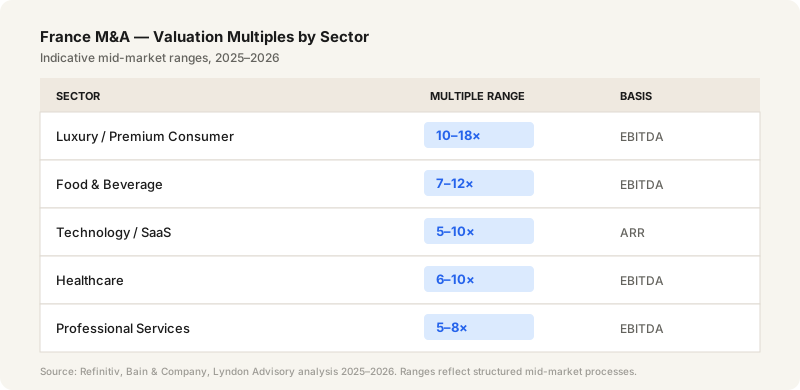
French businesses are priced on enterprise value using sector-appropriate multiples. Achievable multiples depend on quality of earnings, growth profile, brand defensibility, and the competitive intensity of the auction process:
| Sector | Typical Multiple | Basis |
|---|---|---|
| Luxury / Premium Consumer | 10–18× | EBITDA |
| Food & Beverage | 7–12× | EBITDA |
| Technology / SaaS | 5–10× | ARR |
| Healthcare | 6–10× | EBITDA |
| Professional Services | 5–8× | EBITDA |
The difference between a well-run competitive process and a bilateral negotiation can represent several turns of EBITDA. Achieving the upper end of any range requires credible buyer competition — which requires reaching the full international buyer universe, not just the domestic market.
French M&A Deal Considerations
Comité Social et Économique (CSE). Under French labour law, the CSE must be informed and consulted before any change of control of an entity employing 50 or more people. This is not optional and cannot be waived. The process adds 2–4 weeks to the transaction timeline and must be sequenced carefully — typically after signing of a letter of intent but before completion. Buyers expect it; sellers who fail to plan for it create delays.
Décret Montebourg. Foreign acquisitions in defined strategic sectors (defence, energy, transport, health, telecoms, agri-food) require prior authorisation from the French Ministry of Economy. The screening applies to acquisitions of control by non-EU buyers and to certain investments in listed entities. For most mid-market transactions in consumer, technology, and professional services, this screening does not apply — but it must be assessed at the outset.
Garantie d’Actif et de Passif. French law uses a vendor guarantee framework (GAP) rather than the Anglo-Saxon reps and warranties structure. The GAP covers specific identified risks rather than broad representations, and its scope, caps, and duration are heavily negotiated. Warranty and indemnity insurance is available for French transactions but requires adaptation to the GAP framework.
Earnout Structures. Complément de prix (deferred price) structures are common in French M&A to bridge valuation gaps, particularly in owner-operated businesses. French courts have developed substantial jurisprudence on their enforceability — the wording of earnout mechanics requires careful legal drafting.
SAS Structure. The Société par Actions Simplifiée is the preferred structure for M&A-ready French businesses and the standard vehicle for PE-backed platforms. It offers flexibility on governance, shareholder rights, and transfer restrictions that makes the acquisition process cleaner than alternative structures.
How Lyndon Advises French Business Owners
Lyndon Advisory is an international M&A firm covering French transactions for business owners seeking a structured, senior-led sale process. We work with owners of businesses across luxury, food and beverage, technology, healthcare, and professional services categories.
Our approach for French sellers:
Fee transparency. We charge a success fee of 2.5% of enterprise value, capped at US$750,000 (approximately €646,000 using the 8 September 2026 reference rate) — with no retainer, no monthly fees, and no expense recharges. A traditional French boutique on a €15 million transaction would typically charge €400,000–€600,000 including retainers; our fee would be €375,000, payable only on completion.
International buyer access. A structured French sale process should reach US, European, and APAC buyers simultaneously. Our buyer network — built across investment banking careers at Moelis, Citi, and ANZ — includes the Japanese trading houses, Korean strategic acquirers, and Singapore PE funds that are consistently underreached by France-only advisors.
Senior-led process. Every mandate is led by an experienced M&A professional from mandate to closing. No junior analysts, no relationship hand-offs.
Considering a sale of your French business? Lyndon Advisory provides confidential, senior-led M&A advisory for French business owners — transparent 2.5% success fee capped at US$750,000, no retainer, international buyer reach. Submit a confidential valuation inquiry to understand what your business is worth and who would buy it.
Related Guide
For the broader framework behind this topic, see Lyndon Advisory’s guide to selling a business.
About the Author

Daniel Bae
Co-founder & CEO, Lyndon Advisory
Daniel is an investment banker with 15+ years of experience in M&A, having advised on deals worth over US$30 billion. His career spans Citi, Moelis, Nomura, and ANZ across London, Hong Kong, and Sydney. He holds a combined Commerce/Law degree from the University of New South Wales. Daniel founded Lyndon Advisory to solve the pain points in M&A, enabling bankers to focus on what matters most — delivering trusted advice to clients.
About Lyndon Advisory
Lyndon Advisory is an M&A advisory firm built for Asia Pacific. We help business owners sell their companies and investors make strategic acquisitions with senior-led execution, disciplined process management, and structured buyer research. For owners, the first step is a confidential review of valuation range, likely buyer universe, and whether a structured sell-side process is justified.
Request a confidential seller reviewTopic cluster