The Netherlands punches well above its weight in European M&A. Despite a population of 18 million, it ranks among the continent’s top five deal markets by volume — driven by a globally connected economy, Europe’s busiest port, a sophisticated private equity community, and its position as the preferred holding company jurisdiction for international groups operating across the continent.
For business owners considering a sale, the Dutch market offers a genuine depth of acquirer interest. Strategic buyers from across Europe, North America, and Asia Pacific maintain active Netherlands coverage. Private equity activity has accelerated over the past decade, particularly in technology, business services, and healthcare. And the Netherlands’ treaty network — among the world’s most extensive — makes it a natural conduit for cross-border transactions.
The Dutch M&A Market — Size and Structure
Netherlands M&A activity has remained resilient through global cycles. The Amsterdam Stock Exchange (Euronext Amsterdam) provides liquidity benchmarks for listed comparables; the private market is anchored by a deep pool of Dutch PE funds (Waterland, Gilde Buy Out Partners, NPM Capital, Egeria) alongside pan-European firms (Advent International, PAI Partners, EQT, Bridgepoint) that run active Netherlands coverage.
Deal activity concentrates in four broad categories. First, founder exits — the Netherlands has a large base of owner-managed companies across manufacturing, professional services, and specialist distribution where the founding generation is approaching succession. Second, PE portfolio recycling — Dutch PE funds complete significant volumes of secondary buyouts each year, often acquiring from other funds or listed groups. Third, corporate carve-outs — multinational groups headquartered in the Netherlands (Shell, Stellantis, ASML adjacent companies, ING) periodically divest non-core operations. Fourth, cross-border inbound — international acquirers entering continental Europe frequently begin with a Dutch acquisition, given the jurisdiction’s English-language business environment and holding company advantages.
Most Active Sectors
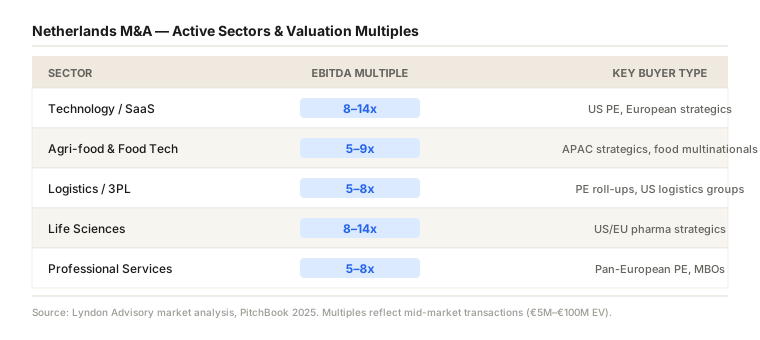
Technology and SaaS — Amsterdam has emerged as a significant European technology hub, home to scale-ups across payments (Adyen), travel (Booking.com), and enterprise software. The broader ecosystem of B2B SaaS, HR tech, logistics technology, and fintech companies represents the most PE-active segment of the Dutch market. Valuation multiples: 6–12x EBITDA for profitable software, 4–10x ARR for high-growth SaaS.
Agri-food and Food Technology — The Netherlands is the world’s second-largest food exporter by value after the United States. The Wageningen University ecosystem anchors a food technology innovation cluster. Buyers range from global food multinationals to APAC buyers seeking European food technology and sustainable food credentials. Multiples: 5–9x EBITDA for established producers, higher for technology-embedded food businesses.
Logistics and Supply Chain — Rotterdam is Europe’s largest port; Schiphol is its busiest cargo airport. The Netherlands has a disproportionate share of European third-party logistics (3PL), cold chain, and freight forwarding businesses. Private equity roll-up activity is significant. Multiples: 5–8x EBITDA for asset-light operators, 4–6x for asset-heavy transport.
Life Sciences and Healthcare — The Netherlands has a strong pharma and medtech presence (Philips Healthcare, DSM-Firmenich). Contract research organisations (CROs), specialty pharma distributors, and medical device companies attract consistent acquirer interest from US and European strategic buyers.
Professional Services — Management consulting, legal, engineering, and accounting firms are active targets for PE consolidation. Dutch professional services businesses often have strong export credentials, with significant revenue from international clients.
Who Buys Dutch Businesses
The Dutch acquirer universe is genuinely broad. European strategic buyers — German industrials, UK-listed groups, French conglomerates — are consistent buyers across most sectors. US private equity is heavily represented: firms including KKR, Bain Capital, and Carlyle maintain active Netherlands coverage, particularly for technology, business services, and healthcare. Dutch and Benelux PE funds are among the most active mid-market buyers, with strong relationships in the local business community.
APAC acquirers merit specific mention for Netherlands transactions. The Netherlands’ holding company framework — Dutch BV structures, extensive tax treaty network, and English-language legal system — makes it the preferred European acquisition vehicle for Japanese, Korean, Singaporean, and Chinese groups. Japanese trading houses and industrials have long used Dutch holdcos for European M&A. For sellers in the Netherlands, APAC buyer interest is not a stretch — it is a well-established feature of the market.
Understanding cross-border M&A dynamics is particularly important for Dutch sellers, given the volume of international acquirer activity in the market.
Valuation Multiples in Dutch M&A
Dutch mid-market valuations broadly track European benchmarks, with a modest premium for the most internationally connected businesses:
| Sector | Typical EBITDA Multiple |
|---|---|
| Technology / SaaS | 8–14x EBITDA or 4–10x ARR |
| Agri-food | 5–9x |
| Logistics / 3PL | 5–8x |
| Life sciences | 8–14x |
| Professional services | 5–8x |
| Healthcare | 6–10x |
Quality of earnings analysis is standard for Dutch transactions. Buyers apply particular scrutiny to WBSO R&D credit portability, innovation box tax regime continuity, and the treatment of 30% ruling benefits for key employees.
Dutch Deal Mechanics — What Sellers Need to Know
Works Council (Ondernemingsraad) — Any transaction that materially affects employment requires advance consultation with the Works Council. This is a legal obligation, not a formality. Works Council consultation typically runs 4–8 weeks and can influence deal structure if the council raises substantive objections. Sellers should factor this into transaction timelines and engage their Works Council adviser early.
ACM Notification — Transactions above relevant thresholds require notification to the ACM. Phase 1 review runs approximately 4–6 weeks. Most mid-market transactions fall below national notification thresholds but may trigger EU-level review if the parties have significant European revenues.
BV Structure — Most Dutch private businesses operate as a Besloten Vennootschap (BV). Share sales are straightforward; asset sales are less common but do occur for carve-out transactions. Sellers should ensure their BV structure is clean — no minority interests, no deferred tax liabilities from historic restructurings — before entering a sale process.
Earnout Structures — Dutch M&A practice mirrors broader European convention on earnouts. They are common in professional services transactions and technology businesses where forward revenue visibility is uncertain. Sellers should negotiate earnout baselines and measurement periods carefully.
Reps and warranties insurance — W&I insurance is widely used in Dutch transactions. Coverage is typically 10–30% of enterprise value, with a 24-month warranty period standard for title and tax warranties.
The Sale Process in the Netherlands
A structured Dutch sale process follows the same five phases as international M&A practice: preparation and vendor due diligence, teaser and NDA, CIM and management presentations, binding offers and exclusivity, and signing and closing.
The key Dutch-specific variable is Works Council timing. A well-run process builds Works Council consultation into the pre-exclusivity phase, so the exclusivity period and confirmatory due diligence can run in parallel without Works Council uncertainty hanging over the closing.
At Lyndon Advisory, our standard process runs 5–6 months from mandate. For Netherlands transactions, we build in an additional 4–6 weeks for Works Council consultation, targeting an overall timeline of 6–8 months from first call to closing.
Why Lyndon Advisory for Netherlands Transactions
Dutch business owners deserve the same quality of advisory that larger transactions command — without paying for it twice over.
Most Netherlands boutiques charge 3–5% of enterprise value as a success fee, plus a monthly retainer of €5,000–€20,000. On a €10 million transaction, that is a fee of €300,000–€500,000 plus retained costs, before the deal even closes. Lyndon Advisory charges a 2.5% success fee capped at US$750,000 — no retainer, no monthly charges, no expense recharges.
Our international advisory team covers Netherlands transactions with the same senior judgment we apply across APAC and North America. For Dutch sellers with APAC buyer interest — and there is genuine APAC interest in Dutch technology, logistics, and food businesses — our buyer network spans Japanese trading houses, Singapore-based PE, and Hong Kong family offices that actively deploy capital via Dutch BV structures.
Considering a sale of your Dutch business? Lyndon Advisory provides senior-led M&A advisory for Netherlands business owners — transparent fees, no retainer, and a structured process built to maximise competitive tension. Submit a confidential valuation inquiry to discuss your business and what a sale process would look like.
Related Guide
For the broader framework behind this topic, see Lyndon Advisory’s guide to selling a business.
About the Author

Daniel Bae
Co-founder & CEO, Lyndon Advisory
Daniel is an investment banker with 15+ years of experience in M&A, having advised on deals worth over US$30 billion. His career spans Citi, Moelis, Nomura, and ANZ across London, Hong Kong, and Sydney. He holds a combined Commerce/Law degree from the University of New South Wales. Daniel founded Lyndon Advisory to solve the pain points in M&A, enabling bankers to focus on what matters most — delivering trusted advice to clients.
About Lyndon Advisory
Lyndon Advisory is an M&A advisory firm built for Asia Pacific. We help business owners sell their companies and investors make strategic acquisitions with senior-led execution, disciplined process management, and structured buyer research. For owners, the first step is a confidential review of valuation range, likely buyer universe, and whether a structured sell-side process is justified.
Request a confidential seller reviewTopic cluster