Sweden sits at the centre of Europe’s most active private equity market. By deal volume relative to GDP, the Nordic region — Sweden, Norway, Denmark, and Finland — consistently outpaces Western Europe, driven by a combination of sophisticated PE firms, high-quality SME ownership, and a culture of structured business succession. For business owners in Sweden and the broader Nordics looking to sell, the M&A advisory landscape is mature, competitive, and increasingly international.
The Nordic M&A Market: Europe’s PE Powerhouse
The Nordic region has produced some of Europe’s most prominent PE firms — EQT, Nordic Capital, IK Partners, and Triton all have Swedish roots — and their influence on the regional deal market is structural, not cyclical. According to PitchBook’s 2025 European PE Report, Nordic PE deal activity as a percentage of GDP has consistently led the European market, with Sweden accounting for the largest share of deal volume in the region.
For sellers, this translates to a sophisticated, well-capitalised buyer pool. Swedish PE firms understand local market dynamics, are comfortable with Swedish AB corporate structures, and move quickly on high-quality assets. International PE funds — from London, New York, and increasingly Singapore and Hong Kong — use Sweden as a gateway to the broader Nordic market.
Cross-border M&A activity is also significant. Swedish technology companies attract US strategic acquirers. Swedish industrials attract Japanese and German buyers. The Swedish market’s transparency and governance standards make cross-border due diligence straightforward compared to less structured markets.
“Swedish owners already understand process discipline. The opportunity is to make the buyer universe equally disciplined: Nordic funds, European platforms, US software and healthcare buyers, and Asian strategics should be assessed together before an owner commits to a single path.” — Daniel Bae, founder of Lyndon Advisory
Sweden’s Succession Dynamic: The Mittelstand Parallel
Sweden has a parallel to Germany’s Mittelstand succession challenge. Thousands of family-owned businesses founded in the 1970s and 1980s are reaching ownership transition. Children of founders frequently pursue careers outside the family business, and Sweden’s social welfare system has removed some of the financial urgency to transfer ownership within the family.
The result is a growing supply of high-quality businesses coming to market — often well-run, profitable, and with clean corporate governance — at a time when both domestic and international PE firms are actively seeking quality assets. Business owners who run a structured, competitive sale process are well-positioned to achieve strong outcomes.
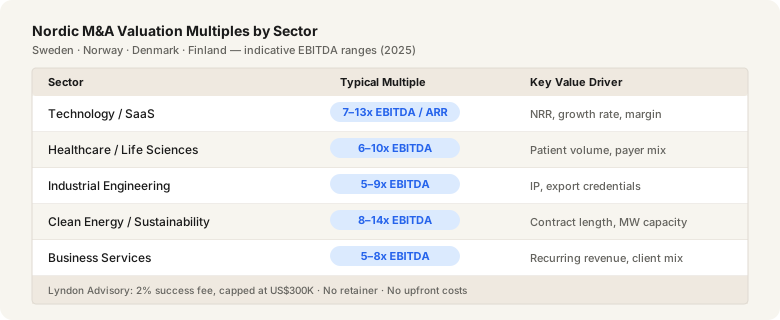
Most Active Sectors for M&A in Sweden
Technology and Fintech
Stockholm is Europe’s second-largest startup hub per capita, having produced global companies including Spotify, Klarna, and King. The fintech cluster around Stureplan and the broader SaaS ecosystem attract consistent buyer interest from US strategic acquirers, European PE, and pan-Nordic roll-up platforms. Invest in Sweden data shows technology as the single largest sector by deal count in Swedish M&A.
For technology business owners, EBITDA multiples and ARR multiples both apply depending on the business model. Profitable SaaS businesses with strong net revenue retention command 8–13x EBITDA or 4–9x ARR. Earlier-stage businesses with strong growth metrics but limited profitability are typically valued on revenue multiples.
Healthcare and Life Sciences
Sweden’s public healthcare system creates a large private healthcare ancillary market — dental, physiotherapy, psychology, ophthalmology, and specialist clinics that complement the public system. Private equity roll-up platforms have been active in Swedish dental and allied health for over a decade, following the playbook pioneered by firms like Colosseum Dental.
Life sciences and medtech benefit from proximity to Karolinska Institutet and a strong research infrastructure. Cross-border buyers — from the US, UK, and Asia — are increasingly active in Swedish life sciences acquisitions.
Industrial Engineering and Manufacturing
Swedish precision engineering — Sandvik, Atlas Copco, SKF-adjacent supply chains — creates a deep pool of high-quality manufacturing SMEs. Japanese industrial conglomerates are particularly active acquirers of Swedish precision manufacturers, valuing the engineering culture and export capability. Valuation multiples for quality Swedish industrials typically run 5–9x EBITDA.
Clean Energy and Sustainability
Sweden’s aggressive decarbonisation targets and strong infrastructure market make clean energy and sustainability-linked businesses increasingly attractive. Infrastructure funds, utilities, and specialist ESG-mandated PE funds are active buyers. Valuation multiples for contracted renewable energy assets are driven by enterprise value per MW rather than traditional EBITDA metrics.
Who Buys Swedish Businesses
The buyer universe for Swedish businesses is genuinely international:
Nordic PE Funds — EQT, Nordic Capital, Triton, IK Partners, and a deep pool of smaller Nordic PE firms are the most frequent acquirers of mid-market Swedish businesses. They understand Swedish corporate law, employment co-determination rules, and the cultural dynamics of dealing with Swedish founders.
Pan-European PE — CVC, Advent International, Bridgepoint, and other London-headquartered funds maintain active Nordic dealflow teams. They typically focus on businesses with €10M+ EBITDA and cross-border growth potential.
US PE and Strategics — US private equity has significantly increased Nordic deal activity over the past five years. US strategic buyers are particularly active in technology — Stockholm’s talent base and IP quality make Swedish SaaS businesses attractive acquisition targets for US software companies seeking European expansion.
International Strategic Acquirers — Japanese industrials, German engineering groups, and UK corporates are consistent acquirers of Swedish businesses in their relevant sectors. Cross-border due diligence processes are typically smooth given Sweden’s strong corporate governance standards.
Deal Considerations for Swedish Sellers
Swedish AB Structures
Most Swedish SMEs operate as Aktiebolag (AB), the standard Swedish limited company. Buyers typically acquire shares rather than assets. The transfer is relatively clean under Swedish law, but sellers should ensure any shareholder agreements, preference shares, or option programmes are resolved prior to sale.
Employee Co-Determination (MBL)
The Medbestämmandelagen (MBL) law requires consultation with employee representatives before certain major business decisions, including ownership changes. For mid-market transactions, this typically means informing Works Council equivalents (Fackförbund) after signing a non-disclosure agreement — it rarely creates material deal risk but must be managed correctly.
Finansinspektionen Approval
For businesses in regulated financial services (banking, insurance, investment management), the Swedish financial regulator (Finansinspektionen) must approve changes of control. This adds 2–3 months to transaction timelines and requires detailed regulatory filings by the buyer.
Tax Structuring
Sweden’s participation exemption regime makes share sales by Swedish holding companies tax-efficient. Many Swedish business owners hold their operating company beneath a holding AB (holdingbolag), which can shelter capital gains from operating company share sales. Sellers should engage a Swedish tax adviser early to optimise exit structuring.
At Lyndon Advisory, we work with international legal and tax advisers to ensure cross-border Swedish transactions are structured correctly — from NDA through to final SPA execution.
Why Lyndon Advisory for Swedish and Nordic Deals
Fee Transparency
Nordic advisory boutiques typically charge 2–5% of enterprise value as a success fee, plus monthly retainers of €5,000–€20,000. Lyndon Advisory charges a single success fee of 2.5% of enterprise value, capped at US$750,000. On a €10M deal, that is €250,000 — versus €300,000–€500,000+ at a traditional Nordic boutique. You pay nothing unless a deal completes.
International Buyer Access
Our auction process reaches buyers that Stockholm-based boutiques systematically underweight — US PE funds, Asian strategic acquirers, and cross-border industrials. For Swedish sellers whose businesses have international appeal, this broadens competition and lifts outcomes.
Senior-Led Process
Every mandate is led by a senior M&A professional. You deal with the people who close deals — not a junior team managed remotely by a partner who appears at key meetings.
The Sale Process
A structured Nordic sell-side process at Lyndon Advisory follows five phases:
- Valuation and preparation — indicative valuation, quality of earnings review, CIM and teaser preparation
- Buyer identification — mapping the Nordic, European, and international buyer universe; approaching under confidentiality
- IOI and management presentations — managing buyer interest, running management meetings
- LOI and exclusivity — negotiating headline terms, entering exclusivity period with preferred buyer
- Due diligence and completion — coordinating due diligence, negotiating the SPA, and completing the transaction
The typical timeline is 5–6 months from mandate to completion, supported by focused buyer outreach and disciplined document management.
Considering a sale of your Swedish or Nordic business? Lyndon Advisory provides confidential, senior-led M&A advisory with transparent fees — 2.5% of enterprise value, capped at US$750,000, with no retainer and no upfront costs. Submit a confidential valuation inquiry to understand what your business is worth and what a sale process would look like.
Sources
- Statistics Sweden: structural business statistics
- OECD: Sweden SME financing profile
- Business Sweden: life science sector
Related Guide
For the broader framework behind this topic, see Lyndon Advisory’s guide to selling a business.
About the Author

Daniel Bae
Co-founder & CEO, Lyndon Advisory
Daniel is an investment banker with 15+ years of experience in M&A, having advised on deals worth over US$30 billion. His career spans Citi, Moelis, Nomura, and ANZ across London, Hong Kong, and Sydney. He holds a combined Commerce/Law degree from the University of New South Wales. Daniel founded Lyndon Advisory to solve the pain points in M&A, enabling bankers to focus on what matters most — delivering trusted advice to clients.
About Lyndon Advisory
Lyndon Advisory is an M&A advisory firm built for Asia Pacific. We help business owners sell their companies and investors make strategic acquisitions with senior-led execution, disciplined process management, and structured buyer research. For owners, the first step is a confidential review of valuation range, likely buyer universe, and whether a structured sell-side process is justified.
Request a confidential seller reviewTopic cluster