US food and beverage M&A is one of the most consistently active deal categories in American private markets. Private equity consolidation, large CPG portfolio optimisation, and sustained consumer demand for branded, on-trend products combine to generate a deep, year-round buyer universe for F&B business owners across every sub-sector. The USDA Economic Research Service identifies meat, dairy, other foods, beverages, and grain/oilseed processing as the largest manufacturing sales categories.
For business owners considering a sale, understanding who buys F&B companies, what they pay, and how to run a process that generates real competition is the difference between a good outcome and a great one.
For the full owner preparation sequence behind this market-specific article, start with our guide to selling a business.
The quick buyer lens is:
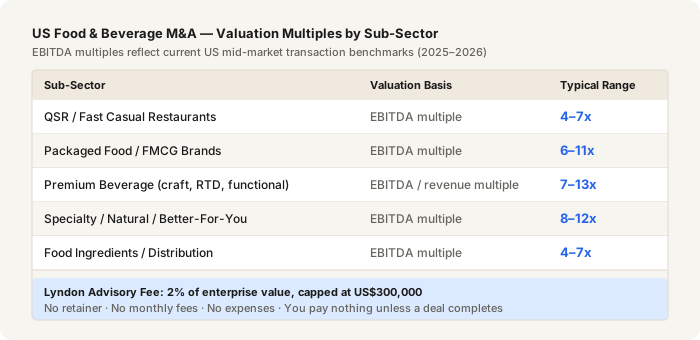
| Segment | Typical valuation lens | Priority buyer concern |
|---|---|---|
| Branded packaged food | 6–11x EBITDA | Retail velocity and margin durability |
| Premium beverages | 7–13x EBITDA or 2–4x revenue | Distribution rights and brand pull |
| QSR / fast casual | 4–7x EBITDA | Unit economics and lease quality |
| Ingredients / distribution | 4–7x EBITDA | Working capital and customer concentration |
“In F&B, buyers pay for evidence of repeat demand, not just a good brand story. Shelf velocity, gross margin resilience, and channel diversity decide whether a seller gets strategic-buyer pricing or commodity-buyer pricing.”
— Daniel Bae, Founder & CEO, Lyndon Advisory
What Makes F&B M&A Different
Food and beverage transactions have characteristics that set them apart from general M&A processes — and that require advisors with sector experience to navigate.
Brand is the primary asset. Unlike professional services or manufacturing businesses, F&B value sits predominantly in the brand — its shelf velocity, consumer recognition, and loyalty metrics. Financial due diligence in F&B transactions goes deep on brand health: repeat purchase rates, SKU-level margins, retail authorisation breadth, and social/digital engagement. Acquirers pay premiums for brands with genuine consumer pull, not just distribution agreements.
EBITDA normalisation is material. Most founder-owned F&B businesses run personal expenses, family compensation, and non-recurring costs through the P&L. Quality of earnings analysis is essential to establish a defensible normalised EBITDA — the figure acquirers actually bid on. Commodity price volatility (packaging, ingredients, freight) also requires careful treatment to show through-cycle margins rather than a single-year snapshot.
Regulatory complexity is real. FDA food safety rules, USDA compliance, labelling requirements, allergen disclosures, and facility certifications are all reviewed in diligence. For food service businesses, local health department records and franchise disclosure documents add layers. Advisors who haven’t handled F&B transactions underestimate the documentation burden.
The buyer universe is sector-specific. Large CPG companies, PE-backed roll-up platforms, and restaurant consolidators operate differently from industrial or technology acquirers. Understanding their acquisition criteria, approval processes, and valuation frameworks — and approaching the right contacts — requires sector knowledge that general M&A advisors typically lack.
The US F&B Sub-Sector Landscape
QSR and Fast Casual Restaurants
Quick-service and fast-casual restaurant groups with proven unit economics and scalable models attract consistent PE and strategic interest. The USDA ERS foodservice market data shows limited-service food sales reached US$516.1 billion in 2025, giving multi-unit operators a large buyer and benchmarking universe. Valuations typically run 4–7x EBITDA, with higher multiples for franchise-enabled models and multi-unit operators with geographic expansion potential. Key diligence items: same-store sales trends, average unit volume (AUV), franchise disclosure documents, lease portfolio quality, and labour cost structure.
Packaged Food and FMCG
Branded packaged food businesses — snacks, condiments, sauces, meal kits, specialty pantry — are among the most actively acquired F&B categories. Enterprise value multiples range from 6–11x EBITDA for established brands with strong retail authorisation. Acquirers include large CPG companies seeking category extension, PE funds building brand portfolios, and international strategics entering the US market. Gross margin above 40% and velocity-per-point-of-distribution (velocity/PoD) data are key value drivers.
Beverages
The beverage category spans craft spirits, premium wine, RTD cocktails, non-alcoholic functional drinks, and energy beverages. High-growth beverage brands are often valued on revenue multiples (2–4x) rather than EBITDA, with premiums for brands demonstrating strong DTC traction and retail distribution momentum. Premium and craft spirits with aged inventory and brand heritage command 7–13x EBITDA. TTB compliance and state distribution rights are diligence priorities.
Specialty and Natural Food
Better-for-you, organic, clean-label, and plant-based brands attract a premium buyer universe: large CPG companies seeking to reposition their portfolios, wellness-focused PE platforms, and category-specific strategic acquirers. Multiples of 8–12x EBITDA are achievable for brands with strong retail velocity, clean formulations, and defensible brand positioning. Supply chain traceability and certification (organic, non-GMO, kosher) documentation are reviewed carefully.
Food Ingredients and Distribution
Ingredients businesses (specialty flavours, functional ingredients, food-grade chemicals) and food distribution companies (broadline, specialty, cold chain) trade at 4–7x EBITDA, reflecting the more commoditised nature of the revenue and higher working capital intensity. PE buyers seeking stable cash flows and consolidation opportunities are the primary acquirer class.
Who Buys US Food and Beverage Businesses
Understanding the buyer universe before going to market shapes the entire process — pricing strategy, information memorandum emphasis, and outreach targeting.
Large CPG strategics — Kraft Heinz, General Mills, Conagra, Campbell Soup, Unilever, Nestlé, Mondelēz, and their tier-two equivalents — are systematic acquirers of branded F&B businesses that fill portfolio gaps, enter new categories, or provide geographic distribution access. They pay strategic premiums for brands with genuine consumer pull and operate through corporate development teams with defined acquisition criteria.
Private equity roll-up platforms are the most active buyer class across QSR, specialty food, and ingredients. These are PE-backed platforms that acquire, integrate, and scale F&B businesses, typically targeting businesses with $2–15M EBITDA. They move faster than strategic acquirers and are willing to pay for businesses that fit their consolidation thesis. Understanding which platforms are actively acquiring in a specific sub-sector — and approaching them at the right moment in their investment cycle — is where advisor knowledge creates real value.
Restaurant consolidators and franchise groups pursue multi-unit operators with proven concepts, strong AUVs, and franchise-ready systems. They value operational scalability and brand consistency over pure financial metrics.
Family offices seek stable, cash-generative F&B businesses with defensible market positions and less cyclicality than technology or financial services. They are patient buyers who often pay fair multiples without requiring aggressive integration.
At Lyndon Advisory, we map the active buyer universe for each F&B mandate — identifying which PE platforms are in active acquisition mode, which strategics have open mandates, and which family offices have sector appetite — before a single outreach is made.
Valuation Drivers That Move the Multiple
Beyond sub-sector benchmarks, specific characteristics separate a 6x outcome from a 10x outcome:
Brand defensibility — Can the brand hold shelf space without constant promotional spend? Brands with genuine consumer pull (repeat purchase above 40%, strong review profiles, social followings with engagement above 3%) command meaningful premiums over private-label-vulnerable alternatives.
Gross margin profile — Acquirers model contribution margins and EBITDA conversion carefully. Branded businesses with gross margins above 45% attract more interest and higher multiples than low-margin distribution plays.
Channel mix — Omnichannel presence (retail + food service + DTC) broadens the buyer universe. Single-channel businesses are more exposed to channel concentration risk, which acquirers discount for.
Clean-label and trend alignment — Better-for-you, organic, plant-based, and functional positioning attracts premium acquirers. Businesses aligned with durable consumer trends (not passing fads) benefit from strategic buyer premiums above pure PE financial returns.
Management depth — Owner-operated businesses where the founder is the key relationship, head chef, or primary customer contact carry key-person risk that acquirers discount. Building a management team capable of operating without the founder materially improves outcomes.
Key Deal Considerations for US F&B Transactions
EBITDA normalisation is typically the first major advisory task. Add-backs for excess owner compensation, non-recurring marketing spend, personal vehicle expenses, and above-market family salaries are standard — but must be defensible. Aggressive add-backs without documentation destroy credibility in diligence.
Commodity price exposure requires careful treatment. If ingredient or packaging costs spiked in the prior year, showing normalised margins with commodity price sensitivity analysis is essential for buyer confidence.
Franchise agreements for restaurant businesses require careful legal review. Franchise disclosure documents (FDDs), territory rights, and franchisee consent-to-transfer provisions can complicate timelines significantly.
FDA/USDA compliance records — facility inspection histories, recall records, and labelling compliance — are reviewed in every F&B diligence process. Clean records accelerate closing; issues discovered in diligence are price chips.
Working capital peg — F&B businesses with seasonal inventory cycles or high raw material buffers require careful working capital peg negotiation. The peg level set at signing determines the final post-completion adjustment.
Why Lyndon Advisory for Your US F&B Sale
The fee structure is the starting point. Traditional US M&A boutiques charge 4–7% of enterprise value as a success fee, plus monthly retainers of $10,000–$20,000 from day one. On a $12 million F&B brand, that is $480,000–$840,000 in advisory fees before expenses.
Lyndon Advisory charges a 2.5% success fee, capped at US$750,000 — no retainer, no monthly fees, no expense recharges. On that same $12 million transaction, our fee is $240,000. You pay nothing unless a deal completes.
The process is senior-led. Every F&B mandate is run by a senior advisor with investment banking experience — not delegated to analysts. The CIM we write, the buyers we approach, the negotiations we run are handled by people who have closed transactions at this level before.
We run a structured auction process — approaching a curated set of qualified buyers simultaneously, creating genuine competitive tension, and using that tension to move price, terms, and conditions in your favour. A negotiated bilateral process with a single buyer, by contrast, leaves value on the table almost every time.
Ready to explore a sale of your food or beverage business? Lyndon Advisory provides senior-led M&A advisory for US F&B business owners — 2.5% success fee capped at US$750,000, no retainer, no upfront costs. Submit a confidential valuation inquiry to understand what your business could be worth and who would buy it.
About the Author

Daniel Bae
Co-founder & CEO, Lyndon Advisory
Daniel is an investment banker with 15+ years of experience in M&A, having advised on deals worth over US$30 billion. His career spans Citi, Moelis, Nomura, and ANZ across London, Hong Kong, and Sydney. He holds a combined Commerce/Law degree from the University of New South Wales. Daniel founded Lyndon Advisory to solve the pain points in M&A, enabling bankers to focus on what matters most — delivering trusted advice to clients.
About Lyndon Advisory
Lyndon Advisory is an M&A advisory firm built for Asia Pacific. We help business owners sell their companies and investors make strategic acquisitions with senior-led execution, disciplined process management, and structured buyer research. For owners, the first step is a confidential review of valuation range, likely buyer universe, and whether a structured sell-side process is justified.
Request a confidential seller reviewTopic cluster