The United States is the world’s largest healthcare M&A market. PitchBook’s 2025 Healthcare M&A Report recorded over US$300 billion in US healthcare deal value in 2024, driven by accelerating private equity consolidation across dental, veterinary, behavioral health, and physician services. For healthcare business owners considering an exit, the buyer universe has never been larger — or more institutional.
For the full owner preparation sequence behind this market-specific article, start with our guide to selling a business.
Understanding who is buying, what they pay, and how regulatory complexity affects the process is the foundation of a well-positioned sale.
The public spending base explains why healthcare buyers remain active even when capital markets are selective. The CMS National Health Expenditure fact sheet reported that U.S. health care spending grew 7.2% to US$5.3 trillion in 2024, or 18.0% of GDP. CMS historical data reports the same 2024 spending base at US$15,474 per person. In M&A, that scale creates buyer appetite, but regulatory and reimbursement risk still determine which practices receive premium terms.
Why US Healthcare M&A Is Structurally Active
Several forces have converged to make US healthcare one of the most deal-intensive sectors in the country.
Fragmentation at scale. Most US healthcare sub-sectors — dental, veterinary, behavioral health, home health — remain highly fragmented despite years of consolidation. Private equity sees a repeatable playbook: acquire a high-quality platform, bolt on regional practices, and exit at a higher multiple through scale. The opportunity is structural, not cyclical.
Demographic demand. An ageing population drives persistent demand for aged care, home health, hospice, and chronic disease management services. Buyers underwrite long-run volume growth regardless of macroeconomic conditions.
Payer complexity as a moat. The US healthcare reimbursement system — Medicare, Medicaid, commercial insurance — creates operational complexity that rewards scale. Larger platforms negotiate better payer contracts, invest in billing technology, and absorb compliance costs more efficiently. This advantages buyers who consolidate.
Fee-driven advisor selection. US healthcare business owners are increasingly shopping advisory fees before mandating. The difference between a 5% Lehman firm with a $20,000/month retainer and a 2.5% success fee capped at US$750,000 can be US$300,000–$500,000 on a single transaction — material at SME deal sizes.
Most Active Sub-Sectors
Dental and DSO Consolidation
Dental service organisations (DSOs) have been consolidating independent dental practices for over a decade. The leading DSOs — Aspen Dental, Pacific Dental Services, Heartland Dental — now operate hundreds of locations each, but the market remains fragmented. PE-backed DSOs continue to pursue acquisitions aggressively.
Multi-location dental groups command premiums over single-practice acquisitions. A well-run group with five or more locations, strong associate dentist retention, and modern practice management systems is highly attractive to institutional buyers.
Veterinary and VCO Platforms
Veterinary consolidation mirrors the dental model closely. Veterinary care organisations (VCOs) including National Veterinary Associates, VCA (Mars Petcare), and Banfield have created a competitive acquisition environment for quality veterinary clinics.
Practices with dedicated specialists (oncology, internal medicine, surgery) and emergency capability attract the highest multiples. Pure general practice clinics are still actively acquired but at more conservative valuations.
Behavioral Health
Behavioral health — including outpatient mental health, substance use disorder treatment, and applied behaviour analysis (ABA therapy for autism) — has attracted substantial PE interest following COVID-era demand surge and expanded insurance parity requirements.
ABA therapy companies with BCBA-credentialed therapists and strong Medicaid/commercial payer mix are among the highest-valued behavioral health assets. Outpatient mental health practices with telehealth capability have broadened their buyer universe to include national platforms.
Home Health and Hospice
Home health and hospice benefit from the secular shift away from institutional care. Medicare-certified agencies with strong quality scores and low hospitalisation rates are actively sought by national home health groups and PE platforms.
Hospice businesses with high Medicare census and established physician relationships command premium valuations. Note that Medicare-certified home health and hospice transactions require careful change of control planning with CMS.
Physician Practice Management
Specialty physician practices — orthopaedics, ophthalmology, dermatology, gastroenterology, urology — have become a significant M&A category as private equity applies the DSO consolidation model to physician services. The physician practice management company (PPMC) model, which failed in the 1990s, has returned in a more sustainable form, backed by stronger technology platforms and improved payer relationships.
Buyer Universe
Private equity platforms are the dominant buyer class across most healthcare sub-sectors. The PE investment thesis is consistent: fragmented market, recurring revenue, demographic tailwinds, and a clear path to roll-up strategy at scale.
Strategic buyers — hospital systems, health insurance groups, and national healthcare operators — are active acquirers of physician practices and specialty services that fit their integrated care strategies.
Family offices and independent sponsors represent a growing buyer class for smaller practices (under $5M EBITDA) that fall below PE platform minimum thresholds. These buyers move faster and often accept seller-friendly structures including minority stakes and management retention arrangements.
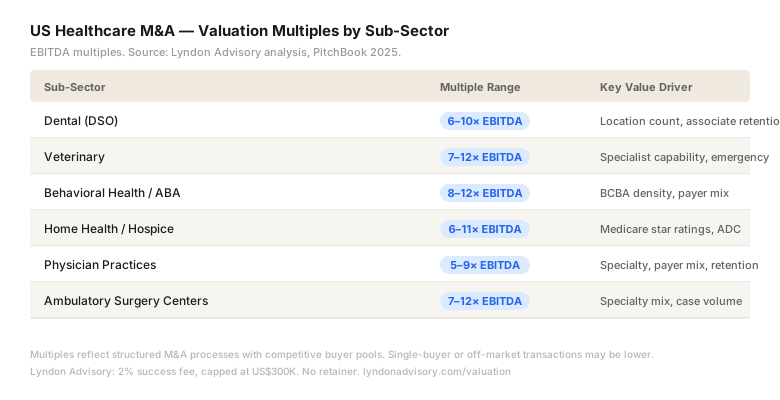
Valuation Multiples
| Sub-Sector | Typical Multiple | Key Driver |
|---|---|---|
| Dental practices (DSO) | 6–10× EBITDA | Location count, associate retention |
| Veterinary clinics | 7–12× EBITDA | Specialist capability, emergency hours |
| Behavioral health (ABA) | 8–12× EBITDA | BCBA density, payer mix |
| Outpatient mental health | 5–8× EBITDA | Telehealth capability, panel size |
| Home health (Medicare) | 6–10× EBITDA | Star ratings, hospitalisation rate |
| Hospice | 7–11× EBITDA | Medicare census, ADC |
| Physician practices | 5–9× EBITDA | Specialty, payer mix |
| Ambulatory surgery centers | 7–12× EBITDA | Specialty mix, case volume |
EBITDA normalisation is critical in healthcare. Owner-physician compensation above a market replacement rate, non-recurring compliance costs, and one-time capital expenditures should all be added back. Quality of earnings analysis by the buyer will scrutinise these adjustments closely — prepare documentation in advance.
Regulatory Considerations
US healthcare M&A involves a regulatory layer absent in most other sectors.
Medicare and Medicaid change of control. Provider agreements do not automatically transfer to a new owner. Buyers must notify CMS and apply for re-enrollment as a new provider. This process can take 60–120 days post-closing and requires the practice to continue operating under the prior owner’s Medicare billing number during the transition period. Structuring the closing conditions of the SPA around this timeline is essential.
Stark Law and Anti-Kickback Statute. The data room must include documentation demonstrating compliance with physician self-referral and anti-kickback requirements. Buyers and their counsel will scrutinise compensation arrangements with referring physicians closely. Any historic violations — even technical — require disclosure.
Certificate of Need. Approximately 35 US states have CON laws requiring regulatory approval for new or expanded healthcare facilities. Hospital and ambulatory surgery center transactions in CON states require planning well in advance of signing.
HIPAA. Buyers must execute a Business Associate Agreement (BAA) before accessing patient-identifiable data in due diligence. The virtual data room must be configured to restrict access accordingly.
Antitrust. Large healthcare transactions may trigger antitrust review under Hart-Scott-Rodino. Hospital and health system acquisitions in concentrated markets have faced increasing FTC scrutiny.
Key Deal Considerations
Physician retention. In physician practice transactions, the value walks out the door if key physicians leave post-closing. Buyers universally require earnout provisions or equity rollovers tied to physician retention. Sellers should expect employment agreements, non-competition clauses, and rollover equity as standard deal components.
Payer mix. A practice heavily dependent on Medicaid reimbursement is valued differently from one with a strong commercial payer mix. Government payer revenue is more predictable but typically lower margin and carries higher regulatory risk.
Revenue concentration. A dental group where 40% of revenue comes from one insurance group, or a behavioral health practice where one payer accounts for the majority of billing, will face buyer scrutiny on contract renewal risk.
Compliance history. Medicare and Medicaid billing audits, overpayment demands, or prior compliance investigations require disclosure and materially affect buyer confidence and indemnification terms.
Why Lyndon Advisory for US Healthcare M&A
“Healthcare sellers need to separate market appetite from diligence risk. Dental, veterinary, behavioral health, and physician-services buyers are active, but premium valuation still depends on clean compliance history, payer mix, provider retention, and whether the business can transfer without the founder.”
— Daniel Bae, Founder & CEO, Lyndon Advisory, former M&A advisor with over US$30 billion in transaction experience.
At Lyndon Advisory, our New York-based senior advisor handles US healthcare mandates end-to-end — from teaser and CIM preparation through auction process management to closing. You deal with a senior professional, not an analyst three years out of school.
Our fee is 2.5% of enterprise value, capped at US$750,000, with no retainer and no monthly charges. On a $10M dental group sale, that is $250,000 — compared with $500,000–$700,000 at a typical US boutique running a Lehman formula plus retainer. On a $15M transaction, the fee is $375,000 and the saving is approximately $125,000–$325,000 before retainers. You pay nothing unless a deal completes.
We cover the full US healthcare buyer universe: PE-backed consolidation platforms, hospital systems, health insurance groups, and family offices. Our process is built to create competitive tension across all buyer types — the mechanism that maximises your price.
Thinking about selling your US healthcare business? Submit a confidential valuation inquiry with our team. We’ll walk you through an indicative valuation, the buyer universe that would be interested, and what a structured sale process would look like — no obligation, no cost.
Sources
About the Author

Daniel Bae
Co-founder & CEO, Lyndon Advisory
Daniel is an investment banker with 15+ years of experience in M&A, having advised on deals worth over US$30 billion. His career spans Citi, Moelis, Nomura, and ANZ across London, Hong Kong, and Sydney. He holds a combined Commerce/Law degree from the University of New South Wales. Daniel founded Lyndon Advisory to solve the pain points in M&A, enabling bankers to focus on what matters most — delivering trusted advice to clients.
About Lyndon Advisory
Lyndon Advisory is an M&A advisory firm built for Asia Pacific. We help business owners sell their companies and investors make strategic acquisitions with senior-led execution, disciplined process management, and structured buyer research. For owners, the first step is a confidential review of valuation range, likely buyer universe, and whether a structured sell-side process is justified.
Request a confidential seller reviewTopic cluster