The US transportation and logistics sector is one of the most active areas for private equity consolidation in America. FMCSA registration statistics show more than 2 million carrier records, and tens of thousands of freight brokerages, 3PLs, and warehousing operators remain sub-scale. That fragmentation is structural. It is also the opportunity: PE-backed platforms have been systematically acquiring sub-scale operators since 2018, and deal activity has accelerated through 2025.
According to PitchBook’s 2025 Global Transportation & Logistics M&A Report, US logistics M&A exceeded $38 billion in deal value in 2025, with PE-backed roll-up platforms accounting for more than 60% of transaction volume. Owner-operators retiring without a succession plan, rising insurance and fuel costs squeezing margins, and the capital requirements of fleet modernisation are all driving sellers to market.
For business owners in this sector, a structured auction process with the right advisor — one who understands the specific buyer universe and deal dynamics of logistics — is the difference between a transaction at 4x EBITDA and one at 7x.
For the full owner preparation sequence behind this market-specific article, start with our guide to selling a business.
The quick sub-sector map is:
| Sub-sector | Typical EBITDA range | Main diligence issue |
|---|---|---|
| Asset-heavy trucking | 4–6x | Fleet age, safety record, driver retention |
| Freight brokerage | 5–8x | Carrier network quality and shipper concentration |
| 3PL / warehousing | 6–9x | Contract duration and technology stack |
| Cold chain logistics | 6–10x | Facility quality and compliance history |
“Logistics sellers win when they can prove revenue quality. A buyer will pay for contracted lanes, diversified shippers, clean DOT records, and systems that let the business scale without the founder in every dispatch decision.”
— Daniel Bae, Founder & CEO, Lyndon Advisory
The US Logistics M&A Market in 2025–2026
US logistics M&A is driven by a combination of structural tailwinds that show no sign of abating. The Bureau of Transportation Statistics estimated transportation’s total contribution to US GDP at about US$1.9 trillion in 2023, while FRED’s transportation and warehousing revenue series shows more than US$1.6 trillion in 2022 revenue for transportation and warehousing establishments. E-commerce penetration continues to increase last-mile delivery volumes. Nearshoring of manufacturing back to North America is driving domestic freight demand. And the technology bifurcation — between operators running legacy systems and those with integrated TMS platforms, real-time visibility, and data analytics — is widening the multiple gap between sellers at the top and bottom of the market.
The most active buyers are PE-backed roll-up platforms, which have capital to deploy and strategic mandates to consolidate fragmented sub-sectors. But strategic acquirers are also active: large logistics groups use tuck-in acquisitions to fill geographic gaps, add fleet capacity, or acquire specialist capabilities like hazmat handling, temperature-controlled logistics, or cross-border customs expertise.
The market is bifurcating. Technology-enabled operators with predictable, contracted revenue streams are achieving multiples at the high end of historical ranges. Traditional, asset-heavy operators with thin margins and customer concentration are facing more scrutiny — and lower multiples — than they did five years ago.
Sub-Sector Landscape and Active Deal Activity
Understanding which sub-sector you operate in is the first step to understanding your likely buyer universe and valuation range.
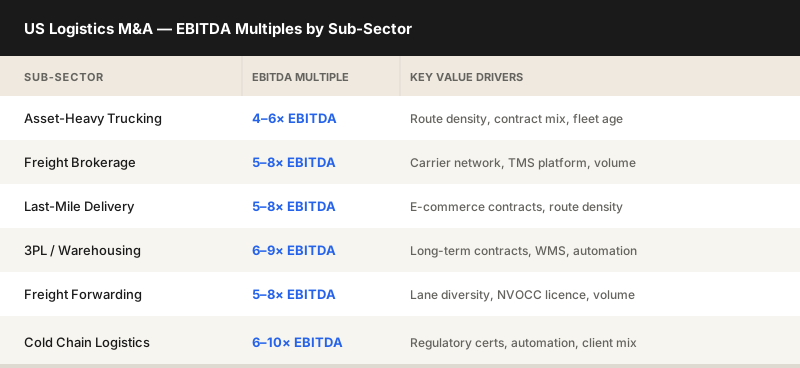
Asset-Heavy Trucking (TL/LTL). Full truckload and less-than-truckload carriers remain an active M&A category, but buyers are selective. Route density, the quality of the customer contract book, and fleet age are the primary value drivers. Owner-operators with strong regional route networks and long-term shipper relationships attract PE interest, particularly where the platform can consolidate multiple regional carriers. Strategic buyers like Knight-Swift, Werner, and Heartland Express pursue tuck-ins for geographic expansion.
Freight Brokerage. Asset-light freight brokerage is the highest-multiple sub-sector. Brokerages with proprietary carrier networks, technology platforms, and diversified shipper relationships trade at 5–8x EBITDA. Echo Global Logistics and Coyote Logistics set the template for what acquirers value: scale, technology differentiation, and contracted volume commitments from both the carrier and shipper sides.
Last-Mile Delivery. The fastest-growing sub-sector, driven by e-commerce. Courier and final-mile operators serving major retailers, grocery chains, and e-commerce platforms command 5–8x EBITDA. Buyers include both PE-backed platforms and strategic acquirers — e-commerce retailers seeking supply chain control and large logistics groups adding last-mile capability to their networks.
3PL and Warehousing. Third-party logistics providers with long-term customer contracts and automated warehouse management systems (WMS) attract premium multiples of 6–9x EBITDA. GXO Logistics, Ryder, and DSV are natural strategic acquirers. PE platforms target operators with multi-client facilities and technology-enabled fulfillment capabilities that can be rolled into larger platforms.
Freight Forwarding. International freight forwarders benefit from cross-border trade flows and typically command 5–8x EBITDA. NVOCC (non-vessel operating common carrier) licences add material value, as do air freight agency relationships. Kuehne+Nagel, DSV, and Sinotrans are active acquirers of US-based forwarders with strong Pacific or transatlantic lane specialisation.
Cold Chain Logistics. Temperature-controlled logistics commands a premium driven by food safety regulations, high barriers to entry (refrigeration infrastructure, regulatory certifications), and the structural growth of fresh food e-commerce. Lineage Logistics and the Americold platform have demonstrated what consolidation in this sub-sector looks like. Multiples of 6–10x EBITDA are achievable for well-run cold chain operators.
Who Buys US Logistics Businesses
The buyer universe for US logistics businesses is well-developed and active. Understanding who is likely to acquire your business — and how to run a process that surfaces the right buyers — determines the outcome of your sale.
PE-backed roll-up platforms are the most consistent buyers across every sub-sector. These are platforms that have already completed one or more acquisitions in your category and are seeking add-on businesses to build scale. Their acquisition criteria are specific — geography, revenue size, customer concentration limits, EBITDA margin floors — and a well-prepared CIM that speaks directly to their criteria accelerates the process. A Lyndon-run auction process systematically identifies and approaches every credible PE platform in your sub-sector.
Large strategic logistics groups acquire businesses for geographic fill, capability expansion, or fleet capacity. These buyers typically pay strategic premiums when the acquisition solves a specific gap in their network. Identifying which strategic has the gap your business fills is an advisory judgment call — not something a buyer list pulled from a database reliably produces.
Infrastructure funds are attracted to logistics businesses with long-term contracted revenue, low customer concentration, and predictable cash flows. Warehousing and cold chain businesses are particularly interesting to this buyer class. Infrastructure funds tend to be less operationally involved than PE, making them attractive to sellers who want the business to run independently post-close.
Corporate strategic acquirers — e-commerce retailers, manufacturers, and food producers — increasingly acquire logistics capabilities rather than outsourcing them. Amazon’s logistics buildout is the most visible example, but mid-market corporates are doing the same at smaller scale, acquiring regional carriers or last-mile operators to secure supply chain reliability.
Valuation Multiples by Sub-Sector
Logistics valuations are primarily EBITDA-based, with adjustments for quality of earnings, customer concentration, and working capital intensity. The table above provides benchmarks, but the multiple achieved in practice depends on the quality of the sale process as much as the underlying business characteristics.
Key factors that expand multiples above the midpoint of the range: contracted recurring revenue, diversified customer base (no single customer above 15% of revenue), proprietary technology or systems, management depth beyond the owner, and EBITDA margins above sector norms.
Key factors that compress multiples: customer concentration, aging fleet, owner-dependency, pending regulatory issues (ELD compliance, DOT violations), and volatile revenue tied to spot market pricing.
Earnouts are common in logistics transactions where revenue concentration exists or where the seller has a specific customer relationship that buyers want protected through the transition. Structuring the earnout correctly — with achievable metrics and a reasonable measurement period — is one of the most important advisory contributions in a logistics deal.
Key Deal Considerations
Logistics M&A has several sector-specific deal dynamics that differ from most other industries.
Customer concentration is the most scrutinised deal risk in logistics. A trucking company where one shipper represents 35% of revenue faces hard questions from every buyer about contract terms, relationship ownership (owner vs team), and renewal risk. Preparing a credible retention narrative — ideally with evidence of multi-year contract extensions or relationship breadth — is essential pre-marketing preparation.
Driver and labour risk. The ongoing driver shortage, combined with the legal complexity around independent contractor vs W-2 classification (the California AB5 ruling and its federal implications), creates due diligence risk in trucking-heavy businesses. Buyers will want to understand your driver classification, turnover rates, and safety record (CSA scores, DOT compliance history).
Technology stack. Buyers differentiate sharply between operators running integrated TMS (Transportation Management System) platforms with real-time visibility and those running manual or legacy systems. Technology investment prior to a sale — even modest improvements to data quality and operational visibility — can meaningfully shift the buyer universe and the achievable multiple.
Working capital intensity. Logistics businesses carry significant working capital — carriers paid weekly, customers paying on 30-60 day terms. The working capital peg negotiation in a logistics transaction can be material. Establishing a defensible normalised working capital target early in the process avoids a painful post-signing adjustment.
Equipment. Whether fleet is owned or leased, the age of equipment, and maintenance capex obligations are all deal terms. Owned equipment adds to the balance sheet and complicates the EBITDA-to-valuation bridge. An accurate quality of earnings report that normalises owner-related add-backs and separates recurring capex from growth capex is standard preparation.
Selling Your US Logistics Business with Lyndon Advisory
The US logistics M&A market is active and the buyer universe is well-developed. The quality of the sale process — who you approach, how you present the business, and how you create competitive tension — determines whether you achieve 4x or 8x EBITDA.
At Lyndon Advisory, our fee is 2.5% of enterprise value, capped at US$750,000. No retainer. No monthly charges. No expense recharges. You pay nothing unless a deal completes.
On a $10 million logistics business, a typical US boutique using the Lehman formula charges $400,000–$700,000 in success fees — plus retainer costs accumulated over the engagement period. The Lyndon fee is $250,000. On a $15 million deal, the comparison is $600,000–$900,000 (traditional) versus $375,000 with Lyndon.
Every mandate is led by a senior M&A professional — a former VP-level investment banker with deal experience across the transportation and logistics sector. You deal with the person running your deal, not an analyst three years out of university.
Our process: a structured competitive auction, targeted buyer outreach across PE platforms and strategic acquirers active in your sub-sector, rigorous due diligence preparation, and senior-led negotiation from the first offer through to the closing of your SPA. The typical timeline from mandate to completion is 5–6 months.
Thinking about selling your logistics business? Submit a confidential valuation inquiry with Lyndon Advisory. We will walk you through your indicative valuation, the buyers who would be interested, and what a process would look like — no obligation, no cost.
About the Author

Daniel Bae
Co-founder & CEO, Lyndon Advisory
Daniel is an investment banker with 15+ years of experience in M&A, having advised on deals worth over US$30 billion. His career spans Citi, Moelis, Nomura, and ANZ across London, Hong Kong, and Sydney. He holds a combined Commerce/Law degree from the University of New South Wales. Daniel founded Lyndon Advisory to solve the pain points in M&A, enabling bankers to focus on what matters most — delivering trusted advice to clients.
About Lyndon Advisory
Lyndon Advisory is an M&A advisory firm built for Asia Pacific. We help business owners sell their companies and investors make strategic acquisitions with senior-led execution, disciplined process management, and structured buyer research. For owners, the first step is a confidential review of valuation range, likely buyer universe, and whether a structured sell-side process is justified.
Request a confidential seller reviewTopic cluster