The United States financial services sector is one of the most active M&A markets globally. Wealth management consolidation, insurance broking roll-ups, and fintech acquisitions have driven deal volumes to record levels — and that activity shows no sign of slowing. For business owners in RIA, insurance, fintech, and adjacent sub-sectors, the window to exit at premium valuations is open.
The challenge is finding an advisor who understands the sector’s regulatory complexity, knows the buyer universe, and won’t charge fees that erode the value of a transaction. Most US financial services M&A boutiques charge 4–6% of deal value plus monthly retainers of $10,000–$20,000 throughout the process. Lyndon Advisory charges a 2.5% success fee only, capped at US$750,000 — with no retainer and no expense recharges.
For the full owner preparation sequence behind this market-specific article, start with our guide to selling a business.
Public regulatory data shows why buyer depth is unusually high in wealth and advisory services. The SEC’s Investment Adviser Statistics compile Form ADV data reported to the Commission, while the Investment Adviser Association’s 2026 snapshot reported 16,544 advisers, 73.7 million clients, and US$176.8 trillion of assets under management in 2025. Scale, fragmentation, and recurring fee revenue are the foundation of the RIA and insurance-brokerage consolidation thesis.
Why US Financial Services M&A Is So Active
Three structural drivers are sustaining deal volume across US financial services:
PE consolidation at scale. Private equity discovered early that fragmented financial services sectors — wealth management, insurance broking, tax practices — are ideal roll-up targets. AUM-based businesses generate highly predictable recurring revenue, client relationships are sticky, and adviser/producer retention can be managed through earnout structures and equity rollover. The result: hundreds of transactions per year as aggregators compete to consolidate.
Adviser succession. The average age of an independent financial adviser in the US is over 55. A wave of founders approaching retirement, combined with PE capital actively seeking acquisitions, has created a seller’s market for well-run RIA and insurance practices.
Fintech maturation. A generation of fintech businesses — payments processors, B2B lending platforms, insurtech, wealthtech — have reached scale and are now either acquisition targets or themselves making acquisitions. Strategic buyers from banking, insurance, and large RIA platforms are competing with PE for these assets.
Sub-Sectors and Valuation Benchmarks
Registered Investment Advisers (RIA) and Wealth Management
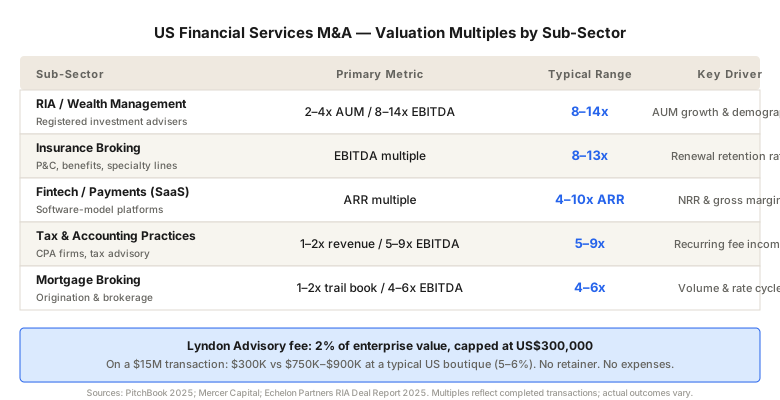
RIAs are valued primarily on AUM multiples (2–4x trailing AUM) or EBITDA multiples (8–14x), depending on the buyer’s preference and the firm’s growth profile. Key drivers of premium valuations include:
- AUM growth rate (organic > 10% per year commands a material premium)
- Client demographics (younger, higher net worth clients attract better multiples)
- Adviser concentration (firms where one adviser manages >40% of AUM trade at discounts)
- Fee structure (fee-only advisory commands premium; commission-based trades at discount)
- Technology stack (modern portfolio management and CRM platforms improve operational scalability)
Insurance Broking
Insurance brokerage businesses — particularly P&C, employee benefits, and specialty lines — trade at 8–13x EBITDA, reflecting the highly recurring commission income and strong client retention characteristic of the sector. Aggregators including Acrisure, Hub International, and BRP Group are consistently among the most active buyers nationally.
Quality of earnings analysis in insurance focuses on commission retention rates, carrier concentration, policy renewal timing, and contingent income normalisation. Buyers typically adjust EBITDA for contingent commissions, owner compensation excess, and non-recurring items before applying the multiple.
Fintech and Payments
Fintech businesses are valued on ARR multiples (4–10x) for SaaS-model platforms, or EBITDA multiples (7–12x) for profitable payment processors and embedded finance businesses. Strategic acquirers — including banks, large insurance groups, and listed fintech platforms — often pay premiums above PE multiples to acquire technology capabilities or distribution.
Mortgage Broking
Mortgage broking businesses trade at 1–2x trailing commission book or 4–6x EBITDA, reflecting the cyclicality of origination volumes. Buyers are typically other mortgage groups, banks expanding broker distribution, or PE platforms building national origination networks.
Tax and Accounting Practices
Accounting and tax practices in the US trade at 1–2x gross revenue or 5–9x EBITDA, driven by strong recurring fee income, established client relationships, and growing PE interest in professional services consolidation.
The US Financial Services Buyer Universe
Understanding who actually buys US financial services businesses is essential to running a process that generates genuine competition.
PE-backed aggregators are the most active buyers across most sub-sectors. In wealth management: Focus Financial Partners, Mercer Advisors, CI Financial, Savant Wealth Management, and Captrust. In insurance: Acrisure, Hub International, Gallagher, Risk Strategies, and BRP Group. These buyers move quickly, have established due diligence processes, and understand regulatory timelines.
Strategic acquirers — regional banks, large RIAs pursuing bolt-on acquisitions, and listed financial groups — often pay premiums for specific capabilities, geographic coverage, or client demographics.
Independent sponsors and family offices are active buyers of smaller transactions ($3M–$10M enterprise value) where aggregators are less competitive, particularly for niche advisory practices or specialty insurance agencies.
Regulatory Considerations in US Financial Services M&A
Every US financial services transaction involves a change of control process that must be completed before or shortly after closing. Sellers and buyers must account for:
- SEC approval for registered investment advisers (Form ADV amendment and client notification)
- FINRA approval for broker-dealers (CMA filing, which typically takes 60–90 days)
- State insurance commissioner filings for insurance agencies and producers (timing varies by state, typically 30–90 days)
- State banking department approvals for mortgage brokers and lenders
Experienced buyers in this sector have established regulatory workflows that reduce uncertainty. Sellers should confirm a buyer’s regulatory experience early in the auction process — delays in regulatory approval have derailed transactions that otherwise closed cleanly.
The engagement letter should explicitly address what constitutes a closing condition versus a post-closing obligation with respect to regulatory approvals, and who bears the cost of the approval process.
Key Deal Considerations
Client and AUM retention risk. Buyers of RIA and wealth management businesses will model client attrition scenarios. Retention is typically managed through adviser earnouts tied to retained AUM over 12–24 months post-close, and through non-solicitation and non-compete provisions for departing advisers.
Key-person concentration. A single founder managing most client relationships creates valuation risk. Sellers who have built a team, distributed client relationships, and documented processes achieve materially better outcomes.
Commission vs fee-only. Commission-based revenue is increasingly scrutinised by PE buyers given regulatory risk from SEC Regulation Best Interest. Fee-only advisory businesses trade at structural premiums.
Technology and operational infrastructure. Buyers conducting vendor due diligence will assess portfolio management systems (Orion, Tamarac, Addepar), CRM (Salesforce, Redtail), and compliance infrastructure. Firms on modern platforms are easier to integrate and command better multiples.
Why Lyndon Advisory for US Financial Services M&A
“Financial services M&A is driven by regulatory complexity and buyer relationships, and the fee structure matters enormously. A US$12 million RIA sale should not cost US$600,000 in advisory fees. We built Lyndon to deliver a senior-led process at a fraction of that cost.”
— Daniel Bae, Founder & CEO, Lyndon Advisory, former M&A advisor with over US$30 billion in transaction experience.
Lyndon Advisory brings a senior NY-based ex-investment banker to your transaction, with no junior staff running your deal. Our fee is 2.5% of enterprise value, capped at US$750,000 — regardless of deal size. On a $15M insurance brokerage sale, that is $375,000 versus $750,000–$900,000 at a typical US boutique charging 5–6%.
We run structured competitive processes — CIM preparation, teaser distribution, managed buyer outreach, NDA execution, LOI management, and exclusivity period negotiation — through to a clean close. No retainers, no monthly fees, no expense recharges.
Selling a financial services business in the United States? Lyndon Advisory offers senior-led M&A advisory at 2.5% of enterprise value, capped at US$750,000 — no retainer, no upfront costs. Submit a confidential valuation inquiry to understand what your business is worth and who would buy it.
Sources
About the Author

Daniel Bae
Co-founder & CEO, Lyndon Advisory
Daniel is an investment banker with 15+ years of experience in M&A, having advised on deals worth over US$30 billion. His career spans Citi, Moelis, Nomura, and ANZ across London, Hong Kong, and Sydney. He holds a combined Commerce/Law degree from the University of New South Wales. Daniel founded Lyndon Advisory to solve the pain points in M&A, enabling bankers to focus on what matters most — delivering trusted advice to clients.
About Lyndon Advisory
Lyndon Advisory is an M&A advisory firm built for Asia Pacific. We help business owners sell their companies and investors make strategic acquisitions with senior-led execution, disciplined process management, and structured buyer research. For owners, the first step is a confidential review of valuation range, likely buyer universe, and whether a structured sell-side process is justified.
Request a confidential seller reviewTopic cluster