The US education and training sector is one of the most active arenas for private equity consolidation in North America. From K-12 tutoring to corporate learning platforms to EdTech software, PE-backed acquirers are building scale businesses across every segment of the $1.8 trillion US education market. For education business owners considering an exit, the buyer universe has never been deeper — and the window to capture premium valuations remains open.
What Makes Education M&A Different
Education businesses carry a specific set of characteristics that distinguish them from other service sectors in M&A.
Revenue quality matters more than revenue size. A tutoring business with $3 million in contracted, recurring enrolments is worth significantly more than one with $5 million in ad hoc, seasonally lumpy revenue. Buyers apply rigorous analysis to quality of earnings in education deals, normalising for seasonal patterns, owner compensation, and one-off promotional discounts.
Accreditation and licensing are deal-critical. Unlike most sectors, education businesses operate under regulatory frameworks that require explicit change-of-control approval. Regional accreditors, state education departments, and federal agencies must be notified of and in many cases approve a transaction before closing. This adds complexity and timeline to deals — experienced advisors identify these requirements early and build the regulatory pathway into the sale process.
The instructor and curriculum dependency question. Buyers scrutinise whether value lives in the business or in specific teachers, tutors, or instructors. Businesses with proprietary curriculum, systematised delivery, and multi-instructor depth command meaningfully higher multiples than those dependent on one or two key practitioners.
Online and hybrid delivery is now table stakes. Post-2020, education businesses that cannot demonstrate a credible digital delivery model face buyer scepticism. Those with proven online or hybrid models — and the metrics to back them — attract the broadest buyer universe and the strongest valuations.
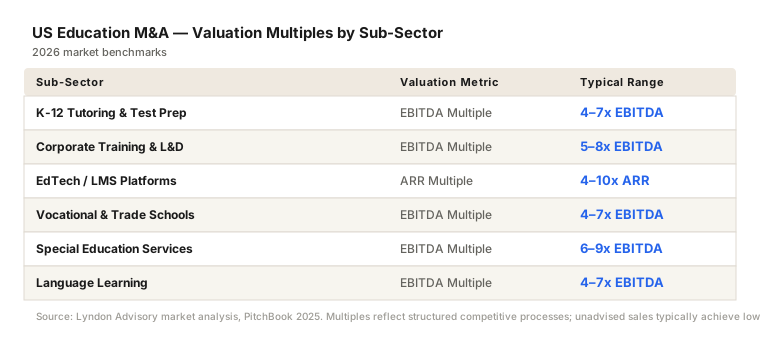
US Education M&A Sub-Sectors and Valuation Benchmarks
The US education market is large and structurally diverse. Buyers, deal activity, and valuation dynamics vary significantly by sub-sector.
K-12 tutoring and test prep (4–7x EBITDA). Businesses serving K-12 students with academic support, SAT/ACT preparation, or supplemental instruction. PE consolidators are active, with platforms like Tutor Doctor and Kumon franchises providing the aggregation model. Premium multiples go to businesses with strong brand recognition, proprietary test prep materials, and multi-location networks.
Corporate training and L&D (5–8x EBITDA). Learning and development businesses serving enterprise clients — compliance training, leadership development, technical skills, and professional certifications. Businesses with multi-year enterprise contracts and SaaS-delivered content are most valuable. Strategic acquirers include GP Strategies, Pearson, and global professional services firms.
EdTech and LMS platforms (4–10x ARR). Software platforms serving education institutions or learners directly — learning management systems, assessment tools, adaptive learning, and content delivery platforms. Valuation is driven by ARR growth rate, net revenue retention (NRR), and gross margin. Platforms with NRR above 110% and gross margins above 70% attract the top of the range.
Vocational and trade schools (4–7x EBITDA). Businesses delivering career-focused training in skilled trades, healthcare support roles, technology, or other vocational pathways. Title IV eligibility is a significant factor — schools receiving federal student aid undergo additional regulatory diligence. Well-run vocational businesses with strong graduate employment outcomes attract premium interest from both PE and strategic buyers.
Special education services (6–9x EBITDA). One of the fastest-growing segments in US education M&A, driven by mandated services under IDEA (Individuals with Disabilities Education Act). Businesses delivering ABA therapy, speech-language services, or other special education support under school district contracts are highly sought after. Government-contracted revenue provides predictability that commands premium valuations.
Language learning (4–7x EBITDA). Adult language training for corporate clients, immigration preparation, or personal development. Businesses with enterprise contracts and digital delivery capabilities attract the strongest interest.
Who Buys US Education Businesses
The US education buyer universe spans private equity, strategic acquirers, and family offices.
Private equity consolidators are the dominant buyer class across most education sub-sectors. PE firms build platform companies and pursue bolt-on acquisitions to achieve scale, operational leverage, and exit multiples above entry. Active platforms include those in tutoring, corporate training, special education, and vocational sectors. PE buyers value recurring revenue, scalable delivery, and geographic expansion potential.
Strategic acquirers include listed education groups (Stride, K12, Adtalem, Grand Canyon Education), global corporate training conglomerates (Pearson, Learning Tree, GP Strategies), and EdTech platform companies seeking content, market access, or technology capability. Strategic acquirers may pay control premiums above PE when the target fills a specific capability or market gap.
Family offices are active buyers of stable, profitable education businesses — particularly tutoring chains, vocational schools, and corporate training businesses with predictable cash flows. They tend to be longer-hold buyers with less leverage than PE, which can suit owners seeking continuity of the business they built.
Key Deal Considerations
Accreditation and regulatory approvals. Any change of control in an accredited institution requires advance notification to the relevant accreditor. For businesses receiving Title IV federal student aid, a Change in Ownership (CIO) application to the Department of Education is required before closing. These processes take 90–180 days and must be factored into deal timelines and closing conditions.
EBITDA normalisation. Education business owners commonly mix personal and business expenses, carry above-market owner compensation, and incur one-off costs that depress stated profitability. A thorough normalisation exercise — presenting adjusted EBITDA that reflects what the business earns under a buyer’s ownership — is essential preparation before running a competitive process.
Government contract portability. Corporate training businesses serving federal, state, or local government clients must verify whether contracts require novation or re-bid upon a change of ownership. Buyers discount businesses where government revenue is at risk post-transaction.
Curriculum IP ownership. Buyers conduct diligence on who owns the curriculum, content, and materials used in delivery. IP developed by contractors, former employees, or third parties may carry uncertainty of ownership that buyers flag as risk. Clear IP assignment documentation before going to market removes a common deal friction point.
Enrollment seasonality. Education businesses often generate disproportionate revenue in specific months or semesters. Buyers normalise for seasonality when assessing LTM (last twelve months) performance and negotiate working capital peg targets that reflect seasonal cash patterns.
The US Education M&A Sale Process
A structured competitive process is the most effective approach for education business owners seeking to maximise value. The steps are consistent with other sectors, with education-specific regulatory preparation added:
Preparation (6–8 weeks). Compile financial records, normalise EBITDA, document curriculum IP ownership, identify accreditation and licensing requirements for a change of control, prepare a Confidential Information Memorandum (CIM) and management presentation.
Buyer outreach (4–6 weeks). Approach a curated set of qualified buyers — PE platforms, strategic acquirers, and family offices. Use a blind teaser to protect identity until buyers sign an NDA and receive the full CIM.
Indications of interest (2–3 weeks). Qualified buyers submit IOIs with indicative valuation ranges and deal structures. Shortlist the most compelling.
Management presentations and LOIs (3–4 weeks). Selected buyers meet management and submit formal letters of intent. Run a competitive process to maintain leverage and improve terms.
Due diligence and regulatory filings (8–16 weeks). Buyers conduct detailed due diligence. Accreditation notifications and Title IV CIO applications (where applicable) filed in parallel to minimise closing delay.
Signing and closing. Final SPA negotiated and signed. Transaction closes upon satisfaction of all conditions, including any regulatory approvals.
At Lyndon Advisory, our NY-based senior advisor manages this process end-to-end. We approach the right buyers, run a competitive process that generates multiple offers, and negotiate the terms — so you can focus on running the business while the sale proceeds.
Why Lyndon Advisory for US Education M&A
The US education M&A market rewards sellers who run a structured, competitive process with experienced representation. Here is what Lyndon Advisory brings:
Fee structure that aligns with your outcome. Most US M&A advisors charge 4–6% of enterprise value under the Lehman formula, plus a monthly retainer of $10,000–$20,000. On a $12 million education business sale, that is $480,000–$720,000 in advisory fees, plus retainers, before you see a dollar of proceeds. Lyndon Advisory charges a flat 2.5% success fee capped at US$750,000 — no retainer, no monthly fees, no expense recharges. You pay nothing until a deal closes.
Senior-led from first call to close. Your deal is run by a senior advisor with investment banking experience at VP level and above — not handed off to an analyst team. Every buyer conversation, every negotiation, every term sheet is handled by the person who knows your business.
US buyer network. We maintain active relationships with PE platforms, strategic acquirers, and family offices across the US education sector — the buyers who will compete for your business and drive value.
Considering selling your education business? Submit a confidential valuation inquiry with revenue and company details. If the mandate fits Lyndon’s buyer reach and advisory model, we will follow up with an indicative value view, buyer universe, and sale-process outline. Submit a valuation inquiry to get started.
Related Guide
For the broader framework behind this topic, see Lyndon Advisory’s education M&A guide.
About the Author

Daniel Bae
Co-founder & CEO, Lyndon Advisory
Daniel is an investment banker with 15+ years of experience in M&A, having advised on deals worth over US$30 billion. His career spans Citi, Moelis, Nomura, and ANZ across London, Hong Kong, and Sydney. He holds a combined Commerce/Law degree from the University of New South Wales. Daniel founded Lyndon Advisory to solve the pain points in M&A, enabling bankers to focus on what matters most — delivering trusted advice to clients.
About Lyndon Advisory
Lyndon Advisory is an M&A advisory firm built for Asia Pacific. We help business owners sell their companies and investors make strategic acquisitions with senior-led execution, disciplined process management, and structured buyer research. For owners, the first step is a confidential review of valuation range, likely buyer universe, and whether a structured sell-side process is justified.
Request a confidential seller reviewTopic cluster