The United States is the world’s largest market for consumer and CPG M&A. In 2025, consumer-sector deal value in North America exceeded US$180 billion, with mid-market transactions — businesses valued between US$10 million and US$150 million — representing the most active segment by deal count, according to PitchBook’s 2025 Global Consumer M&A Report. For business owners considering a sale, understanding the US buyer universe, valuation drivers, and how to run a competitive process is the difference between a fair exit and an exceptional one.
This page addresses US consumer-sector buyers, valuation and sale preparation. For the cross-market CPG sale framework and Lyndon’s sector advisory service, read CPG M&A advisory: strategy, buyers and valuation. Owners comparing firms can use the consumer M&A advisor selection checklist.
The US Consumer M&A Landscape
The US consumer and CPG sector has experienced sustained M&A activity driven by several structural forces: large strategic acquirers refreshing portfolios by divesting legacy brands and acquiring high-growth challengers, private equity consolidating fragmented categories through roll-up platforms, and international buyers — particularly from Asia — seeking US brands with proven retail distribution and brand equity.
Active deal categories in 2025–2026 include:
- Better-for-you food and beverage — clean label, organic, functional food brands with growing retail shelf presence
- Personal care and beauty — independent brands with DTC strength and specialty retail distribution
- Pet products — one of the most active PE consolidation categories in US consumer
- Private label manufacturing — consolidation plays targeting production capacity and retailer relationships
- Direct-to-consumer brands — brands with high repeat purchase rates and strong unit economics attracting strategic acquirers looking for customer relationships
According to Bain & Company’s 2025 Consumer Products M&A Outlook, deal multiples for premium consumer businesses with defensible positioning and growing omnichannel penetration have held firm despite broader market volatility, with strategic buyers paying meaningful premiums over financial buyers for brands that fit their portfolio priorities.
For the full owner preparation sequence behind this market-specific article, start with our guide to selling a business.
Who Buys US Consumer and CPG Businesses
The buyer universe for US consumer businesses is broader than most owners realise — and the most valuable deals often come from buyers that domestic advisors underweight.
Global CPG strategics — Unilever, Nestlé, Kraft Heinz, Procter & Gamble, and their category-specific subsidiaries — are consistent acquirers of US mid-market consumer brands. These buyers pay premium multiples for brands that fill a white space in their portfolio, accelerate a category strategy, or provide a direct-to-consumer capability they lack. Strategic fit drives price more than financial metrics.
Private equity roll-up platforms are the most active buyer class by deal count in US consumer M&A. PE funds have built platform companies across nearly every consumer sub-category — pet nutrition, specialty food, personal care, and health & wellness — and are actively acquiring bolt-on businesses to add scale, SKUs, and distribution reach. These buyers move quickly and offer competitive terms for businesses that fit an existing platform thesis.
Family offices and independent sponsors are a growing buyer class for stable, cash-generative consumer businesses in the US$10–40 million range. They are typically less price-sensitive than PE on multiples but slower-moving and more relationship-driven.
For consumer brands with APAC distribution or international growth narratives, Lyndon can also access Asian strategic acquirers — Japanese trading houses, Korean conglomerates, and Singapore-based PE funds — who are active buyers of US consumer assets.
Valuation Multiples for US Consumer Businesses
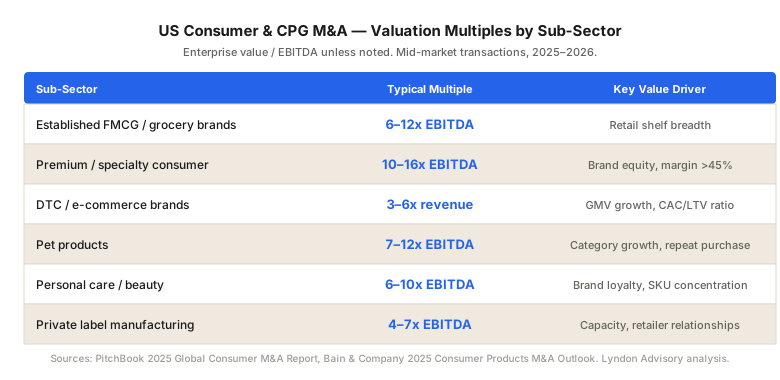
US consumer transaction multiples vary significantly by sub-sector, growth profile, channel mix, and margin quality.
| Sub-Sector | Typical Multiple | Key Driver |
|---|---|---|
| Established FMCG / grocery brands | 6–12x EBITDA | Retail shelf breadth, margin stability |
| Premium / specialty consumer | 10–16x EBITDA | Brand equity, gross margin >45% |
| DTC / e-commerce brands | 3–6x revenue | GMV growth rate, CAC/LTV ratio |
| Pet products | 7–12x EBITDA | Category growth, recurring purchase |
| Personal care / beauty | 6–10x EBITDA | Brand loyalty, SKU concentration |
| Private label manufacturing | 4–7x EBITDA | Customer concentration, capacity |
EBITDA normalisation is critical in US consumer transactions. Common add-backs include above-market founder compensation, discretionary marketing spend that acquirers will manage differently, one-time product launches, and related-party costs. Quality of earnings analysis commissioned by the buyer will scrutinise these adjustments — sellers who prepare a clean QoE before going to market reduce negotiation friction and protect valuation.
Enterprise value is the standard basis for US consumer M&A transactions. Cash-free, debt-free pricing with a working capital peg is the market convention. Understanding how seasonal inventory, distributor relationships, and promotional accruals affect the working capital target is important for sellers entering a process.
What Drives Premium Multiples
The spread between median and top-quartile multiples in US consumer M&A can be 4–6x EBITDA for otherwise similar businesses. The variables that explain the gap:
Retail distribution breadth and depth. National shelf presence at major retailers (Target, Walmart, Whole Foods, Costco, Kroger) signals both brand credibility and distribution infrastructure that acquirers value. Businesses with strong e-commerce GMV alongside retail presence command premium multiples from buyers seeking omnichannel capability.
Gross margin profile. Consumer businesses with gross margins above 45% attract strategic buyers willing to pay for the pricing power implied by those margins. Commodity-exposed businesses with margins below 30% trade at significant discounts regardless of revenue scale.
Repeat purchase rate and customer loyalty. Subscription penetration, loyalty programme data, and cohort retention metrics are increasingly standard diligence items for consumer acquirers. Businesses with demonstrable customer loyalty trade at premiums to those dependent on new customer acquisition.
Brand defensibility. Proprietary formulations, clean label positioning, certifications (organic, non-GMO, B-Corp), and category leadership in a defensible niche drive premium multiples. Commodity or undifferentiated products in fragmented categories face multiple compression regardless of revenue scale.
Management team continuity. For PE buyers especially, the quality and commitment of the management team post-acquisition is a significant valuation factor. Founders willing to roll equity and remain through an integration period attract better terms than those seeking a clean break.
Running a US Consumer M&A Process
A structured auction process is the standard approach for US mid-market consumer transactions. A well-run process involves:
-
Preparation — Financial normalisation, preparation of the CIM and teaser, buyer list development. For consumer businesses, this phase should include a detailed brand analysis, retail velocity data, and e-commerce channel breakdown.
-
Broad outreach — Simultaneous approach to qualified buyers across all categories: strategics, PE platforms, family offices, and international buyers. NDA execution before information sharing.
-
First-round bids — Indicative offers (IOI) submitted by buyers who reviewed the CIM. Advisors use these to calibrate interest and narrow to a finalist group.
-
Management presentations — Finalist buyers meet the management team, ask detailed questions, and refine their investment thesis before submitting final bids (LOI).
-
Exclusivity and due diligence — Preferred buyer enters exclusivity, conducts diligence via virtual data room, and works toward a signed SPA.
-
Closing — Legal documentation, regulatory approvals where applicable, and funds flow at completion.
A compressed timeline of 5–7 months is achievable for well-prepared businesses. Cross-border processes involving international buyers may run 1–2 months longer.
“The most common mistake US consumer brand owners make is running a narrow process. A structured competitive process with a fully built-out buyer list almost always delivers a materially better outcome. Competitive tension is what drives price, not a bilateral conversation with one buyer.”
— Daniel Bae, Founder & CEO, Lyndon Advisory, former M&A advisor with over US$30 billion in transaction experience.
Why Lyndon Advisory for US Consumer M&A
Lyndon Advisory brings a combination that most boutique advisors in this space do not: transparent, competitive fees and a senior New York-based advisor who runs your deal from first call to closing.
Fee structure. Traditional US M&A advisors charge 4–7% of enterprise value on a Lehman or modified Lehman formula, plus monthly retainers of US$10,000–$25,000 from day one. Lyndon Advisory charges a flat 2.5% success fee, capped at US$750,000, with no retainer and no expense recharges. On a US$15 million consumer deal, a standard 5% Lehman advisor charges US$750,000 plus retainers — Lyndon charges US$375,000 total. You pay nothing unless the deal closes.
Senior-led. Your mandate is led by a former VP-level investment banker based in New York. Not handed to a junior analyst after the pitch. The person you meet is the person who runs your process, negotiates your terms, and represents your business to buyers.
Full buyer universe. US PE consumer roll-up funds, global CPG strategics, family offices, and independent sponsors — all approached simultaneously to create competitive tension. For businesses with APAC distribution or international growth potential, we can extend reach to Asian strategic buyers as well.
Considering a sale of your consumer or CPG business? Lyndon Advisory provides senior-led M&A advisory for US mid-market consumer businesses — structured competitive process, 2.5% success fee capped at US$750,000, no retainer, no upfront costs. Submit a confidential valuation inquiry to understand what your business is worth and what a process would look like.
About the Author

Daniel Bae
Co-founder & CEO, Lyndon Advisory
Daniel is an investment banker with 15+ years of experience in M&A, having advised on deals worth over US$30 billion. His career spans Citi, Moelis, Nomura, and ANZ across London, Hong Kong, and Sydney. He holds a combined Commerce/Law degree from the University of New South Wales. Daniel founded Lyndon Advisory to solve the pain points in M&A, enabling bankers to focus on what matters most — delivering trusted advice to clients.
About Lyndon Advisory
Lyndon Advisory is an M&A advisory firm built for Asia Pacific. We help business owners sell their companies and investors make strategic acquisitions with senior-led execution, disciplined process management, and structured buyer research. For owners, the first step is a confidential review of valuation range, likely buyer universe, and whether a structured sell-side process is justified.
Request a confidential seller reviewTopic cluster