US construction and specialty trades M&A is one of the most active private equity consolidation themes in America. Fragmented ownership, aging founder demographics, and infrastructure tailwinds from the Infrastructure Investment and Jobs Act (IIJA) have converged to create exceptional exit conditions for construction business owners — particularly in specialty trades.
For business owners considering a sale, the combination of PE interest, strategic buyer competition, and a transparent advisory fee structure makes 2026 an opportune window.
For the full owner preparation sequence behind this market-specific article, start with our guide to selling a business.
Public construction data supports the scale of the opportunity. The U.S. Census Bureau’s May 2026 construction spending release estimated total construction spending at a seasonally adjusted annual rate above US$2.2 trillion. Census also explains that its Value of Construction Put in Place survey covers monthly construction work on new structures and improvements across private and public sectors. For sellers, that scale matters because buyers can build consolidation theses around specialty trades, infrastructure, facilities services, and regional contractor density.
What Makes Construction M&A Different
Construction businesses present a distinct set of considerations for buyers and advisors that differ from most other sectors.
Backlog is the business. Unlike a recurring-revenue SaaS company or a contracted services firm, a construction business’s forward revenue sits in its backlog — projects awarded but not yet completed. Buyers scrutinise backlog quality, customer concentration within it, margin profile by project type, and the conversion rate from bid to awarded. A business with $30 million in backlog from five diversified customers at healthy margins is worth materially more than the same revenue from two customers at compressed margins.
EBITDA normalisation is complex. Owner compensation, equipment depreciation, related-party lease arrangements, and bonuses to key project managers all require careful normalisation. Construction EBITDA often understates true earning power — and equally often overstates it when project timing distorts a single year’s results. A trailing twelve-month view adjusted for these factors is the starting point for any valuation discussion.
Bonding and surety are non-negotiable. Most commercial and public construction projects require payment and performance bonds. A buyer acquiring a bonded contractor must transfer or replace that bonding capacity — a process that depends on the bonding company’s assessment of the new ownership. Buyers with existing bonding relationships can absorb the acquisition cleanly; buyers without them face a meaningful hurdle.
Licensing is jurisdictional. General contractor and specialty trade licences are issued at the state level. A business operating across multiple states holds multiple licences, each of which may need to be reissued or transferred upon a change of ownership. This is manageable but must be planned for upfront in the deal process.
US Construction M&A Sub-Sectors and Buyer Universe
The construction sector encompasses a wide range of business models, each attracting a different buyer universe.
Specialty trades — electrical, mechanical, plumbing, HVAC, and fire protection — are the most actively acquired sub-sector. PE consolidators have been rolling up specialty trade contractors for a decade, building regional and national platforms that command premium exit multiples. The maintenance and service agreement component of specialty trade businesses (recurring HVAC servicing, electrical maintenance contracts) is what buyers prize most.
General contracting attracts fewer PE buyers and more strategic acquirers. Margins are thin and project concentration risk is high, which limits multiple expansion. Strategic buyers — larger GCs seeking geographic entry or capability — are the most likely acquirers.
Civil and infrastructure businesses benefit from long-term government contracts and IIJA tailwinds. Infrastructure funds and strategic acquirers are the primary buyers. Valuations reflect contract duration and the predictability of cash flows.
Environmental engineering firms command premium multiples due to their regulatory expertise, recurring remediation contracts, and the complexity barriers to entry. PE buyers and strategic acquirers compete actively for quality environmental businesses.
Facilities management businesses with contracted recurring revenue — building maintenance, janitorial, landscaping at scale — attract PE buyers seeking predictable cash flows and roll-up potential.
At Lyndon Advisory, we run structured competitive sale processes across all construction sub-sectors — preparing the CIM, building a targeted buyer list spanning PE platforms, strategic acquirers, and infrastructure funds, and managing the process to create genuine buyer competition.
Valuation Multiples for US Construction Businesses
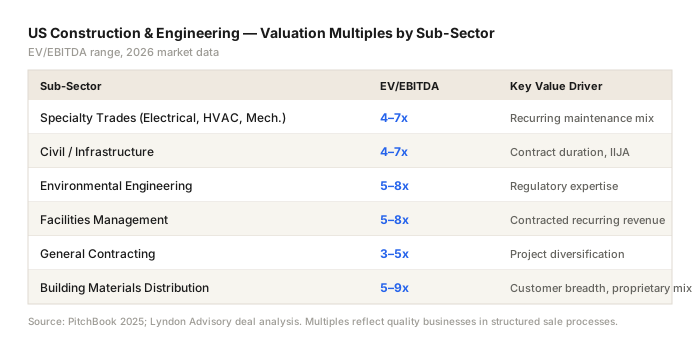
Valuation in construction M&A is driven primarily by enterprise value to EBITDA multiples, with adjustments for backlog quality, customer concentration, and recurring revenue mix.
| Sub-Sector | Typical EV/EBITDA | Key Driver |
|---|---|---|
| Specialty trades (electrical, HVAC, mechanical) | 4–7x | Recurring maintenance mix |
| Civil / infrastructure | 4–7x | Contract duration, IIJA exposure |
| Environmental engineering | 5–8x | Regulatory expertise, recurring remediation |
| Facilities management | 5–8x | Contracted recurring revenue |
| General contracting | 3–5x | Project diversification, margin |
| Building materials distribution | 5–9x | Customer breadth, proprietary products |
Multiples compress for businesses with high customer concentration (one customer >25% of revenue), project-only revenue with no maintenance component, and thin EBITDA margins below 8%. They expand for businesses with diversified service agreement revenue, licensed and scalable workforce, and geographic expansion optionality.
The right comparison is not “what multiple did a deal I read about trade at” — it is “what multiple will the specific buyers interested in my business pay given my particular profile.” A structured auction process answers that question with real bids rather than estimates.
Key Deal Considerations
Customer concentration. Most construction buyers apply informal thresholds: no single customer should represent more than 15–20% of revenue, and the top five customers should represent less than 50%. Businesses that fail this test face pushback on valuation or deal structure — often an earnout tied to customer retention post-closing.
Workforce and licensing. Licensed tradespeople — journeyman and master electricians, licensed plumbers, certified HVAC technicians — are difficult to hire and even harder to retain through an ownership transition. Buyers want to see workforce depth, apprenticeship pipelines, and retention agreements for key project managers and foremen. Retention bonuses tied to deal closing are standard.
Equipment. Asset-heavy businesses carry equipment fleets on their balance sheets. Buyers assess whether equipment is owned or leased, age and remaining useful life, and whether capital expenditure is required post-acquisition to maintain operational capacity. A quality of earnings analysis will normalise equipment-related costs and identify any deferred maintenance.
Backlog margin analysis. Not all backlog is equal. A buyer will ask for a project-by-project margin analysis — estimated gross margin at completion for every open project. Projects with compressed margins, change order disputes, or schedule overruns are red flags. Sellers who have done this analysis themselves before going to market are in a far stronger negotiating position.
Prevailing wage and union status. Union shops operating under collective bargaining agreements have additional considerations around change of control provisions and continuity of agreement obligations. Non-union businesses in prevailing wage jurisdictions must demonstrate compliance. Both are manageable — but they need to be disclosed and understood early.
Why Lyndon Advisory for US Construction Deals
Construction M&A requires an advisor who understands the sector’s specific dynamics — backlog normalisation, bonding transfer, licensing, and the distinct buyer universe of PE roll-up platforms versus strategic acquirers.
“Construction business owners often underestimate what a structured process delivers. A well-run auction that reaches 20-30 targeted buyers creates the competition that moves multiples. Most owners who sell without a structured process leave significant value on the table.”
— Daniel Bae, Founder & CEO, Lyndon Advisory, former M&A advisor with over US$30 billion in transaction experience.
Our fee structure is simple: 2.5% of enterprise value, capped at US$750,000. No retainer. No monthly fees. No expense recharges. You pay nothing unless a deal completes.
On a $10 million construction business, a traditional US boutique charges $400,000–$600,000 in success fees plus $120,000–$300,000 in retainers — a total cost of $520,000–$900,000. Our fee is $250,000.
Our NY-based advisory team brings senior M&A experience to every engagement. You deal with the people who run your deal — not an analyst three years out of university.
The Sale Process for a US Construction Business
A structured sale process for a construction business typically follows five phases:
Preparation (4–6 weeks). Financial normalisation, backlog analysis, CIM preparation, management presentation. We identify the universe of relevant buyers — PE platforms, strategic acquirers, infrastructure funds — and prepare targeted outreach materials.
Market (4–6 weeks). Simultaneous outreach to 20–40 targeted buyers under NDA. IOI deadline set to create urgency and competitive tension.
Due diligence and negotiation (4–6 weeks). Management presentations with shortlisted buyers. LOI negotiation. Exclusivity granted to preferred bidder. Full due diligence process — financial, operational, legal, environmental.
Documentation (4–6 weeks). SPA negotiation. Reps and warranties finalisation. Bonding transfer coordinated in parallel.
Closing. Regulatory filings, licence transfers, funds flow.
Thinking about selling your construction or engineering business? Submit revenue and company details for confidential review. If the mandate fits Lyndon’s buyer reach and advisory model, we will follow up with an indicative valuation, likely buyer universe, and process outline. Submit a valuation inquiry to get started.
Sources
About the Author

Daniel Bae
Co-founder & CEO, Lyndon Advisory
Daniel is an investment banker with 15+ years of experience in M&A, having advised on deals worth over US$30 billion. His career spans Citi, Moelis, Nomura, and ANZ across London, Hong Kong, and Sydney. He holds a combined Commerce/Law degree from the University of New South Wales. Daniel founded Lyndon Advisory to solve the pain points in M&A, enabling bankers to focus on what matters most — delivering trusted advice to clients.
About Lyndon Advisory
Lyndon Advisory is an M&A advisory firm built for Asia Pacific. We help business owners sell their companies and investors make strategic acquisitions with senior-led execution, disciplined process management, and structured buyer research. For owners, the first step is a confidential review of valuation range, likely buyer universe, and whether a structured sell-side process is justified.
Request a confidential seller reviewTopic cluster