Most business owners who sell regret not starting sooner. The businesses that achieve the strongest multiples and cleanest completions are rarely the ones that decided to sell last month. They are the ones that spent 12 to 18 months preparing before their business ever went to market.
Exit readiness is not a bureaucratic checklist. It is the difference between a buyer discovering problems in due diligence — chipping the price, adding escrows, walking away — and a buyer who pays full value because the business is exactly what it appeared to be in the CIM.
This article walks through the five dimensions of exit readiness, what buyers actually scrutinise, and how to score your business honestly before you go to market. Owners who want a fast starting point can use the Business Exit Readiness Assessment, or download Lyndon Advisory’s Business Exit Readiness Scorecard 2026 and CSV worksheet.
Why Most Businesses Aren’t Ready
According to PitchBook’s 2025 M&A Report, over 30% of mid-market transactions that reach advanced diligence fail to close — and the most common reason is undisclosed or unresolved issues that the seller assumed wouldn’t matter. Buyers do not assume. They verify everything.
IBBA and M&A Source’s Q1 2026 Market Pulse release reported that 83% of deals above US$5 million attracted at least three offers. That is good news for prepared sellers, but it also raises the evidence bar: multiple interested buyers create competition only if each buyer can verify the business without finding preventable gaps.
“Readiness is what lets a seller use buyer competition instead of being overwhelmed by it. If the evidence is weak, every extra buyer becomes another route to a price chip.” - Daniel Bae, Founder and CEO of Lyndon Advisory
The 12-to-18-month preparation window matters because the most common exit readiness gaps take time to fix:
- Key-person dependency cannot be resolved overnight. Hiring and embedding a replacement for the owner-operator role takes 6 to 12 months minimum.
- EBITDA normalisation requires at least two, ideally three, years of clean management accounts before a buyer will accept the adjustments.
- Customer concentration is impossible to fix quickly — diversifying a revenue base that relies on one client for 40% of sales requires winning new customers over time.
Owners who start 18 months out have options. Those who start 3 months before they want to sell are constrained.
The Five Dimensions of Exit Readiness
1. Financial Readiness
Buyers pay for sustainable, verified earnings. The first question in every diligence process is: is the EBITDA real, and is it maintainable after the owner leaves?
Financial readiness requires:
- Clean, reconciled accounts. Management accounts should tie to statutory accounts. Unexplained variances are a red flag.
- EBITDA normalisation. Owner salary above market rate, personal expenses run through the business, one-off costs, and non-recurring items all need to be identified and documented as add-backs. A quality of earnings review gives buyers confidence in the adjustments.
- Working capital discipline. Buyers will scrutinise the working capital peg — the normalised level of working capital required to run the business. Unusual swings in debtors, creditors, or inventory raise questions.
- Three years of history. One good year proves nothing. Three consecutive years of growth tells a story.
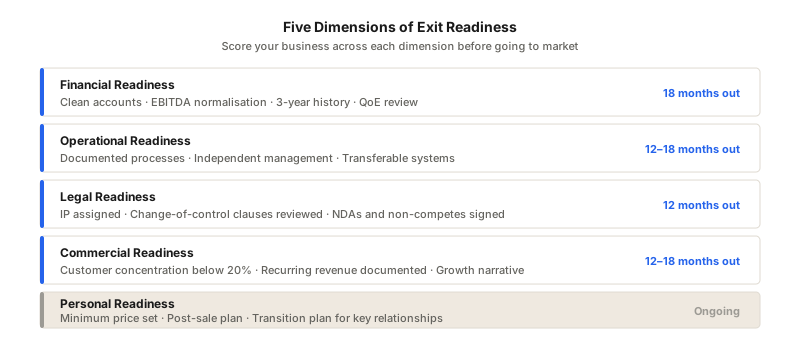
2. Operational Readiness
A business that runs on the owner’s relationships, knowledge, and daily involvement is not a business — it is a job. Buyers are acquiring a system, not a person.
Operational readiness means:
- Documented processes. Sales, delivery, finance, and HR processes should be written down and followed consistently, not held in the owner’s head.
- A management team that operates independently. The owner should be able to take four weeks off without the business deteriorating. If they cannot, the key-man clause in the earnout agreement will reflect this.
- Technology and systems that are transferable. Proprietary systems built on personal relationships or non-transferable contracts are liabilities, not assets.
Buyers will ask for management references. They will interview the senior team without the owner present. Prepare accordingly.
3. Legal Readiness
Legal surprises are the most common deal-killer in due diligence. They are also the most preventable.
Legal readiness requires:
- IP clearly assigned to the company. Founders who developed IP before incorporation often hold it personally. Rectify this before going to market.
- Customer contracts reviewed for change of control clauses. A contract that terminates on change of ownership is a material liability. Identify these early, negotiate amendments, or disclose them prominently.
- Employment agreements and non-compete agreements signed. Senior employees without non-solicitation agreements represent a risk. Buyers will notice.
- No material unresolved disputes. Outstanding litigation, regulatory proceedings, or warranty claims need to be resolved or properly disclosed.
4. Commercial Readiness
Buyers pay premiums for defensible, diversified, growing businesses. Commercial readiness is about building and documenting that story.
- Customer concentration below 20%. If one customer represents more than 20% of revenue, most buyers will want a price reduction or earnout structure to protect against churn risk.
- Recurring revenue documented. Subscription, retainer, or contract revenue commands higher multiples than transactional revenue. Quantify it, track renewal rates, and present it clearly.
- A credible growth narrative. What is the pipeline? What markets are untapped? Why will revenue grow after the owner leaves? Back the narrative with data.
5. Personal Readiness
The most overlooked dimension. Owners who are ambivalent about selling run bad processes — they over-negotiate, stall at decision points, and sometimes walk away from signed deals.
Personal readiness means:
- A clear minimum price and structure. Know your walk-away number before you enter any conversation.
- A plan for what comes next. The post-sale void is real. Owners who have thought about it run calmer, better processes.
- Succession planning for key relationships. If you are the primary relationship holder with customers, suppliers, or staff, buyers will want a transition plan — and often an earnout tied to it.
What Kills Deals in Diligence
The most common deal-killers, in order of frequency:
- EBITDA that cannot be verified. Add-backs that cannot be documented, or earnings that collapse once normalised.
- Customer concentration revealed late. Disclosed in the IM but not quantified honestly.
- Key-person dependency confirmed. The management team interviews badly, or the owner cannot articulate a transition plan.
- Legal issues surfacing. An IP dispute, an undisclosed contract termination right, or an employee without a signed agreement.
- Owner ambivalence. The deal dies in the final negotiation because the seller changes their mind about price, structure, or timing.
None of these are unfixable. But they are all significantly harder to fix once a buyer has already found them.
The Preparation Timeline
18 months before launch: Start financial normalisation. Commission a vendor due diligence readiness review. Begin reducing customer concentration. Hire into key-person roles.
12 months before launch: Clean up legal documentation. Finalise IP assignments. Ensure management accounts are clean and reconciled. Brief senior management on the process.
6 months before launch: Finalise three-year normalised EBITDA. Prepare the information memorandum with your advisor. Run a quiet pre-market process with selected buyers to test positioning and price.
At launch: Your business is ready. Every question a buyer asks has a documented, accurate answer. Due diligence is fast, surprises are few, and the deal closes.
Not sure where your business stands? Lyndon Advisory’s Exit Readiness Assessment scores your business across eight practical sale-readiness factors in five minutes. You’ll receive a score and a clear view of what to address before going to market. There’s no cost and no obligation.
Ready to understand what your business is worth? Submit a confidential valuation inquiry with Lyndon Advisory. We’ll tell you your indicative valuation, who would buy your business, and what a sale process would look like — at no cost and no commitment.
Related Guide
For the broader framework behind this topic, see Lyndon Advisory’s guide to selling a business.
For a citation-ready worksheet, use Lyndon Advisory’s Business Exit Readiness Scorecard 2026.
About the Author

Daniel Bae
Co-founder & CEO, Lyndon Advisory
Daniel is an investment banker with 15+ years of experience in M&A, having advised on deals worth over US$30 billion. His career spans Citi, Moelis, Nomura, and ANZ across London, Hong Kong, and Sydney. He holds a combined Commerce/Law degree from the University of New South Wales. Daniel founded Lyndon Advisory to solve the pain points in M&A, enabling bankers to focus on what matters most — delivering trusted advice to clients.
About Lyndon Advisory
Lyndon Advisory is an M&A advisory firm built for Asia Pacific. We help business owners sell their companies and investors make strategic acquisitions with senior-led execution, disciplined process management, and structured buyer research. For owners, the first step is a confidential review of valuation range, likely buyer universe, and whether a structured sell-side process is justified.
Request a confidential seller reviewTopic cluster