Financial services M&A operates under constraints that most other sectors do not face. Regulatory approvals, licence transfers, AUM retention risk, and adviser portability clauses make these transactions structurally more complex — and more dependent on specialist advisory — than comparable deals in unregulated industries.
This guide covers the buyer universe, valuation benchmarks, key deal considerations, and how a structured sale process works for wealth managers, insurance brokers, fintechs, mortgage businesses, and related financial services firms.
What Makes Financial Services M&A Different
Selling a regulated financial services business is categorically different from selling a consumer goods or logistics business. Three factors drive the complexity.
Regulatory change of control. Every material acquisition of a licensed financial services entity requires approval from the relevant regulator — APRA and ASIC in Australia, MAS in Singapore, the FCA in the UK, the OCC or state regulators in the US, JFSA in Japan. Approval timelines run 2–6 months and add a layer of closing risk that unregulated transactions do not face. Buyers will insist on conditions precedent tied to regulatory approval, and sellers need to plan for this from day one.
AUM and client portability. For wealth managers, fund managers, and insurance brokers, the asset being acquired is largely the client relationship — not physical assets or IP. Buyers underwrite AUM retention assumptions carefully, and earn-outs tied to retention over 12–24 months post-close are standard deal structures. The adviser covenant — preventing key advisers from departing and taking clients — is a central negotiation point.
Valuation methodology divergence. Most M&A uses EBITDA multiples as the primary valuation anchor. Financial services sub-sectors use a range of metrics: recurring revenue multiples for IFAs, trail book multiples for mortgage brokers, ARR multiples for fintechs. Buyers and sellers operating from different valuation frameworks is a common source of deal friction — specialist advice bridges this.
Sub-Sectors and Valuation Benchmarks
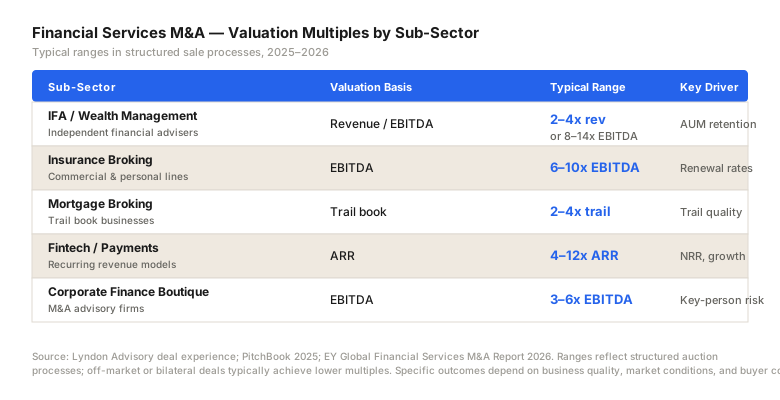
Financial services M&A covers a wide range of business types. Valuation logic varies significantly by sub-sector.
Wealth Management and IFA
Independent financial advisers and wealth management firms are the most actively traded sub-sector globally. Private equity-backed consolidation platforms have been acquiring IFA practices at scale across the US, UK, Australia, and increasingly APAC since 2018.
Valuation for IFA businesses typically runs at 2–4x recurring revenue (funds under advice × adviser fee) or 8–14x EBITDA. The specific multiple reflects revenue quality, AUM concentration per adviser, client demographic profile, adviser tenure, and whether technology infrastructure supports scale.
Quality of earnings analysis in IFA transactions focuses on separating genuine recurring revenue from one-off advice fees and on normalising owner compensation — many IFA principals pay themselves well below or well above market.
Insurance Broking
Insurance broking businesses command 6–10x EBITDA in structured sale processes. The key valuation drivers are commission income quality (renewal rates, average age of book, commercial versus personal lines mix), client concentration, and geographic footprint.
PE consolidators — including platforms such as Steadfast, AUB Group, and Arthur J. Gallagher — are the most consistent buyers of insurance broking businesses globally, with strategies built around distribution aggregation and carrier leverage.
Mortgage Broking
Mortgage broking businesses are typically valued on trail book multiples of 2–4x, reflecting the recurring nature of trail commissions. Trail quality — average loan age, arrears rates, lender concentration, and clawback exposure — drives multiple variation within that range.
The buyer universe for mortgage broking is more concentrated than other financial services sub-sectors: listed aggregators (AFG, Mortgage Choice, Connective in Australia; United Wholesale Mortgage in the US) and PE-backed platforms are the primary acquirers.
Fintech and Payments
Fintech and payments businesses with recurring revenue trade at 4–12x ARR, with the multiple driven by growth rate, net revenue retention, gross margin, and the depth of customer switching costs. Profitability is secondary to growth profile at the lower end of the valuation range; at 10x+ ARR, buyers expect demonstrated path to profitability with strong NRR metrics.
Buyer types vary: incumbent banks and insurance companies acquire fintechs for capability (embedded finance, payments infrastructure, AI); private equity targets profitable software-enabled financial businesses; and global payments platforms acquire regional distribution.
Corporate Finance Boutiques
M&A advisory and corporate finance boutiques typically trade at 3–6x EBITDA, with the multiple capped by key-person concentration risk. Buyers are typically listed advisory firms (Houlihan Lokey, Rothschild, Lazard) seeking sector or geographic capability, or domestic financial groups building advisory divisions.
Earn-outs are nearly universal in boutique M&A transactions — typically 2–3 years tied to revenue production by retained principals.
The Buyer Universe
Financial services M&A attracts a distinct buyer set relative to other sectors.
PE-backed consolidation platforms are the dominant buyer class for IFA, insurance broking, and mortgage broking businesses globally. These platforms are acquiring businesses at scale across multiple jurisdictions, offering sellers both liquidity and a platform for continued growth. PE buyers move faster than strategic buyers in most cases, are comfortable with regulatory approval processes, and typically offer rollover equity alongside upfront cash.
Listed financial groups — ASX-listed wealth platforms, NYSE-listed insurance broking groups, SGX-listed financial services conglomerates — are strategic buyers seeking earnings accretion, distribution scale, or specific market entry.
Banks and global insurers are capability acquirers. An Australian bank acquiring a fintech seeks technology or customer data. A global insurer acquiring a regional broking network seeks distribution access.
Cross-border M&A buyers are increasingly active in APAC financial services. Japanese financial institutions (Nomura, MUFG, Sumitomo Mitsui) have been among the most consistent acquirers of APAC financial services assets over the past five years, targeting scale and geographic diversification. US and European PE funds have built pan-APAC financial services platforms through acquisitions across Singapore, Australia, and Southeast Asia.
“The buyer universe for a well-positioned financial services business is genuinely global,” says Daniel Bae, Founder and Managing Director of Lyndon Advisory and former M&A advisor with over US$30 billion in transaction experience. “PE platforms in New York and London are actively bidding on IFA businesses in Sydney and Singapore — and Japanese strategics are competitive on APAC financial services assets that most local advisors wouldn’t think to approach them for.”
Key Deal Considerations
Regulatory Change-of-Control Planning
Regulatory approval is not a formality — it is a parallel workstream that must begin early. Buyers will require conditions precedent tied to approval, and sellers who have not pre-mapped the regulatory process face delays that can erode deal momentum and buyer confidence.
Practical steps: identify the relevant regulator(s) pre-marketing, confirm whether informal pre-notification is available, build regulatory approval timelines into the deal schedule, and ensure the business has no unresolved compliance matters that would complicate approval.
AUM Retention Underwriting
Buyers model AUM retention assumptions into their valuation. The earn-out structure in most wealth management transactions is a direct expression of AUM retention risk: if AUM falls materially post-close, the earn-out payment reduces. Sellers should be prepared to share client demographic data, retention history through prior ownership changes (if any), and adviser tenure data to support buyer underwriting.
Adviser and Key-Person Covenants
The non-compete agreement and adviser restraints are critical negotiation points. Buyers want long, broad restraints — 3–5 years, covering the full geographic footprint. Sellers want narrow, short restraints. Market practice sits at 2–3 years, geographically scoped to the business’s actual operating territory.
EBITDA Normalisation
Financial services owner-operators often structure compensation in ways that obscure true profitability — excess director fees, related-party service agreements, owner-managed leases at above or below market rates. The quality of earnings process normalises these, producing a defensible EBITDA figure that buyers will underwrite. This step is more important in financial services than most sectors because buyers are often using EBITDA multiples alongside AUM-based valuation — two methodologies that need to reconcile.
The Sale Process
A structured financial services M&A process follows the standard auction process mechanics with regulatory approval as an additional layer.
Preparation (months 1–3): Business preparation, QoE, CIM drafting, regulatory approval mapping. The teaser and CIM must address AUM retention risk, regulatory status, and adviser covenant terms directly — buyers will ask, and pre-empting the questions builds confidence.
Marketing and indicative offers (months 3–5): Targeted buyer outreach under NDA, information memorandum distribution, management presentations, indicative offers.
Due diligence and negotiation (months 5–8): Detailed due diligence, LOI and SPA negotiation, earn-out structure finalisation.
Regulatory approval and closing (months 8–15): Regulatory filings, approval period, closing conditions satisfaction, funds flow.
At Lyndon Advisory, we specialise in financial services M&A for business owners across Asia Pacific and the United States. Our fee is 2.5% of enterprise value, capped at US$750,000 — no retainer, no monthly charges, no expense recharges.
APAC and US Market Context
Financial services M&A is active across both APAC and North America, with distinct dynamics in each.
In APAC, Australia’s wealth management sector is among the most actively traded globally, driven by the post-FOFA advice model, superannuation consolidation, and PE capital targeting the sector since 2019. Singapore’s financial services M&A market reflects its role as a regional hub — MAS-licensed entities attract international buyers seeking APAC financial services platforms. Southeast Asian fintech M&A is growing rapidly, driven by digital banking licence issuances across Indonesia, the Philippines, and Vietnam.
In the US, registered investment advisers (RIAs) are being acquired at record pace by PE-backed aggregators including Focus Financial, Mercer Advisors, and Hightower. The RIA consolidation wave mirrors what occurred in Australia’s IFA market from 2019 to 2023 — a playbook that PE buyers are now actively applying in APAC.
Cross-border financial services deals — US PE funds acquiring Australian IFAs, Japanese insurers buying Southeast Asian distribution networks — are an increasingly significant part of the market, and a dimension where advisors with APAC and US coverage add specific value.
Choose the Right Financial Services M&A Advisory Path
| Situation | What Lyndon should understand first | Best next step |
|---|---|---|
| You are evaluating whether to sell a wealth, insurance, fintech, brokerage, payments, or advisory business | Revenue, EBITDA, AUM or premium base, licences, adviser headcount, client concentration, and buyer universe | Submit a financial services valuation inquiry |
| A bank, insurer, PE platform, RIA aggregator, fintech buyer, or overseas acquirer has approached | Buyer motive, offer logic, regulatory approval path, client disclosure risk, exclusivity pressure, and alternative buyer universe | Review the buyer approach |
| You are 6-18 months away from a possible sale | Licence status, compliance history, AUM retention, adviser agreements, normalised EBITDA, and data-room gaps | Check financial services exit readiness |
| You are comparing financial services M&A advisors | Retainer exposure, fee cap, sector buyer reach, regulatory process experience, tail period, and expected net proceeds | Compare advisory economics |
| You are an investor looking for financial services targets | Sub-sector thesis, target geography, AUM or EBITDA range, licence requirements, and control preference | Register on MergerMatch |
Considering a sale of your financial services business? Lyndon Advisory provides specialist sell-side advisory for wealth managers, insurance brokers, fintechs, and financial services businesses across Asia Pacific and the United States. Success fee only — 2.5% success fee capped at US$750,000. Submit a confidential valuation inquiry to understand what your business is worth and who would buy it.
Related Guide
For the broader framework behind this topic, see Lyndon Advisory’s M&A valuation guide.
About the Author

Daniel Bae
Co-founder & CEO, Lyndon Advisory
Daniel is an investment banker with 15+ years of experience in M&A, having advised on deals worth over US$30 billion. His career spans Citi, Moelis, Nomura, and ANZ across London, Hong Kong, and Sydney. He holds a combined Commerce/Law degree from the University of New South Wales. Daniel founded Lyndon Advisory to solve the pain points in M&A, enabling bankers to focus on what matters most — delivering trusted advice to clients.
About Lyndon Advisory
Lyndon Advisory is an M&A advisory firm built for Asia Pacific. We help business owners sell their companies and investors make strategic acquisitions with senior-led execution, disciplined process management, and structured buyer research. For owners, the first step is a confidential review of valuation range, likely buyer universe, and whether a structured sell-side process is justified.
Request a confidential seller reviewTopic cluster