Lyndon Advisory provides sell-side M&A advisory for advanced manufacturing and engineered products businesses in Asia Pacific and the United States. If you are considering selling your manufacturing business or have received an unsolicited approach, request a confidential valuation to understand your options.
Manufacturing and industrial businesses represent one of the most technically demanding asset classes in mid-market M&A. The valuation spread between a well-positioned manufacturer and an equivalent business brought to market without preparation can exceed 3–4x EBITDA — often millions of dollars in absolute terms. Understanding how buyers evaluate manufacturing assets, what drives and destroys value, and how to structure a process is essential before engaging an advisor.
PwC’s 2026 mid-year industrials and services M&A outlook identifies defence priorities, roll-up strategies, and digital transformation as key drivers of industrials deal activity. Bain’s 2026 M&A Report also highlights machinery, equipment, and advanced manufacturing as areas where companies are buying technology, software capability, and scope. For manufacturing sellers, that means valuation depends on whether buyers see a defensible industrial platform rather than just a production facility.
What Makes Manufacturing M&A Different
Manufacturing transactions carry a distinct complexity profile compared to service or technology deals. Several factors consistently define the advisory challenge.
Asset-heavy balance sheets. Manufacturing businesses often hold significant plant, equipment, and real estate. Buyers must assess whether assets are properly maintained, functionally current, and free from environmental liability. A facility with deferred maintenance or legacy chemical use creates open-ended indemnification exposure that sophisticated buyers will price aggressively.
Customer concentration. The single biggest value driver — or destroyer — in manufacturing M&A is revenue concentration. A business where one customer represents 40% of revenue is fundamentally a different risk proposition from one where the top customer is 15%. Buyers model churn risk explicitly; advisors must either reframe concentration as strategic partnership or demonstrate contractual protections that mitigate it.
Proprietary process vs commodity production. The valuation gap between a manufacturer with proprietary processes, certifications, or technology and one producing commodity components at thin margins is 3–5x EBITDA. Proprietary manufacturers attract a broader buyer universe — including strategics willing to pay control premiums for technology access. Commodity manufacturers compete primarily on price and attract a narrower buyer base.
Working capital intensity. Manufacturing businesses carry substantial inventory, receivables, and payables. The working capital peg — the baseline level of net working capital the seller delivers at closing — is a critical negotiation point. Seasonal businesses and those with long production cycles require careful working capital analysis to avoid post-closing disputes.
Environmental and regulatory exposure. For any manufacturing business with chemical use, waste generation, or legacy site contamination, environmental due diligence is a major buyer focus. Buyers will engage specialist environmental consultants. Unresolved liabilities create contingent liability reserves or price chips that are difficult to recover.
Manufacturing Sub-Sectors and Valuation Benchmarks
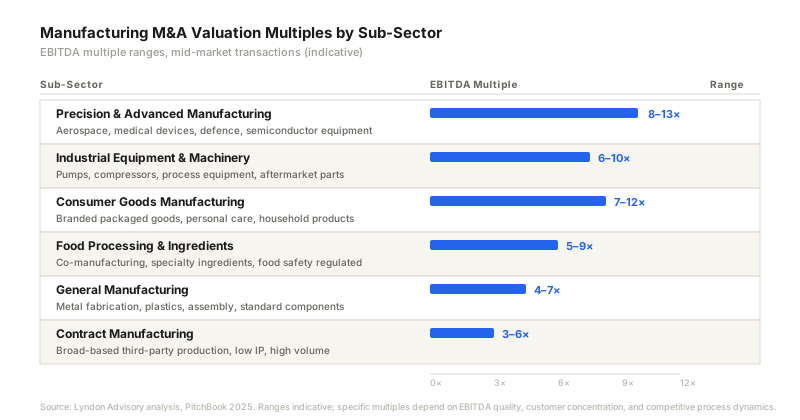
Manufacturing is not a monolithic category. Valuation dynamics vary substantially by sub-sector:
Precision and advanced manufacturing — aerospace components, medical devices, defence parts, semiconductor equipment. Long-term OEM and government contracts, ISO and IATF certifications, high switching costs. 8–13x EBITDA. Attracts strategic acquirers and PE platforms; US defence and APAC electronics supply chains are active.
Industrial equipment and machinery — pumps, compressors, conveying systems, process equipment. Recurring aftermarket parts and service revenue enhances multiple. 6–10x EBITDA. Japanese and Korean industrials are consistent acquirers of niche equipment makers.
Consumer goods manufacturing — branded packaged goods, personal care, household products. Multiple reflects brand equity and distribution network as much as production capability. 7–12x EBITDA for branded; lower for private label production.
Food processing and ingredients — co-manufacturing, contract processing, specialty ingredients. Regulatory (FDA, SFA, FSANZ) and food safety compliance are critical. 5–9x EBITDA.
Contract manufacturing — broad-based production for third parties, low IP retention. Multiple reflects volume, customer quality, and asset utilisation. 3–6x EBITDA. Buyer universe is narrower; PE roll-ups and strategic consolidators dominate.
General manufacturing — metal fabrication, plastics, assembly. Margin quality and capital intensity drive the range. 4–7x EBITDA.
According to PitchBook’s 2025 Global M&A Report, industrial manufacturing was the second most active sector for PE buyout activity globally in 2024, with roll-up platforms accounting for over 40% of deal count in sub-$100M transactions.
| Buyer question | What the seller should prove before market |
|---|---|
| Is the margin defensible? | Customer-level gross margin, pricing clauses, and evidence that input-cost inflation can be passed through |
| Is production transferable? | Documented processes, maintenance records, quality certifications, and a management team below the founder |
| Is capex under control? | Equipment register, recent capex history, forward maintenance plan, and quantified catch-up capex |
| Is there hidden liability? | Phase I environmental review, workplace safety records, permits, and hazardous material handling documentation |
| Is there strategic value? | Proprietary process, scarce certifications, export approvals, customer stickiness, or supply-chain resilience value |
The Buyer Universe
Understanding who buys manufacturing businesses — and why — is the foundation of a well-run advisory process. The buyer universe divides into four distinct categories, each with different valuation logic and process requirements.
Private equity roll-up platforms are among the most active buyers at sub-$150M enterprise values. PE firms identify fragmented manufacturing sub-sectors, acquire a platform acquisition, then add bolt-on acquisitions to build scale. Industrial roll-ups in HVAC, specialty chemicals, electrical components, and food processing are among the most active globally. PE buyers move quickly and pay competitive multiples for businesses that fit their thesis — but require clean financials, management continuity, and a clear path to EBITDA expansion.
Global industrial strategics — companies like Honeywell, ABB, Emerson, Danaher, and their APAC equivalents — acquire manufacturers for technology, customer relationships, geographic presence, or production capacity. Strategic buyers often pay premiums above financial buyer valuations because they can realise synergies unavailable to a standalone PE investor. The challenge is identification and approach: large corporates have formal M&A processes, and a cold approach is rarely effective without relationships or an advisor with established access.
Asian manufacturers acquiring technology and brands. Japanese conglomerates and trading houses, Korean chaebols, and Chinese manufacturers have been consistent acquirers of mid-market manufacturers in APAC, the US, and Europe. The driver is typically technology acquisition, brand access, or geographic diversification. Cross-border M&A by Asian strategics peaked in 2021–22 and has moderated, but remains active in precision manufacturing, food technology, and advanced materials.
Family offices and private investors acquire stable, cash-generative manufacturing businesses with low technology obsolescence risk. They are patient capital — less focused on rapid EBITDA expansion than PE — and often willing to retain the existing management team with incentive packages. Family offices are attractive buyers for sellers who want continuity post-sale.
“The most competitive manufacturing processes involve all four buyer types at once. When a PE roll-up, an Asian strategic, and a global industrial are all in the room, you get genuine price tension.” — Daniel Bae, Founder & CEO, Lyndon Advisory
Key Deal Considerations
Several factors consistently determine deal structure and pricing in manufacturing transactions.
Environmental site assessment. Phase I and Phase II environmental assessments are standard for manufacturing sites. Clean records accelerate timelines; legacy contamination triggers escrow reserves, price adjustments, or earnout structures to allocate remediation risk. Sellers should commission a Phase I before going to market — surprises during buyer due diligence are far more damaging than disclosed and priced risks.
Customer contract review. Buyers examine every material customer contract for change-of-control provisions, termination rights, and pricing mechanisms. Contracts that give customers the right to terminate or renegotiate pricing on a change of control create binary transaction risk. Advisors work to waive or modify these provisions pre-closing.
Capex and maintenance records. Buyers model forward capital expenditure requirements. Businesses with deferred maintenance or aging equipment face capex haircuts — buyers reduce their valuation by the estimated catch-up investment needed. Detailed maintenance records, recent equipment upgrades, and clear capex plans reduce the haircut.
Quality certifications. ISO 9001, IATF 16949 (automotive), AS9100 (aerospace), ISO 13485 (medical devices), and equivalent certifications signal process discipline and customer requirements. Certified businesses are demonstrably more transferable — buyers can confirm quality standards without relying solely on the founding operator’s knowledge.
Management depth. Manufacturing businesses with founder-dependent operations — where the owner knows every machine, every customer, and every process detail — face the highest transition risk. Buyers discount for key-person dependency. Sellers who build an operations team capable of running the business independently command higher multiples and face fewer post-closing earnout structures.
APAC and US Advisory Context
Manufacturing M&A dynamics differ materially between APAC and North America, and understanding both markets is essential for any seller trying to maximise their buyer universe.
In Asia Pacific, supply chain diversification has redefined the buyer landscape. US and European manufacturers are actively acquiring APAC production capacity — particularly in Vietnam, Indonesia, Malaysia, and Thailand — as an alternative to China dependency. Simultaneously, Japanese trading houses (Mitsui, Sumitomo, Marubeni, Itochu) remain among the most consistent acquirers of mid-market manufacturers across the region, particularly in food processing, industrial equipment, and specialty chemicals. Southeast Asian family conglomerates are consolidating domestic manufacturing in consumer goods and construction materials.
In the United States, PE-driven roll-up activity is the defining feature of sub-$100M manufacturing M&A. The US Department of Commerce’s advanced manufacturing initiatives and the CHIPS Act have increased strategic acquirer activity in semiconductor equipment, precision components, and electronics manufacturing. The US buyer universe for a well-positioned manufacturer is deep — often 150–300 qualified buyers — giving advisors meaningful room to run competitive processes.
Lyndon Advisory advises manufacturing business owners across Asia Pacific and the United States, running structured sell-side processes that engage both financial and strategic buyer universes simultaneously. Our 2.5% success fee capped at US$750,000 — with no retainer and no expense recharges — means our incentives are aligned with your outcome.
Choosing an M&A Advisor for a Manufacturing Business
Manufacturing M&A requires advisors with specific sector experience. A generalist who understands services businesses may undervalue proprietary manufacturing assets, miss environmental red flags during buyer due diligence, or fail to identify the specialist PE roll-up platforms that pay the highest multiples in fragmented industrial sub-sectors.
The right advisor brings: a documented buyer list with active industrial roll-up platforms and strategic acquirers; the ability to prepare a CIM that translates operational complexity into investable narrative; experience managing technical due diligence (plant inspections, equipment valuations, environmental assessments); and the relationships to navigate cross-border processes into Japan, Korea, the US, and Europe.
Evaluate advisors on their recent manufacturing transaction record — not their general M&A capabilities. The sector-specific buyer relationships and technical process experience are what separate a good outcome from a great one.
Choose the Right Manufacturing M&A Advisory Path
| Situation | What Lyndon should understand first | Best next step |
|---|---|---|
| You are evaluating whether to sell a manufacturing business | Revenue, EBITDA, sub-sector, customer concentration, plant footprint, certifications, and expected buyer universe | Submit a manufacturing valuation inquiry |
| A PE platform, OEM, supplier, customer, or overseas buyer has approached | Buyer motive, offer logic, information requested, exclusivity pressure, customer-disclosure risk, and alternative buyer universe | Review the buyer approach |
| You are 6-18 months away from a potential sale | Management depth, environmental records, maintenance history, customer contracts, capex plan, and data-room gaps | Check manufacturing exit readiness |
| You are comparing industrial M&A advisors | Retainer exposure, fee cap, sector buyer reach, cross-border process capability, tail period, and expected net proceeds | Compare advisory economics |
| You are an investor looking for manufacturing targets | Sub-sector thesis, target geography, EBITDA range, certification needs, and control preference | Register on MergerMatch |
Considering selling your manufacturing or industrial business? Lyndon Advisory runs structured sell-side processes for manufacturing business owners across Asia Pacific and the United States — with deep coverage of PE roll-up platforms, global industrial strategics, and cross-border buyers. Our fee is a 2.5% success fee capped at US$750,000, with no retainer and no upfront costs. Submit a confidential valuation inquiry to understand what your business is worth and who would buy it.
Related Guide
For the broader framework behind this topic, see Lyndon Advisory’s guide to selling a business.
About the Author

Daniel Bae
Co-founder & CEO, Lyndon Advisory
Daniel is an investment banker with 15+ years of experience in M&A, having advised on deals worth over US$30 billion. His career spans Citi, Moelis, Nomura, and ANZ across London, Hong Kong, and Sydney. He holds a combined Commerce/Law degree from the University of New South Wales. Daniel founded Lyndon Advisory to solve the pain points in M&A, enabling bankers to focus on what matters most — delivering trusted advice to clients.
About Lyndon Advisory
Lyndon Advisory is an M&A advisory firm built for Asia Pacific. We help business owners sell their companies and investors make strategic acquisitions with senior-led execution, disciplined process management, and structured buyer research. For owners, the first step is a confidential review of valuation range, likely buyer universe, and whether a structured sell-side process is justified.
Request a confidential seller reviewTopic cluster