Professional services businesses — consulting firms, IT managed service providers, engineering practices, law firms, marketing agencies — are among the most actively traded assets in mid-market M&A globally. Private equity has systematically consolidated these sectors over the past decade, and strategic acquirers continue to pursue capability and geography. But professional services transactions carry structural complexity that generic M&A advisors routinely underestimate.
This article covers the advisory landscape, buyer universe, and valuation benchmarks for professional services M&A — globally, with particular depth in Asia Pacific and North America where Lyndon Advisory is active.
What Makes Professional Services M&A Different
Professional services businesses derive their value from people, relationships, and reputation — not assets, inventory, or intellectual property in the traditional sense. This creates transaction dynamics that differ fundamentally from product or asset-heavy businesses.
Client portability risk is the defining challenge. Buyers ask a single question above all others: will the clients stay after the founder leaves? Where revenue is concentrated in relationships held personally by the founding partner or director, buyers demand structural protections — earnouts, deferred consideration, employment lockups — that reduce seller certainty and create post-closing friction. Firms that have deliberately institutionalised client relationships across a senior team command meaningfully higher multiples and cleaner deal structures.
Billing rate and utilisation concentration is the professional services equivalent of customer concentration. A firm where 60% of fee income derives from one client, or where the founding partner personally bills the majority of chargeable hours, faces the same structural discount.
Partner and key staff equity structures complicate deal mechanics. Where equity is held across multiple partners or there are partnership agreements governing profit distribution, the transaction requires alignment across multiple stakeholders — each with their own economic interests and views on post-sale employment. Simplifying the cap table and obtaining lock-up commitments from key professionals before going to market materially accelerates process.
Non-compete enforceability varies significantly by jurisdiction. In Australia, the US, and Singapore, courts enforce reasonable non-compete agreements in the context of a business sale. In some Southeast Asian jurisdictions, enforceability is less certain. Buyers will require non-solicit and non-compete protections from founders and key staff — sellers should obtain independent legal advice on the scope and enforceability of these provisions before negotiating.
Sub-Sectors and Their Buyer Universes
Professional services M&A is not monolithic. Each sub-sector has a distinct buyer universe and valuation logic.
IT Managed Service Providers (MSPs) are among the most actively acquired professional services assets globally. PE roll-up platforms — including platforms backed by Thoma Bravo, Francisco Partners, and a range of mid-market sponsors — are systematically consolidating regional MSPs into scaled IT services groups. Strategic acquirers include global IT services companies and telecoms groups seeking enterprise capabilities. MSPs with recurring managed services contracts, strong net revenue retention, and multi-year client agreements attract premium multiples.
Management and Strategy Consulting sees selective acquisition by global consulting groups (McKinsey, BCG, Accenture, Deloitte) pursuing capability or sector expertise, and by PE-backed consulting roll-ups targeting mid-market advisory firms. The buyer universe narrows significantly for generalist firms without a defensible specialisation. Boutique strategy firms with a defined sector niche — healthcare strategy, financial services risk, supply chain — attract the strongest buyer interest.
Engineering and Technical Consulting is one of the most PE-active categories in professional services. Infrastructure consulting, environmental engineering, and geotechnical practices are being consolidated into scaled platforms across Australia, the US, and the UK. Government-adjacent revenue (defence, utilities, transport infrastructure) commands a significant premium due to its predictability and contracted nature. Cross-border interest from Asian infrastructure groups acquiring Western technical capability has also increased.
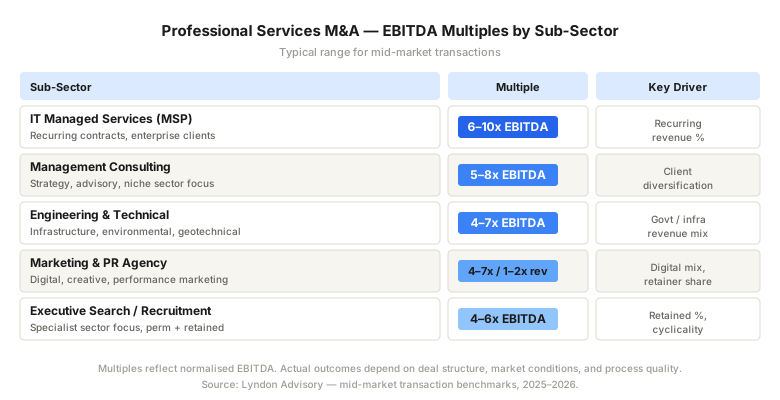
Marketing and PR Agencies attract strategic acquirers (global agency networks — WPP, Publicis, IPG, Dentsu) and PE platforms. The buyer universe for agencies is narrower than in other sub-sectors: buyers are highly selective on sector specialisation, digital capability mix, and creative talent retention. Revenue multiples (1.0–2.0x) are used alongside EBITDA multiples for high-growth digital agencies where margins are temporarily compressed by growth investment.
Law Firm Combinations are structurally different from other professional services deals. Most are mergers of equals or acquisitions by listed legal groups (Slater & Gordon, National Accident Helpline) rather than traditional buyouts. Economics are referenced to partner profit rather than EBITDA, and regulatory approval requirements vary by jurisdiction. Law firm M&A is a specialist advisory discipline and requires advisors with specific transactional experience in the legal sector.
Valuation Benchmarks
Professional services valuations reference EBITDA multiples adjusted for revenue quality, client concentration, and management depth. Quality of earnings analysis is particularly important in professional services, where EBITDA is often distorted by above-market owner compensation, related-party expenses, or discretionary investment in growth headcount.
| Sub-Sector | Typical EBITDA Multiple | Notes |
|---|---|---|
| IT MSP (recurring contracts) | 6–10x | Premium for >80% recurring revenue |
| Management consulting | 5–8x | Discount for founder concentration |
| Engineering/technical consulting | 4–7x | Premium for government/infrastructure revenue |
| Marketing/PR agency | 4–7x EBITDA / 1–2x revenue | Revenue multiple used for high-growth digital agencies |
| Executive search/recruitment | 4–6x | Discount for cyclicality and contractor concentration |
| Law firms | 3–5x partner profit | Specialist valuation methodology |
Precedent transactions in professional services tend to be private and lightly disclosed, which makes comparable analysis difficult without access to proprietary deal databases. Experienced M&A advisors bring benchmarks from closed transactions that are not publicly available.
Enterprise value calculations in professional services typically treat normalised EBITDA as the base — adjusting for owner compensation above market replacement cost, non-recurring revenues, and costs that will not transfer with the business. The working capital peg requires careful negotiation, as professional services businesses often carry significant work-in-progress and client debtors that must be measured consistently at close.
Key Deal Considerations
Earnout structures are standard in professional services transactions. A typical structure defers 20–40% of the purchase price contingent on revenue or EBITDA over 2–3 years post-closing. Sellers should push for revenue-based (rather than EBITDA-based) earnout metrics, which are less susceptible to post-acquisition cost allocation by the buyer. Any earnout should explicitly exclude costs introduced by the buyer after closing, and should have a clear dispute resolution mechanism.
Management continuity commitments are a buyer requirement. Key professionals — including but not limited to the founding partner — will be expected to commit to a defined post-closing period (typically 2–3 years) under an employment or consulting agreement. Sellers should negotiate these terms as part of the overall deal package, not as an afterthought to the SPA.
Non-solicitation agreements covering both clients and employees are standard. The scope and duration of these provisions (typically 2–3 years for clients, 12–18 months for employees) should be negotiated carefully, with independent legal advice on enforceability in the relevant jurisdiction.
Due diligence focus areas in professional services differ from product businesses: buyers will examine client concentration and retention data (3–5 years of client revenue history), fee agreement terms and notice periods, staff utilisation and billing rate trends, work-in-progress quality and collectability, professional indemnity claims history, and regulatory compliance (particularly for financial services advisors and law firms subject to professional licensing).
Change of control provisions in client contracts and key staff employment agreements require careful review before going to market. Some client contracts include assignment restrictions or termination rights on change of ownership — identifying and addressing these early prevents deal disruption in due diligence.
Preparing for Sale: What Moves the Multiple
The single highest-ROI action before a professional services sale is reducing founder concentration in client relationships. This takes 12–24 months to do properly and should start well before any sale process. Specific actions: introduce clients formally to two or more senior team members, migrate client contacts and service delivery to the firm’s systems rather than personal email or mobile, and build documented relationship maps that a buyer can review.
Beyond client relationships, the variables that most reliably improve multiples are:
- Revenue quality: the higher the proportion of recurring retainer revenue (versus project-based), the higher the multiple. PE buyers in particular price recurring revenue at a significant premium.
- Management depth: a capable CFO or COO who can operate the business independently of the founder signals to buyers that the business will survive the transition.
- Profitability clarity: a clean set of management accounts showing normalised EBITDA — with owner compensation benchmarked to market, non-recurring items removed, and working capital clearly tracked — reduces buyer uncertainty and negotiation friction.
- Pipeline documentation: a visible, quantified pipeline of prospective engagements gives buyers confidence in post-acquisition revenue continuity.
At Lyndon Advisory, our professional services mandates typically begin 12–18 months before any formal process — helping owners prepare the business for sale in ways that directly translate into better multiples and cleaner deal structures.
APAC and US Buyer Dynamics
Professional services M&A is genuinely global. The most active PE roll-up platforms for IT MSPs, engineering consultancies, and accounting firms operate across the US, Australia, the UK, and increasingly Southeast Asia. A well-positioned professional services firm in Singapore or Australia will attract buyer interest from platforms headquartered in New York or London alongside domestic APAC acquirers.
In Asia Pacific specifically, the professional services M&A market has several distinctive features. Australian engineering and infrastructure consulting firms are highly sought after by both domestic PE roll-ups and Asian infrastructure groups seeking Western technical standards and government relationships. Singapore-based management consulting and financial advisory firms attract interest from regional banking groups and global consulting networks seeking ASEAN coverage. Japanese professional services acquisitions are relationship-driven and typically require a longer pre-deal engagement period.
In the US, PE consolidation of professional services is further advanced than in APAC. IT MSP roll-ups, accounting firm aggregators, and engineering consulting platforms are well-established buyer categories — and increasingly looking for APAC platform acquisitions as their portfolios internationalise.
Lyndon Advisory provides advisory coverage across Asia Pacific and the United States, with direct access to PE roll-up platforms, strategic acquirers, and family office buyers across both regions.
Choose the Right Professional Services M&A Advisory Path
| Situation | What Lyndon should understand first | Best next step |
|---|---|---|
| You are evaluating whether to sell a consulting, agency, MSP, engineering, law, or professional services firm | Revenue, EBITDA, sub-sector, client concentration, recurring revenue, partner structure, management depth, and buyer universe | Submit a professional services valuation inquiry |
| A PE platform, strategic acquirer, network, competitor, or management team has approached | Buyer motive, offer logic, client disclosure risk, earnout proposal, exclusivity pressure, and alternative buyer universe | Review the buyer approach |
| You are 6-18 months away from a possible sale | Client relationship transfer, partner alignment, recurring revenue quality, WIP/debtor records, staff retention, and data-room gaps | Check professional services exit readiness |
| You are comparing professional services M&A advisors | Retainer exposure, fee cap, sector buyer reach, earnout negotiation experience, tail period, and expected net proceeds | Compare advisory economics |
| You are an investor looking for professional services targets | Sub-sector thesis, target geography, EBITDA range, recurring-revenue preference, partner-retention needs, and control preference | Register on MergerMatch |
Thinking about selling your consulting firm, agency, or professional services practice? Lyndon Advisory advises professional services owners on structured exits — valuation, buyer identification, and a managed sale process. Success fee only: 2.5% success fee capped at US$750,000, no retainer. Submit a confidential valuation inquiry to understand what your business is worth and who would buy it.
Related Guide
For the broader framework behind this topic, see Lyndon Advisory’s professional services M&A guide.
About the Author

Daniel Bae
Co-founder & CEO, Lyndon Advisory
Daniel is an investment banker with 15+ years of experience in M&A, having advised on deals worth over US$30 billion. His career spans Citi, Moelis, Nomura, and ANZ across London, Hong Kong, and Sydney. He holds a combined Commerce/Law degree from the University of New South Wales. Daniel founded Lyndon Advisory to solve the pain points in M&A, enabling bankers to focus on what matters most — delivering trusted advice to clients.
About Lyndon Advisory
Lyndon Advisory is an M&A advisory firm built for Asia Pacific. We help business owners sell their companies and investors make strategic acquisitions with senior-led execution, disciplined process management, and structured buyer research. For owners, the first step is a confidential review of valuation range, likely buyer universe, and whether a structured sell-side process is justified.
Request a confidential seller reviewTopic cluster