Technology M&A has its own language. EBITDA multiples — the standard measure in most sectors — often don’t apply. Buyers price SaaS businesses on ARR multiples, IT services on EBITDA, and cybersecurity platforms on a blend of growth rate and strategic fit. Understanding which metric governs your valuation, and how to optimise for it, is the first job of a technology M&A advisor.
This guide covers how technology company M&A works, who buys tech businesses, what drives valuation across sub-sectors, and what founders need to know before entering a sale process.
What Makes Technology M&A Different
Technology M&A differs from general business sales in three fundamental ways.
Valuation metrics diverge from standard M&A. In traditional M&A, buyers pay a multiple of enterprise value to EBITDA. In technology, the primary metric depends on the sub-sector:
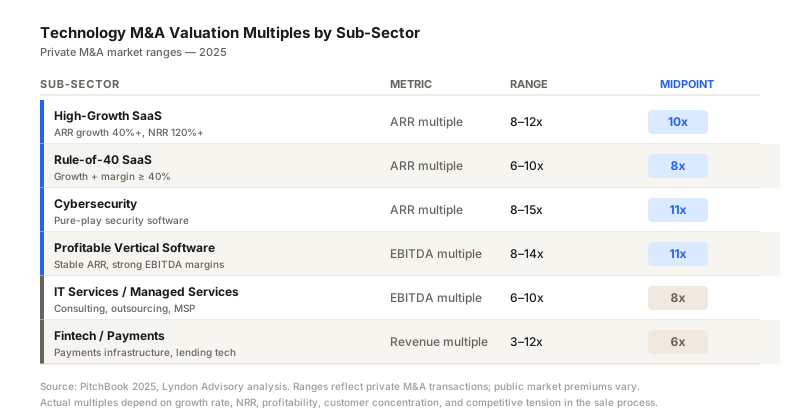
- SaaS and software: ARR multiples (annual recurring revenue), not EBITDA. A SaaS business at breakeven with strong growth may trade at 6–10x ARR while a mature, profitable traditional software business trades at 8–14x EBITDA.
- IT services and outsourcing: EBITDA multiples (6–10x), reflecting the labour-intensive, lower-margin nature of services businesses.
- Cybersecurity: ARR or revenue multiples (8–15x), reflecting strategic scarcity and structural demand growth.
- Fintech: Varies widely — payments and lending platforms often trade on revenue multiples (3–8x), while embedded finance infrastructure commands higher multiples.
Due diligence goes deep on product and engineering. Buyers commission technical due diligence alongside financial due diligence — reviewing code quality, architecture scalability, security posture, and IP ownership. A clean technical DD is a meaningful value lever; undisclosed technical debt or IP disputes are common deal-killers.
Talent retention is a closing condition. In most M&A transactions, management retention is desirable but not contractually critical. In technology deals, key engineers and product leaders are often subject to retention packages and lock-up arrangements as a condition of closing — particularly in acqui-hire situations and R&D-driven acquisitions.
According to PitchBook’s 2025 Global Technology M&A Report, global technology M&A deal volume exceeded 12,000 transactions in 2024, with software and SaaS accounting for nearly 40% of all deals by count. The technology sector consistently attracts the broadest buyer universe of any vertical — strategic acquirers from adjacent sectors, global PE platforms, and sovereign wealth funds all compete for quality assets.
Who Buys Technology Companies
The technology buyer universe is the most diverse of any sector. Understanding who is likely to buy your business — and what they value — shapes how you prepare for a sale and who your advisor approaches.
Strategic acquirers remain the largest buyers by deal value. They include:
- Global technology platforms (Microsoft, Salesforce, SAP, Oracle) acquiring product capabilities or customer bases
- Large IT services firms (Accenture, Infosys, Cognizant) buying specialist practices or regional footprints
- Financial institutions acquiring fintech capabilities in payments, lending, or wealth management
- Industrial and healthcare companies acquiring digital and software capabilities adjacent to their core
Private equity has become the dominant buyer by deal count. Software-focused PE platforms — including Vista Equity Partners, Thoma Bravo (US), and their APAC counterparts — execute buy-and-build strategies, acquiring profitable vertical software businesses and consolidating fragmented markets. PE buyers prioritise ARR quality, customer retention, and margin expansion potential over growth rate alone.
Strategic buyer vs financial buyer dynamics matter for price. Strategic acquirers pay synergy premiums — they can justify higher prices because of revenue or cost benefits unavailable to PE. Financial buyers price on standalone fundamentals and their ability to drive operational improvement. Running a process that attracts both buyer types maximises competitive tension and final valuation.
Cross-border dynamics are substantial. US and European technology acquirers actively pursue APAC targets for market access, talent, and cost arbitrage. Japanese technology companies and trading houses are consistent acquirers of Australian and Southeast Asian software businesses. Korean conglomerates have become active in cybersecurity and enterprise software M&A regionally.
“The global buyer universe for quality software businesses has never been deeper,” says Daniel Bae, founder of Lyndon Advisory and former M&A advisor with over US$30 billion in transaction experience. “We regularly see US strategic acquirers competing alongside APAC PE platforms for the same Australian or Singapore SaaS asset — that competition is what drives premium outcomes.”
Valuation Multiples by Technology Sub-Sector
Technology valuations are more variable than any other sector. The same business described as “a software company” can trade at 4x or 14x depending on business model, growth profile, and competitive tension in the sale process.
SaaS and recurring revenue software — the most acquisitive category:
| Profile | ARR Multiple Range |
|---|---|
| High-growth (40%+ ARR growth, NRR 120%+) | 8–12x ARR |
| Rule of 40+ (growth + margin ≥ 40%) | 6–10x ARR |
| Stable, profitable (sub-20% growth, strong margins) | 4–8x ARR |
| Declining growth or high churn | 3–5x ARR |
Net revenue retention (NRR) is the single most predictive metric for SaaS multiples. Businesses with NRR above 120% — meaning existing customers expand faster than they churn — command significant premiums. Buyers view high NRR as evidence that the product delivers genuine customer value, not just sticky switching costs.
IT services and managed services trade on EBITDA:
- Offshore delivery IT services: 6–8x EBITDA
- Onshore specialist consulting: 7–10x EBITDA
- Managed service providers (MSPs): 7–9x EBITDA, higher for platforms with significant recurring MRR
Cybersecurity commands the highest multiples:
- Pure-play cybersecurity software: 10–15x ARR
- Security operations and managed SOC services: 8–12x EBITDA
- Identity and access management (IAM): 10–14x ARR
Fintech varies by sub-sector:
- Payments infrastructure: 6–12x revenue
- Lending technology: 3–6x revenue (regulatory risk discount)
- Wealth management / robo-advisory: 4–8x revenue
- Embedded finance / BaaS platforms: 8–15x ARR
These are market ranges, not guarantees. The final multiple in any deal reflects the quality of the sale process, the competitive tension among bidders, and the specifics of the business. An auction process with three credible bidders regularly produces outcomes 20–40% above bilateral negotiation.
Key Deal Considerations for Technology Founders
IP ownership is non-negotiable. Every line of code the business uses must be cleanly owned or properly licensed. Open-source dependencies with viral licensing (GPL), freelancer-written code without IP assignment agreements, and offshore development without proper work-for-hire documentation are all diligence red flags that can delay or derail deals. Clean IP is table-stakes.
Customer contracts need to survive a change of control. Many enterprise SaaS agreements include change-of-control provisions that give customers the right to terminate or renegotiate on an acquisition. A review of customer contracts — particularly the top 10 by ARR — is a standard early diligence step. Contracts that allow assignment without consent are materially more valuable.
Earnout structures are common but negotiable. In technology deals, earnouts tied to ARR milestones, product roadmap delivery, or revenue retention are frequently proposed — particularly where the business is pre-profitability or where valuation expectations differ. Earnouts are negotiable in their structure, duration, and the metrics that trigger payment. Founders should understand what they’re agreeing to before signing an LOI.
Quality of earnings in SaaS is not GAAP revenue. Buyers normalise technology company financials for deferred revenue recognition, capitalised development costs, related-party transactions, and non-cash compensation. The CIM and financial model need to present ARR, MRR, churn, and NRR accurately and consistently — buyers will build their own model from raw data and compare it to your presented numbers.
Talent retention packages need to be structured carefully. Key-person retention bonuses are typically funded by the buyer at closing, but the structure — cash vs equity, vesting schedules, good-leaver vs bad-leaver definitions — needs to be negotiated and agreed before signing the definitive agreement.
Preparing a Technology Business for Sale
The preparation phase — typically 3–6 months before going to market — is where most deal value is won or lost.
Clean up the cap table. Investors, option holders, and former founders with residual equity need to be identified and their rights documented. A messy cap table adds weeks to diligence and legal negotiations.
Document the technology stack. Buyers want a clear architecture diagram, a list of third-party software dependencies, an explanation of the hosting and infrastructure setup, and evidence that security controls are in place (SOC 2, ISO 27001, or equivalent).
Organise customer data. Build a clean customer database showing ARR, contract start/end dates, renewal history, and expansion revenue. Segmented by cohort, this data tells the retention story more powerfully than any headline metric.
Resolve technical debt proactively. Any known technical debt — legacy code, deprecated dependencies, security vulnerabilities, undocumented APIs — should be inventoried and, where material, remediated before going to market. Buyers will find it in technical due diligence. Better to disclose proactively with a remediation plan than to have it surface as a surprise.
Lyndon Advisory works with technology founders across Asia Pacific and the United States to prepare businesses for market and run structured sale processes. Our sector team understands SaaS metrics, technical due diligence, and the cross-border buyer universe — positioning technology businesses for the premium multiples that competitive processes deliver.
The Technology M&A Sale Process
A well-run technology company sale follows a structured process regardless of deal size.
Preparation (months 1–2): Financial model, ARR waterfall, customer cohort analysis, CIM, and teaser preparation. Technical documentation review. IP audit.
Buyer outreach (months 2–4): Targeted approach to strategic and financial buyers. NDA execution. Management presentations. Data room setup.
Indicative offers (month 4–5): IOI collection and analysis. Shortlist selection. Management presentations with shortlisted buyers.
Binding bids and exclusivity (months 5–7): Final bids. LOI negotiation. Exclusivity period granted to preferred buyer.
Due diligence and closing (months 7–10): Financial, legal, and technical DD. SPA negotiation. Regulatory approvals where required. Closing.
The process timeline compresses significantly with an experienced advisor — buyers who have done diligence on similar businesses move faster, and advisors who have run comparable processes know where to push and where to hold.
Choose the Right Technology M&A Advisory Path
| Situation | What Lyndon should understand first | Best next step |
|---|---|---|
| You are evaluating whether to sell a software, SaaS, IT services, cybersecurity, or fintech business | ARR, revenue, EBITDA, NRR, churn, gross margin, customer concentration, IP ownership, and buyer universe | Submit a technology valuation inquiry |
| A strategic acquirer, PE fund, platform, or competitor has approached | Buyer motive, offer logic, ARR multiple or EBITDA multiple, information requested, exclusivity pressure, and alternative buyer universe | Review the buyer approach |
| You are 6-18 months away from a possible sale | ARR quality, cohort data, IP assignment, security posture, management depth, and data-room gaps | Check technology exit readiness |
| You are comparing technology M&A advisors | Retainer exposure, fee cap, SaaS metric fluency, technical diligence experience, cross-border buyer reach, and tail period | Compare advisory economics |
| You are an investor looking for technology targets | Sector thesis, target geography, ARR or EBITDA range, control preference, and platform or bolt-on logic | Register on MergerMatch |
Considering a sale of your technology business? Lyndon Advisory advises technology founders across Asia Pacific and the United States — SaaS, IT services, cybersecurity, and fintech. Our 2.5% success fee capped at US$750,000 means you pay nothing unless the deal completes. Submit a confidential valuation inquiry to understand what your business is worth and who would buy it.
Related Guide
For the broader framework behind this topic, see Lyndon Advisory’s guide to selling a business.
About the Author

Daniel Bae
Co-founder & CEO, Lyndon Advisory
Daniel is an investment banker with 15+ years of experience in M&A, having advised on deals worth over US$30 billion. His career spans Citi, Moelis, Nomura, and ANZ across London, Hong Kong, and Sydney. He holds a combined Commerce/Law degree from the University of New South Wales. Daniel founded Lyndon Advisory to solve the pain points in M&A, enabling bankers to focus on what matters most — delivering trusted advice to clients.
About Lyndon Advisory
Lyndon Advisory is an M&A advisory firm built for Asia Pacific. We help business owners sell their companies and investors make strategic acquisitions with senior-led execution, disciplined process management, and structured buyer research. For owners, the first step is a confidential review of valuation range, likely buyer universe, and whether a structured sell-side process is justified.
Request a confidential seller reviewTopic cluster