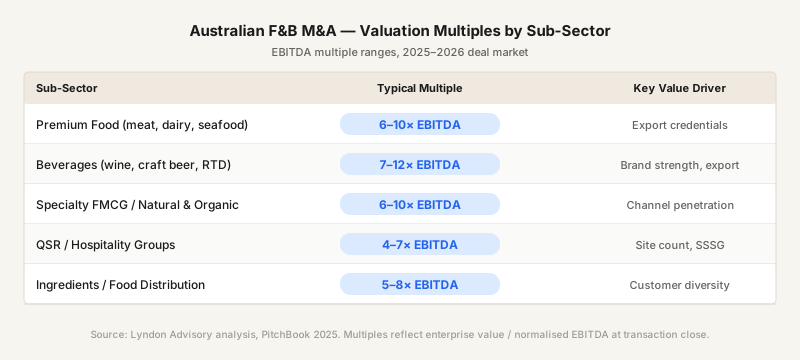
Australian food and beverage businesses sell for 5–12x EBITDA in structured processes — sub-sector, export credentials, and brand equity determine where in that range you land. Branded beverages achieve 7–12x; premium food producers with Asian export revenue reach 6–10x; QSR and hospitality groups trade at 4–7x. Japanese trading houses, Korean strategics, ASX-listed consolidators, global FMCG groups, and private equity are all active buyers, and a well-run process reaches all four simultaneously.
Lyndon Advisory runs sell-side processes for Australian F&B business owners. This guide covers what you need to know about who buys, what they pay, and how a sale process works.
PwC Australia’s 2026 retail, consumer and experiences M&A outlook describes a market moving with conviction around portfolio reviews, succession, and private equity backlogs. The Australian Government’s 2026 FIRB monetary threshold guidance also confirms that agricultural land thresholds are not indexed annually, including the more than A$15 million cumulative agricultural land threshold. For F&B sellers with agricultural, processing, or export-linked assets, buyer selection and approval planning need to be addressed before exclusivity.
Why Australian F&B Assets Command Premium Multiples
The global premium for Australian-origin food and beverage products is well established. Asian consumers — particularly in Japan, South Korea, and China — associate Australian provenance with food safety, quality, and trust. This premium translates directly into M&A valuation multiples.
According to Bain & Company’s Asia-Pacific Private Equity Report 2025, consumer and F&B deal activity in APAC remained resilient through 2024–2025, with Australian assets attracting disproportionate international buyer interest relative to market size.
Several structural factors drive this: Australia’s clean biosecurity record, its established export infrastructure into Asian markets, and the growing appetite of Japanese and Korean trading houses for upstream supply security. For branded FMCG businesses, the ability to demonstrate a growth story in Asia — not just domestic revenue — materially expands the buyer universe and compresses required returns.
Sub-Sectors and Valuation Benchmarks
Australian F&B encompasses a wide range of sub-sectors with meaningfully different valuation profiles.
Premium food (meat, dairy, seafood, horticulture) — 6–10× EBITDA. Export-credentialled beef, lamb, dairy, and seafood businesses with direct Asian distribution relationships attract the strongest buyer interest from Japanese trading houses and Korean conglomerates. FIRB approval timelines are a standard feature of these transactions.
Beverages (wine, craft beer, RTD, non-alcoholic) — 7–12× EBITDA. Branded beverage businesses with established trade channels trade at some of the highest multiples in the F&B space. Premium wine and spirits assets with export track records attract both strategic and financial buyers. The RTD and functional beverage categories have seen elevated deal activity driven by changing consumer preferences.
Specialty FMCG and natural/organic — 6–10× EBITDA. Health food, natural snacking, and organic FMCG brands with supermarket ranging and demonstrated consumer loyalty sit in the premium band. Buyers value distribution breadth, private label penetration, and repeat purchase rate data.
QSR and hospitality groups — 4–7× EBITDA. Multi-site QSR operators and hospitality groups are valued on EBITDA with adjustments for lease liabilities, same-store sales growth, and corporate versus franchised revenue mix. Buyers include ASX-listed food service groups and PE-backed platform operators.
Ingredients and food distribution — 5–8× EBITDA. B2B-facing businesses supplying ingredients, packaging, or logistics to food manufacturers are valued on contract quality, customer diversification, and gross margin consistency. These businesses attract PE consolidators and strategic acquirers building supply chain capabilities.
| Value driver | Why buyers care |
|---|---|
| Asian export revenue | Proves the brand or supply chain already travels beyond Australia |
| Clean provenance and certification | Supports premium positioning with Japanese, Korean, Chinese, and domestic buyers |
| Customer diversification | Reduces the risk that a supermarket, distributor, or major food-service account controls the deal |
| Gross margin resilience | Shows pricing power through ingredient, labour, freight, and packaging cost cycles |
| Management continuity | Lets a foreign or financial buyer underwrite growth without relying on the founder alone |
The Buyer Universe for Australian F&B
A well-run sale process for an Australian F&B business should reach four distinct buyer classes simultaneously.
Japanese and Korean strategics are the most active cross-border acquirers of Australian food assets. Marubeni, Itochu, Mitsubishi, and their Korean equivalents (CJ, Lotte, Ottogi) pursue Australian F&B assets for supply security, export platform value, and branded consumer products. These buyers move methodically, require management presentations, and conduct thorough due diligence — but often pay strategic premiums that domestic buyers cannot match.
ASX-listed food groups are active consolidators of bolt-on acquisitions that add scale, category breadth, or geographic distribution. Listed buyers can move quickly and offer deal certainty, but are more price-disciplined than strategic acquirers paying for cross-border synergies.
Private equity — including Pacific Equity Partners, Adamantem Capital, Anacacia Capital, and sector-focused funds — back roll-up platforms in fragmented F&B segments and make direct buyouts of established businesses. Private equity buyers focus on EBITDA quality, management continuity, and a credible growth story.
Global FMCG multinationals pursuing Asia Pacific expansion use Australian acquisitions as platform plays — acquiring an established Australian brand to access APAC distribution networks. These transactions command the highest multiples when the business has demonstrated Asian market traction.
“The premium for Australian F&B provenance is real and durable. The businesses that achieve the top of the multiple range have already built the Asian growth story.” — Daniel Bae, Founder & CEO, Lyndon Advisory
At Lyndon Advisory, we run structured sell-side processes that simultaneously approach all four buyer classes — domestic, regional, and international — to create the competitive tension that drives price.
Key Deal Considerations for Australian F&B Transactions
Several factors are specific to Australian F&B M&A and must be addressed in preparation and execution.
EBITDA normalisation — quality of earnings analysis is essential in owner-operated F&B businesses. Owner compensation above or below market, related-party transactions, seasonal revenue adjustments, and one-off costs must be clearly documented. Buyers conduct their own QoE; sellers who present a clean normalised EBITDA position from the outset reduce re-trading risk significantly.
Foreign Investment Review Board (FIRB) — acquisitions of agricultural and food production businesses by foreign buyers trigger FIRB review requirements at lower thresholds than general commercial businesses. FIRB approval adds 30–90 days to the completion timeline and must be factored into exclusivity periods and closing conditions. Experienced advisors manage the FIRB process as a standard component of cross-border transactions.
Export credentials and certification — Australian provenance value is amplified by organic certification, non-GMO status, biosecurity clearances, and export registration for specific markets (particularly Japan and Korea, which have detailed requirements). Buyers pay premiums for businesses with existing certifications in place; gaps in certification are valuation discounts.
Seasonal revenue normalisation — many Australian F&B businesses have seasonal revenue profiles. Harvest cycles, seasonal hospitality trading, and promotional calendar effects should be clearly explained and normalised in the financial model presented to buyers. A trailing twelve-month EBITDA that reflects seasonal patterns is more credible than a point-in-time figure.
Working capital — the working capital peg for F&B businesses must account for inventory valuation methodology, seasonal stock building, and any perishable inventory write-down risk. Advisors should establish the working capital target methodology early in the process to avoid disputes at completion.
The Sale Process: How Australian F&B Deals Are Structured
A competitive auction process is the standard approach for Australian F&B businesses above approximately A$8–10 million in enterprise value. The process unfolds in four phases.
Preparation (4–6 weeks): valuation analysis, preparation of the CIM, management presentation, and FIRB assessment for likely buyer mix. A teaser document is prepared for initial buyer screening.
Marketing (6–8 weeks): confidential outreach to a curated buyer list under NDA. Interested buyers receive the CIM and are invited to management meetings. The process runs simultaneously across domestic, regional, and international buyer groups.
Bid phase (4–6 weeks): buyers submit indicative offers, a shortlist proceeds to detailed due diligence, and final binding bids are submitted. The earnout structure is common in Australian F&B transactions — particularly where the business has a strong relationship with a founder-owner whose continuity is valued by buyers.
Completion (6–12 weeks): exclusivity is granted to the preferred buyer, a definitive agreement is negotiated, FIRB approval obtained where required, and the transaction completes.
Considering a sale of your Australian food or beverage business? Lyndon Advisory runs structured sell-side processes for Australian F&B owners, approaching the full buyer universe — domestic consolidators, Japanese and Korean strategics, global FMCG groups, and private equity — simultaneously. Our fee is 2.5% of enterprise value, capped at US$750,000. No retainer. No monthly charges. You pay nothing unless a deal completes. Submit a confidential valuation inquiry to understand what your business is worth and who would buy it.
Related Guide
For the broader framework behind this topic, see Lyndon Advisory’s APAC M&A guide.
About the Author

Daniel Bae
Co-founder & CEO, Lyndon Advisory
Daniel is an investment banker with 15+ years of experience in M&A, having advised on deals worth over US$30 billion. His career spans Citi, Moelis, Nomura, and ANZ across London, Hong Kong, and Sydney. He holds a combined Commerce/Law degree from the University of New South Wales. Daniel founded Lyndon Advisory to solve the pain points in M&A, enabling bankers to focus on what matters most — delivering trusted advice to clients.
About Lyndon Advisory
Lyndon Advisory is an M&A advisory firm built for Asia Pacific. We help business owners sell their companies and investors make strategic acquisitions with senior-led execution, disciplined process management, and structured buyer research. For owners, the first step is a confidential review of valuation range, likely buyer universe, and whether a structured sell-side process is justified.
Request a confidential seller reviewTopic cluster