Singapore is the natural gateway for consumer and retail M&A across Southeast Asia. Its holding company structures, MAS-regulated financial infrastructure, and institutional buyer access make it the jurisdiction of choice for regional brand sales — whether the business operates primarily in Singapore or uses a Singapore holdco to consolidate ASEAN operations.
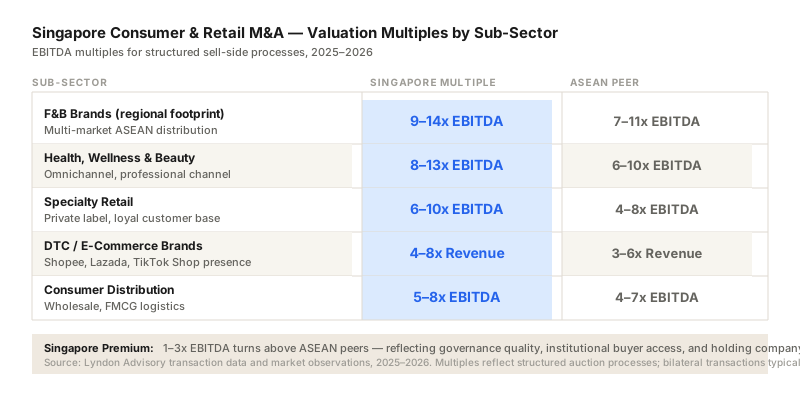
Consumer and retail businesses headquartered or held in Singapore consistently command valuation premiums of 1–3x EBITDA turns over comparable assets in other ASEAN markets. Buyers trust the regulatory environment, the legal documentation, and the governance standards. That trust is worth real money at closing.
Why Singapore Is the ASEAN Consumer M&A Gateway
Singapore’s structural advantages for consumer M&A are not incidental — they are the product of deliberate regulatory design.
Holding company clarity. Many consumer and F&B groups operating across Indonesia, Vietnam, Thailand, and Malaysia are legally held through Singapore entities. This structure simplifies deal execution: a buyer acquires the Singapore holdco and inherits the regional operating subsidiaries without navigating multiple simultaneous foreign investment approvals.
Institutional buyer access. Singapore hosts the regional offices of virtually every major global consumer conglomerate, pan-Asian private equity fund, and family office active in ASEAN. Buyers are on the ground, familiar with the jurisdiction, and staffed to execute quickly. Deal timelines in Singapore are materially shorter than equivalent transactions in Indonesia or Vietnam.
MAS regulatory trust. The Monetary Authority of Singapore’s oversight of financial transactions, combined with robust anti-money laundering frameworks, satisfies the compliance requirements of North American, European, and Japanese institutional buyers. Clean source-of-funds and ownership history documentation is standard — not exceptional — in Singapore deals.
SGX comparables. Singapore Exchange-listed consumer and retail companies provide a live comparable company set that supports valuation conversations. Buyers familiar with Sheng Siong, Dairy Farm International, and BreadTalk’s historical trading multiples have a ready reference point for private company valuations.
Active Deal Sectors in Singapore Consumer M&A
Consumer M&A in Singapore spans a range of sub-sectors, each with distinct buyer dynamics.
Food and beverage brands with regional footprint. Singapore F&B brands that have expanded into ASEAN markets — particularly Indonesia and Malaysia — attract the strongest buyer interest. Japanese trading houses, global food multinationals, and PE-backed consolidation platforms are consistent acquirers. According to Nikkei Asia, Japanese conglomerates including Kirin, Asahi, and Suntory have been among the most active cross-border acquirers of ASEAN F&B assets over the past five years.
Health, wellness, and beauty. Singapore-based health and beauty brands with omnichannel presence — combining physical retail with direct-to-consumer e-commerce — attract both strategic acquirers (L’Oréal, Shiseido, Unilever) and PE funds building regional beauty platforms. Consumer health brands with evidence-based positioning and professional channel sales command the highest multiples in this sub-sector.
Specialty retail with defensible formats. Specialty retail concepts with proprietary private label product ranges and loyal repeat customer bases attract strategic acquirers seeking to expand their ASEAN retail footprint. Asset-light formats — franchise models or mall-based specialty formats without freehold property — trade at higher multiples than traditional large-format retail.
Direct-to-consumer brands with ASEAN e-commerce presence. Digitally-native consumer brands generating meaningful revenue across Shopee, Lazada, TikTok Shop, and their own channels attract a distinct buyer class: global e-commerce platforms, US and European brands seeking ASEAN market entry, and growth equity investors. Valuation for these businesses typically references revenue multiples (3–8x ARR) rather than EBITDA, reflecting growth-stage economics.
Buyer Universe for Singapore Consumer Businesses
The buyer universe for Singapore consumer and retail businesses is international and broad.
Global CPG multinationals use Singapore as the preferred platform for ASEAN brand acquisition. A Singapore-held consumer brand with regional distribution becomes an immediately deployable regional platform — not just a standalone market entry. Unilever, Nestlé, Procter & Gamble, L’Oréal, and Reckitt all run active M&A programs from their Singapore regional offices.
Japanese and Korean conglomerates are among the most active cross-border acquirers of ASEAN consumer brands. Japanese trading houses (Mitsubishi, Mitsui, Sumitomo) pursue food and beverage businesses with ASEAN distribution. Korean beauty and food companies pursue Singapore brands as ASEAN brand platforms. These buyers value clean governance, strong brand equity, and regional channel relationships.
Pan-Asian and global private equity funds with Singapore presence — including KKR, Warburg Pincus, CVC, PAG, and Affinity Equity Partners — are active in consumer roll-up strategy plays, particularly in food, health, and beauty. PE funds pursue platform businesses with the capacity to integrate bolt-on acquisitions across ASEAN. According to Preqin’s 2025 APAC Private Equity Report, consumer was the second most active sector for APAC PE deal flow in 2024.
Temasek-linked entities including Helios Investment Partners and other GIC/Temasek-adjacent funds are active in consumer and retail, particularly for assets with regional strategic relevance.
US and European buyers — particularly US consumer brands seeking ASEAN market entry — increasingly use Singapore acquisitions as their ASEAN entry strategy. Lyndon Advisory’s New York advisory presence provides direct access to this buyer class.
Valuation Multiples in the Singapore Context
Singapore consumer businesses command premiums over regional peers across sub-sectors:
| Sub-sector | Singapore Multiple | Regional ASEAN Peer |
|---|---|---|
| F&B brands (regional) | 9–14x EBITDA | 7–11x EBITDA |
| Health & wellness | 8–13x EBITDA | 6–10x EBITDA |
| Specialty retail | 6–10x EBITDA | 4–8x EBITDA |
| DTC / e-commerce brands | 4–8x revenue | 3–6x revenue |
| Distribution businesses | 5–8x EBITDA | 4–7x EBITDA |
The premium reflects governance quality, institutional buyer access, and the optionality of ASEAN expansion from a Singapore platform. Businesses with verifiable ASEAN revenue — not just Singapore domestic revenue — consistently achieve the upper end of these ranges.
Quality of earnings analysis is particularly important for Singapore consumer businesses. Owner-operator salary structures, related-party transactions with regional subsidiaries, and one-off marketing investments are common EBITDA normalisation items that, properly documented, can materially improve the enterprise value basis for a fee calculation.
Regulatory Considerations
Consumer M&A in Singapore involves a straightforward regulatory framework relative to other ASEAN jurisdictions.
ACRA and corporate governance. The Accounting and Corporate Regulatory Authority maintains Singapore’s company registry. Buyers conduct standard ACRA searches for ownership history, charges, and corporate structure verification. Clean ACRA records — no outstanding charges, no litigation, no related-party complexity — materially accelerate buyer due diligence.
Competition and Consumer Commission of Singapore (CCCS). Transactions creating or strengthening a dominant market position in Singapore may require CCCS notification. Most SME consumer transactions fall below the mandatory notification thresholds, but transactions involving significant Singapore market share warrant legal review.
Foreign ownership. Singapore imposes no general restrictions on foreign ownership of consumer businesses. Certain licensed activities (food establishment licences, retail liquor licences) require licence transfer or re-application, but these are administrative steps rather than ownership restrictions.
Employment Act considerations. Transfer of business under TUPE-equivalent Singapore provisions may apply. Acquirers typically assume employment contracts for transferring employees, and severance liabilities are a standard SPA negotiation item.
The Transaction Process in Singapore
A structured consumer business sale in Singapore follows a well-established process:
Preparation (4–6 weeks). Financial model preparation, CIM drafting, data room construction, and teaser development. EBITDA normalisation and quality of earnings documentation are prepared at this stage.
Buyer marketing (6–8 weeks). Targeted outreach to the qualified buyer universe — strategic acquirers, PE funds, family offices — under NDA. First-round indications of interest (IOI) are solicited.
Management presentations and second round (4–6 weeks). Shortlisted buyers receive management presentations and access to the full data room. Second-round bids are received, typically in the form of a letter of intent with indicative pricing and key deal terms.
Exclusivity and closing (6–10 weeks). The preferred buyer enters exclusivity. Final due diligence, SPA negotiation, and regulatory approvals complete. Funds flow at closing.
Total timeline: 4–6 months for domestic transactions. Cross-border transactions with CCCS review or foreign investment approval requirements in the buyer’s home jurisdiction may extend to 7–9 months.
At Lyndon Advisory, we run structured sell-side processes for Singapore consumer and retail businesses — preparing investment-bank-quality materials, managing the buyer outreach, and negotiating transaction terms. Our advisory team spans Hong Kong and New York, giving Singapore consumer businesses direct access to both APAC and North American buyer pools.
Choosing an Advisor for a Singapore Consumer Business Sale
Singapore’s consumer M&A advisory market is served by a mix of global investment banks (Morgan Stanley, Goldman Sachs), regional boutiques (PwC Deals, KPMG Deal Advisory, Deloitte), and specialist mid-market advisors.
For SME consumer businesses — typically valued between US$5 million and US$100 million — global investment banks rarely take mandates, and regional professional services firms charge upfront retainers regardless of outcome. The practical choice is between local business brokers and specialist M&A advisors.
The distinction matters: brokers typically list businesses passively and wait for inbound interest. M&A advisors run active, structured processes — preparing auction process dynamics, approaching a curated buyer universe, and managing competitive tension to maximise price. For businesses with a genuine ASEAN story or cross-border buyer interest, a passive listing approach leaves significant value on the table.
Selling a consumer or retail business in Singapore? Lyndon Advisory advises Singapore consumer and retail business owners on structured sell-side M&A — success fee only, 2.5% of enterprise value capped at US$750,000, no retainer, no upfront costs. Submit a confidential valuation inquiry to understand what your business could be worth and who would buy it.
Related Guide
For the broader framework behind this topic, see Lyndon Advisory’s APAC M&A guide.
About the Author

Daniel Bae
Co-founder & CEO, Lyndon Advisory
Daniel is an investment banker with 15+ years of experience in M&A, having advised on deals worth over US$30 billion. His career spans Citi, Moelis, Nomura, and ANZ across London, Hong Kong, and Sydney. He holds a combined Commerce/Law degree from the University of New South Wales. Daniel founded Lyndon Advisory to solve the pain points in M&A, enabling bankers to focus on what matters most — delivering trusted advice to clients.
About Lyndon Advisory
Lyndon Advisory is an M&A advisory firm built for Asia Pacific. We help business owners sell their companies and investors make strategic acquisitions with senior-led execution, disciplined process management, and structured buyer research. For owners, the first step is a confidential review of valuation range, likely buyer universe, and whether a structured sell-side process is justified.
Request a confidential seller reviewTopic cluster