Singapore is Southeast Asia’s most active technology M&A market. As the region’s financial, regulatory, and talent hub, Singapore attracts a buyer universe that spans US strategics, Japanese conglomerates, and global private equity — giving technology founders a genuinely competitive sale process that smaller ASEAN markets cannot replicate.
For technology business owners considering a sale, the combination of Singapore’s regulatory infrastructure, ASEAN market access, and sophisticated buyer ecosystem creates conditions for premium valuations. But capturing that premium requires a structured process that reaches the right buyers and builds genuine competitive tension.
Singapore as APAC’s Technology M&A Hub
Singapore’s position in APAC technology M&A is structural, not coincidental. The Monetary Authority of Singapore’s fintech regulatory sandbox, the Infocomm Media Development Authority’s enterprise development programmes, and the Economic Development Board’s headquarter incentives have created a concentration of technology businesses that global buyers actively seek.
The numbers reflect this. According to PitchBook’s 2025 Southeast Asia Technology Report, Singapore accounted for over 60% of Southeast Asian technology deal value in 2024, with deal count growing 18% year-on-year despite global M&A headwinds. The ASEAN digital economy — valued at US$360 billion in 2024 by Google, Temasek, and Bain’s e-Conomy SEA report — creates an acquisition rationale that global buyers have moved decisively to capture.
For founders, this means a Singapore-based technology business is not just a local asset — it is an ASEAN platform, and buyers price it accordingly.
Active Sub-Sectors
Fintech and payments remains the highest-value category. MAS-licensed payment service providers, digital lending platforms, and B2B financial infrastructure businesses attract the broadest buyer universe — US and European fintech acquirers, Asian banks seeking digital capability, and PE funds building regional fintech platforms.
Enterprise SaaS and workflow software has become a consolidation target as regional businesses digitise operations. HR tech, supply chain platforms, and procurement software with sticky enterprise contracts and low churn command strong ARR multiples.
Logistics technology and supply chain platforms benefit from ASEAN’s manufacturing and trade volume. Singapore-based logistics tech businesses with multi-country deployments are attractive to global logistics groups and PE-backed freight platforms.
Healthtech and MedTech is an emerging category. MAS-licensed digital health platforms, hospital management software, and medical device technology businesses are attracting PE interest as APAC healthcare digitisation accelerates.
Cybersecurity attracts both strategic and financial buyers. Singapore’s position as a regional financial and government services hub creates genuine demand for cybersecurity capability, and US and Israeli cybersecurity acquirers use Singapore acquisitions as ASEAN market entry vehicles.
Who Buys Singapore Technology Businesses
Understanding the buyer universe is the most important determinant of whether a sale achieves a market-clearing price or settles for a single-bidder outcome.
US technology strategics — Microsoft, Salesforce, ServiceNow, Workday, and their ecosystem partners — use Singapore as the primary ASEAN acquisition hub. Regional teams with Singapore mandates are actively sourcing acquisitions that provide customer bases, technology capabilities, or regulatory licences for ASEAN expansion.
Japanese technology conglomerates — NTT, Fujitsu, NEC, Hitachi, and trading houses including Sumitomo, Marubeni, and Itochu — are systematic acquirers of Singapore IT services and enterprise software businesses. Japan’s domestic technology constraints drive outbound acquisition activity, and Singapore’s English-language environment and proximity make it a preferred target market.
Global and regional private equity is a significant buyer class. Warburg Pincus, KKR, General Atlantic, Sequoia, and Temasek-linked vehicles (Vertex, SeaTown) all run active Singapore technology deal programmes. The roll-up strategy applied to fragmented IT services and SaaS categories has produced several successful PE-backed regional platforms.
SGX-listed technology groups — including established players across IT services, distribution, and enterprise software — make bolt-on acquisitions to expand capability and customer base.
Cross-border APAC acquirers from Australia (ASX-listed technology groups), South Korea (Samsung affiliates, Kakao), and India (Infosys, Wipro, TCS for services capability) round out the buyer universe for businesses with the right profile.
Valuation Multiples
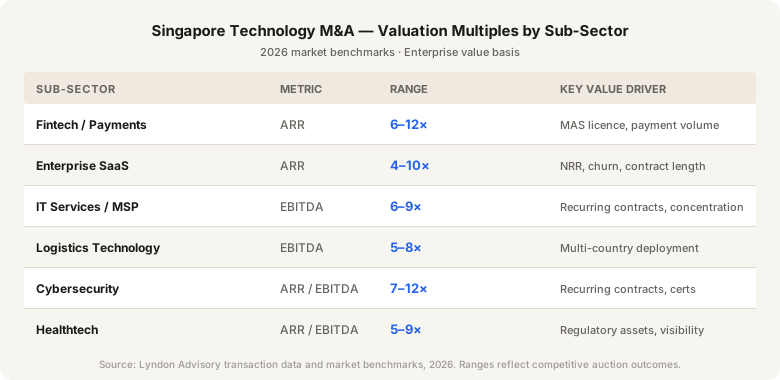
Technology valuation in Singapore follows global frameworks but reflects a local premium for ASEAN scalability.
| Sub-Sector | Primary Metric | Multiple Range | Key Driver |
|---|---|---|---|
| Fintech / payments | ARR | 6–12× | MAS licence, payment volume, margin |
| Enterprise SaaS | ARR | 4–10× | NRR, churn, contract length |
| IT services / MSP | EBITDA | 6–9× | Recurring contracts, customer concentration |
| Logistics tech | EBITDA | 5–8× | Multi-country deployment, volume |
| Cybersecurity | ARR / EBITDA | 7–12× | Recurring contracts, certifications |
| Healthtech | ARR / EBITDA | 5–9× | Regulatory assets, contract visibility |
The top of each range requires: net revenue retention above 110%, annual churn below 5%, gross margins above 65%, and a customer base that demonstrates ASEAN scalability beyond Singapore’s domestic market of 5.9 million.
EBITDA normalisation is particularly important for founder-led technology businesses. Add-backs commonly include above-market founder compensation, one-off development costs capitalised to P&L, and non-recurring cloud infrastructure costs incurred during rapid scaling.
Singapore-Specific Deal Considerations
MAS regulated entities — businesses holding Capital Markets Services licences, Major Payment Institution licences, or Insurance licences — require MAS notification or approval for a change of control. MAS review timelines of 90–120 days should be built into deal planning. Buyers typically require MAS approval as a condition precedent in the SPA.
IMDA grants and incentive programmes — the Productivity Solutions Grant, the Enterprise Development Grant, and IMDA-certified vendor status — are common in Singapore tech businesses but may not transfer automatically to an acquirer. Buyers conduct due diligence on incentive eligibility post-acquisition; sellers should obtain clarity on transferability before running a process.
IP ownership and employment agreements — Singapore’s Employment of Foreign Manpower Act, IP assignment clauses in employment agreements, and the enforceability of non-solicitation agreements are standard buyer due diligence items. Clean IP ownership documentation (assignment agreements from all contributors, including contractors) is a prerequisite for a smooth process.
Employee equity structures — ESOP schemes, phantom equity plans, and founder share structures with vesting schedules require legal analysis to determine whether change of control triggers acceleration, payouts, or consent requirements.
The Sale Process
A competitive technology M&A sale in Singapore typically follows this sequence:
Preparation (4–6 weeks): Financial model build and quality of earnings analysis, CIM and teaser preparation, data room setup, regulatory review.
Market outreach (6–8 weeks): Confidential approach to curated buyer universe under NDA, management of indications of interest, first-round meetings.
Competitive bid round (4–6 weeks): Management presentations, process letter, LOI submissions, bid comparison and negotiation.
Exclusivity and close (8–12 weeks): Exclusivity granted to preferred bidder, due diligence in virtual data room, SPA negotiation, regulatory notifications, completion.
The auction process is critical for Singapore technology businesses — a single-bidder process consistently underperforms a competitive process by 20–35% on final enterprise value, according to Lyndon Advisory’s transaction experience.
“Singapore technology founders consistently underestimate the breadth of their buyer universe,” says Daniel Bae, Founder of Lyndon Advisory and former M&A professional with over US$30 billion in transaction experience across APAC. “When we run a structured process for a Singapore SaaS or fintech business, we’re approaching buyers across the US, Japan, Korea, Australia, and regional PE simultaneously. That breadth creates the competitive tension that drives price.”
At Lyndon Advisory, we run structured Singapore technology M&A mandates on a success-fee-only basis: 2.5% of enterprise value, capped at US$750,000, with no retainer and no expense recharges.
Considering a sale of your Singapore technology business? Lyndon Advisory provides confidential valuations and structured M&A processes for Singapore technology, fintech, and SaaS businesses across APAC. Submit a valuation inquiry to understand what your business is worth and who would buy it.
Related Guide
For the broader framework behind this topic, see Lyndon Advisory’s APAC M&A guide.
About the Author

Daniel Bae
Co-founder & CEO, Lyndon Advisory
Daniel is an investment banker with 15+ years of experience in M&A, having advised on deals worth over US$30 billion. His career spans Citi, Moelis, Nomura, and ANZ across London, Hong Kong, and Sydney. He holds a combined Commerce/Law degree from the University of New South Wales. Daniel founded Lyndon Advisory to solve the pain points in M&A, enabling bankers to focus on what matters most — delivering trusted advice to clients.
About Lyndon Advisory
Lyndon Advisory is an M&A advisory firm built for Asia Pacific. We help business owners sell their companies and investors make strategic acquisitions with senior-led execution, disciplined process management, and structured buyer research. For owners, the first step is a confidential review of valuation range, likely buyer universe, and whether a structured sell-side process is justified.
Request a confidential seller reviewTopic cluster