UK healthcare owners should prepare a sale around regulated revenue quality, clinician continuity, CQC or NHS contract transfer risk, normalised EBITDA, and buyer certainty, because the highest headline price is not always the safest offer if approvals, staffing, or clinical governance issues are weak.
UK healthcare M&A is among the most active deal markets in Europe. Private equity has consolidated thousands of dental practices, pharmacy chains, mental health facilities, and veterinary clinics over the past decade. Public data explains the buyer thesis: ONS estimated UK healthcare expenditure at around GBP292 billion in 2023, GOV.UK reported GBP34.5 billion of adult social care expenditure in England in 2024 to 2025, and NHSBSA dental statistics reported 18 million adult patients seen in the 24 months to 31 March 2025. For healthcare business owners considering a sale, the market is deep, buyers are motivated, and regulated revenue quality remains a major source of demand.
For the full owner preparation sequence behind this market-specific article, start with our guide to selling a business.
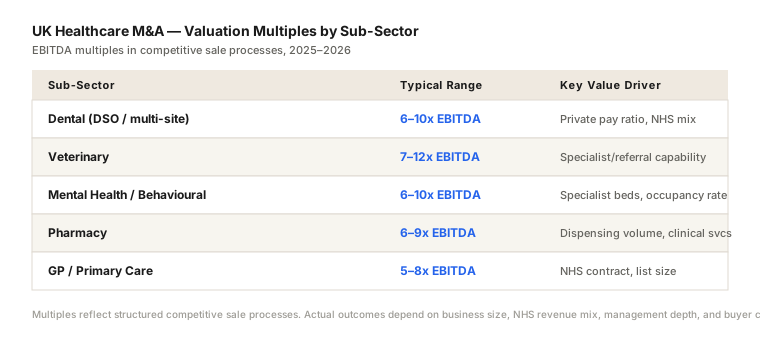
The UK Healthcare M&A Landscape
The UK’s dual public-private healthcare model creates a distinctive M&A environment. NHS-funded businesses carry reliable, government-backed revenue — a characteristic that attracts both PE consolidators and institutional investors who value income predictability. Private-pay businesses, particularly in dental, veterinary, and elective care, attract buyers drawn to margin profiles and pricing power.
According to PitchBook’s 2025 Healthcare M&A Report, UK healthcare saw over £4 billion in PE-backed deal activity in 2024, with dental, mental health, and primary care representing the three most active sub-sectors by transaction count.
The post-pandemic landscape has accelerated consolidation in several sub-sectors. Mental health services have seen demand outpace supply, creating a shortage-driven M&A premium. GP practices are consolidating as single-handed practitioners exit and integrated primary care networks gain scale. Dental consolidation, now two decades in, continues at pace as independent principals retire and new DSO platforms seek scale.
Active Sub-Sectors
Dental
UK dental M&A is one of the most mature consolidation stories in European healthcare. The dental service organisation (DSO) model — pioneered by IDH (now Bupa Dental Care), MyDentist, and Portman Dental — has since attracted dozens of PE-backed platforms and independent consolidators.
Independent dental practices with 3–10 surgeries and a mix of NHS and private revenue are the most sought-after acquisition targets. Practices with growing private pay ratios command premium multiples, as buyers price in the ability to convert NHS-heavy revenue to higher-margin private.
Valuation range: 6–10x EBITDA, with premium practices achieving above 10x in competitive processes.
Pharmacy
Pharmacy consolidation accelerated following NHS contract reforms that increased the regulatory burden on independent dispensaries. PE-backed pharmacy groups — including Well Pharmacy, Day Lewis, and Bestway Healthcare — have been active acquirers.
Dispensing volumes, the NHS contract tier, and the clinical services revenue mix are the primary value drivers. Pharmacies with MUR, NMS, and structured clinical services generate higher EBITDA margins and attract stronger buyer interest.
Valuation range: 6–9x EBITDA.
GP and Primary Care
GP practice M&A has grown significantly as NHS England’s Primary Care Network (PCN) framework has incentivised scale. Primary care networks, integrated care boards, and private GP operators have all become active acquirers.
NHS contract portability is the central regulatory consideration. Buyers require certainty that the existing GMS or PMS contract will transfer without disruption.
Valuation range: 5–8x EBITDA, with multi-site practices and those with additional service income at the higher end.
Mental Health and Behavioural Health
UK mental health services have seen exceptional deal activity, driven by a structural undersupply of CAMHS, adult inpatient, and community mental health services relative to demand. Priory Group, The Huntercombe Group, and Elysium Healthcare represent large-scale consolidators; smaller PE-backed platforms operate in sub-segments including autism, eating disorders, and complex needs.
Valuation range: 6–10x EBITDA, with specialist residential services at the premium end.
Veterinary
UK veterinary consolidation mirrors the dental model — independent practices acquired by large groups (IVC Evidensia, CVS Group, Vets4Pets/Jollyes) and mid-market PE consolidators. The sector has attracted significant capital, and independent vets with 3+ locations or specialist referral capabilities are highly sought after.
Valuation range: 7–12x EBITDA, with specialist referral and out-of-hours practices at the upper end.
Who Buys UK Healthcare Businesses
The UK healthcare buyer universe spans three distinct groups.
UK PE-backed consolidators are the most active buyers by volume. Firms including Inflexion, LDC, Livingbridge, Palatine, and Sovereign Capital have backed healthcare roll-up platforms across dental, pharmacy, mental health, and primary care. These buyers are motivated, well-capitalised, and experienced in healthcare transactions.
Listed healthcare groups — Bupa, Nuffield Health, Priory, CVS Group, and similar — acquire businesses that provide geographic or service line extension. These transactions often move quickly when the strategic rationale is clear.
US and international PE have entered UK healthcare at scale since 2021. US PE firms view UK healthcare as attractively valued relative to US equivalents, and post-Brexit currency adjustments have added a further pricing advantage. For UK healthcare vendors, this has materially widened the buyer pool and supported competitive tension in auction processes.
“The UK healthcare market offers something relatively rare in M&A — a combination of government-backed revenue, structural undersupply, and PE consolidation dynamics that together create a very active buyer market. Owners who run a structured, competitive process consistently achieve materially better outcomes than those who accept the first approach.” — Daniel Bae, founder of Lyndon Advisory
Regulatory Considerations
Healthcare M&A in the UK involves regulatory requirements that distinguish it from other sector transactions. Planning these early is essential to avoiding completion delays.
CQC registration — the Care Quality Commission requires all regulated care providers to register independently. A change of ownership does not automatically transfer CQC registration; the new owner must apply and be assessed. This process takes 3–6 months and should be initiated as early as possible in the transaction timeline.
NHS contract transfer — for businesses with NHS contracts (GP, dental, pharmacy), NHS England approval is required for change of ownership. The approval timeline varies but typically adds 4–8 weeks to completion.
Competition and Markets Authority (CMA) — large transactions or those creating significant local market concentration may attract CMA scrutiny. This is most relevant for pharmacy and dental group acquisitions in concentrated local markets.
GPhC and GDC — pharmacy and dental regulatory bodies require notification of ownership changes. These are generally administrative rather than substantive approval processes, but must be managed carefully.
At Lyndon Advisory, we structure transaction timelines to account for regulatory lead times — initiating CQC and NHS contact well ahead of expected completion.
Quality of Earnings and EBITDA Normalisation
Healthcare businesses often carry significant EBITDA distortions that must be addressed in buyer due diligence. Common normalisation items include:
- Owner clinician remuneration — founder clinicians frequently draw below-market salaries, which overstates EBITDA. Buyers will apply a replacement cost for clinical hours and adjust accordingly.
- Associate and subcontractor costs — dental and veterinary businesses that rely heavily on associates need to demonstrate clinical staffing continuity post-acquisition.
- NHS contract mix — NHS revenue is reliable but low-margin. Private pay revenue is higher margin but more variable. The revenue mix significantly affects normalised EBITDA.
- One-off costs — CQC registration costs, IT system upgrades, or regulatory compliance spend may be legitimately added back.
A thorough quality of earnings review — typically commissioned by the buyer — will scrutinise all of these. Sellers who prepare vendor-side financial analysis ahead of the process reduce uncertainty and maintain pricing.
The Sale Process for UK Healthcare Businesses
A structured UK healthcare M&A process typically runs 5–8 months, depending on regulatory complexity.
Preparation (4–6 weeks): Financial model, normalised EBITDA analysis, CIM and teaser preparation, data room setup, CQC/NHS contact initiated.
Buyer outreach and IOIs (6–8 weeks): Targeted buyer list — typically 15–30 buyers for a mid-market healthcare business — approached under NDA. Indications of interest received and evaluated.
Management presentations and LOIs (4–6 weeks): Shortlisted buyers invited to management presentations. Letters of intent received; preferred buyer selected and exclusivity granted.
Due diligence and SPA (6–8 weeks): Buyer due diligence. Share purchase agreement negotiation. Regulatory approvals running in parallel.
Completion: Funds transferred, regulatory registrations completed.
Why Lyndon Advisory for UK Healthcare M&A
Lyndon Advisory offers UK healthcare business owners a structured, senior-led advisory process at a fraction of the cost of traditional boutiques.
Our fee is 2.5% of enterprise value, capped at US$750,000 — with no retainer, no monthly fees, and no expense recharges. Compare that to a typical UK healthcare boutique charging 4–5% plus a £8,000–£15,000 monthly retainer: on a £7 million dental group sale, you would pay £350,000+ with a traditional adviser; with Lyndon, approximately £175,000.
Every mandate is led by a senior M&A professional — not delegated to junior analysts. We run a competitive auction process that maximises buyer interest and deal certainty, with regulatory timelines built into the process from day one.
Considering a sale of your UK healthcare business? Submit a confidential valuation inquiry with Lyndon Advisory — we’ll walk you through your indicative valuation, the buyer universe for your business, and what a structured process would look like. No obligation, no cost.
Sources
About the Author

Daniel Bae
Co-founder & CEO, Lyndon Advisory
Daniel is an investment banker with 15+ years of experience in M&A, having advised on deals worth over US$30 billion. His career spans Citi, Moelis, Nomura, and ANZ across London, Hong Kong, and Sydney. He holds a combined Commerce/Law degree from the University of New South Wales. Daniel founded Lyndon Advisory to solve the pain points in M&A, enabling bankers to focus on what matters most — delivering trusted advice to clients.
About Lyndon Advisory
Lyndon Advisory is an M&A advisory firm built for Asia Pacific. We help business owners sell their companies and investors make strategic acquisitions with senior-led execution, disciplined process management, and structured buyer research. For owners, the first step is a confidential review of valuation range, likely buyer universe, and whether a structured sell-side process is justified.
Request a confidential seller reviewTopic cluster