UK consumer business owners should prepare a sale around brand evidence, channel quality, margin sustainability, management depth, and buyer reach, because the best outcomes usually come from comparing UK strategics, European FMCG groups, US private equity, and APAC buyers at the same time.
The United Kingdom is one of the most active consumer and retail M&A markets globally — and one of the most internationally accessible. A well-positioned UK consumer brand attracts buyers from across Europe, North America, and increasingly from APAC. Public data shows why buyer underwriting remains active: ONS retail sales volumes rose 1.0% in June 2026 after a 1.2% rise in May, and the UK government’s 2025 business population estimates show a broad private-company base of small and medium-sized enterprises. The combination of brand heritage, established retail infrastructure, and international distribution reach makes UK consumer assets consistently attractive to strategic acquirers and private equity alike.
This guide covers the UK consumer and retail M&A landscape in 2026: who is buying, what they pay, and how to run a process that generates genuine competitive tension.
For the full owner preparation sequence behind this market-specific article, start with our guide to selling a business.
The UK Consumer M&A Market in 2026
UK consumer M&A activity has remained resilient despite macroeconomic headwinds. According to PitchBook’s 2025 UK M&A Report, consumer and retail transactions accounted for a significant share of UK mid-market deal flow, with branded FMCG, health and wellness, and pet care emerging as the most actively traded sub-sectors.
Several structural forces are driving deal activity:
Post-pandemic category evolution. The consumer shift toward health, wellness, and premium food and beverage that accelerated during 2020–2022 has created a cohort of scale-up consumer brands now ready for institutional capital or trade acquisition.
Retail consolidation. Physical retail consolidation has continued, with PE-backed platforms and listed groups acquiring specialist chains, franchise networks, and established retailers with omnichannel capability.
DTC maturation. Direct-to-consumer brands built on digital marketing and e-commerce have reached scale and are attracting strategic buyers seeking to acquire customer bases and brand equity rather than build them organically.
APAC interest in UK brands. Japanese trading houses, Korean conglomerates, and Asian family offices have become consistent acquirers of UK consumer brands — particularly in premium food, beauty, and lifestyle categories. British brand provenance carries a significant premium in Asian consumer markets.
Who Buys UK Consumer and Retail Businesses
The buyer universe for UK consumer and retail transactions spans strategic acquirers, private equity, and an increasingly active APAC cohort.
Global CPG strategics — Unilever, Nestlé, Kraft Heinz, Reckitt, L’Oréal, Diageo, and their peers — are consistent acquirers of UK consumer brands that complement existing portfolios or provide category entry. These buyers pay strategic premiums and typically close quickly once engaged.
European FMCG consolidators — listed and PE-backed — pursue UK assets as bolt-on acquisitions to existing European platforms. German, French, and Dutch consumer groups have been particularly active in UK food and beverage.
US private equity — funds including KKR, Bain Capital, and consumer-specialist funds — run active UK consumer platforms and pursue bolt-on acquisitions to build scale. PE buyers are disciplined but competitive when presented with quality assets in structured auction processes.
APAC strategic buyers — Japanese trading houses (Mitsubishi, Itochu, Marubeni), Korean conglomerates (CJ, Lotte, Amorepacific), and Singapore-based family offices are active acquirers of UK consumer brands. Premium British heritage in food, lifestyle, and beauty commands a meaningful multiple premium in Asian markets.
UK-listed groups and independent sponsors — for businesses in the £5–30 million enterprise value range, listed UK retail groups, franchise consolidators, and independent sponsors are a consistent buyer class.
A well-run sale process reaches all of these buyer types simultaneously — creating competition across categories that maximises both price and terms.
Valuation Multiples for UK Consumer Businesses
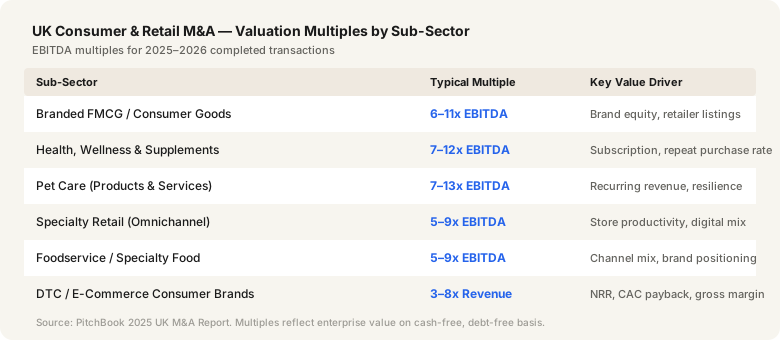
Valuation in UK consumer M&A is driven by EBITDA multiples for established businesses and revenue multiples for high-growth DTC brands. The ranges below reflect 2025–2026 completed transactions:
| Sub-Sector | Typical Multiple | Key Value Drivers |
|---|---|---|
| Branded FMCG / consumer goods | 6–11x EBITDA | Brand equity, category growth, retailer listing quality |
| Specialty retail (omnichannel) | 5–9x EBITDA | Store productivity, private label mix, digital capability |
| Health, wellness, and supplements | 7–12x EBITDA | Subscription penetration, clinical validation, repeat rates |
| Pet care (products and services) | 7–13x EBITDA | Recurring revenue, category resilience |
| DTC / e-commerce consumer brands | 3–8x revenue | NRR, CAC payback, gross margin |
| Foodservice / specialty food | 5–9x EBITDA | Channel mix, brand positioning |
Quality of earnings analysis is standard in UK consumer M&A. Buyers normalise for owner compensation, marketing investment levels, and one-off costs before applying multiples. The enterprise value is calculated on a cash-free, debt-free basis with a working capital adjustment — sellers should understand this mechanics before entering a process.
What Drives Premium Multiples
The difference between a 7x and a 12x outcome is rarely the headline business — it is how the process is run and how clearly the value story is articulated to buyers.
Brand defensibility. Buyers pay for brands with genuine consumer franchise — repeat purchase rates, independent brand awareness, and retailer relationships that would be expensive to replicate. Category-leader positioning in a niche commands a premium over a generic own-brand-competing product.
Channel diversification. Businesses selling across multiple channels (retail, foodservice, export, e-commerce) are lower-risk acquisitions than single-channel operators. Omnichannel retailers with strong digital metrics attract broader buyer pools.
International potential. UK consumer brands with untapped international distribution — particularly in APAC markets where British provenance is valued — attract higher premiums from buyers who see geographic expansion as a primary value creation lever.
Margin quality. Gross margins above 45% and EBITDA margins above 15% consistently attract higher multiples. Buyers underwrite on their ability to scale the business — margin compression at scale is penalised.
Management team depth. Businesses with a management team that can operate independently post-acquisition attract higher rollover equity interest from PE and fewer execution concerns from strategic buyers.
Key Deal Considerations for UK Consumer Transactions
Lease portfolio. For retail businesses with physical store networks, the quality and duration of lease agreements is a critical diligence area. Buyers assess remaining lease terms, break clauses, and rent-to-revenue ratios for each location. Onerous leases or large upcoming rent reviews can materially affect enterprise value and deal structure.
Working capital. Inventory-heavy consumer businesses carry significant working capital variability. The working capital peg — the normalised level of net working capital required to run the business — is a key negotiation point in the SPA. Sellers should understand their working capital seasonality before entering a process.
EBITDA normalisation. Owner compensation above market rate, family-member salaries, non-commercial related-party expenses, and one-off marketing investments should all be identified and documented before buyer engagement. A clean EBITDA bridge supported by accountant-prepared workings reduces due diligence friction and protects the multiple.
Earnout structures. In consumer transactions where forward growth is a key value driver, buyers may propose earnout components tied to post-acquisition revenue or EBITDA milestones. Sellers should negotiate earnout terms carefully — measurement periods, payment timing, and post-acquisition management rights all affect the economic outcome.
Regulatory and competition considerations. Large strategic acquisitions may require Competition and Markets Authority (CMA) review. For most mid-market consumer transactions, CMA merger control is not triggered, but sellers in concentrated categories should assess this early.
Running a Competitive UK Consumer Sale Process
The difference between a bilateral negotiation and a structured auction process is typically a 15–30% difference in outcome — driven by competitive tension, not by the individual buyer’s first offer.
A well-structured UK consumer sale process works as follows:
Preparation (4–6 weeks). Prepare the Information Memorandum, management accounts, EBITDA bridge, and buyer materials. Build the buyer list across strategics, PE, and APAC buyers. This phase determines the ceiling of the process — shortcuts here cost money later.
First round (6–8 weeks). Approach the full buyer list under NDA. Distribute the teaser and CIM to qualified parties. Collect Indications of Interest from interested parties.
Management presentations and final bids (4–6 weeks). Shortlisted buyers attend management presentations. Final bids are submitted against a structured process letter setting out deal terms.
Exclusivity, diligence, and completion (6–10 weeks). Select the preferred bidder, enter exclusivity, open the data room, and negotiate the SPA through to completion.
The total timeline is typically 5–8 months. Adviser experience in managing buyer dynamics and maintaining competitive tension through to completion is the primary determinant of outcome quality.
“The quality of a sale process is determined in the preparation phase, not the negotiation phase. A properly prepared consumer business — with a clean EBITDA bridge, a compelling brand narrative, and a curated buyer list — consistently achieves the top of the valuation range. Shortcuts in preparation always cost more than they save.” — Daniel Bae, founder of Lyndon Advisory
Thinking about selling your UK consumer or retail business? Lyndon Advisory provides senior-led M&A advisory with transparent fees — 2.5% of enterprise value, capped at US$750,000, with no retainer and no expenses. We run structured sale processes that reach strategic buyers, private equity, and APAC acquirers simultaneously. Submit a confidential valuation inquiry to understand what your business is worth and who would buy it.
Sources
About the Author

Daniel Bae
Co-founder & CEO, Lyndon Advisory
Daniel is an investment banker with 15+ years of experience in M&A, having advised on deals worth over US$30 billion. His career spans Citi, Moelis, Nomura, and ANZ across London, Hong Kong, and Sydney. He holds a combined Commerce/Law degree from the University of New South Wales. Daniel founded Lyndon Advisory to solve the pain points in M&A, enabling bankers to focus on what matters most — delivering trusted advice to clients.
About Lyndon Advisory
Lyndon Advisory is an M&A advisory firm built for Asia Pacific. We help business owners sell their companies and investors make strategic acquisitions with senior-led execution, disciplined process management, and structured buyer research. For owners, the first step is a confidential review of valuation range, likely buyer universe, and whether a structured sell-side process is justified.
Request a confidential seller reviewTopic cluster