US manufacturing and industrial M&A is one of the most active deal segments in the American private markets. Reshoring tailwinds, federal industrial policy (CHIPS Act, Inflation Reduction Act), and a wave of founder retirements among baby-boomer manufacturing owners are driving deal volume — while private equity’s appetite for platform-and-add-on strategies in fragmented manufacturing sub-sectors keeps buyer competition high.
For manufacturing business owners considering a sale, the good news is clear: enterprise value multiples are healthy, the buyer universe is broad, and a well-run process creates genuine competitive tension. The challenge is finding an advisor who understands industrial businesses, has real relationships with the right buyers, and charges a fee that doesn’t consume a third of your sale proceeds.
For the full owner preparation sequence behind this market-specific article, start with our guide to selling a business.
Public industrial data gives buyers a large base to underwrite. The U.S. Census Bureau’s Manufacturers’ Shipments, Inventories, and Orders release reported May 2026 manufactured-goods shipments of US$653.2 billion and unfilled orders of US$1,579.5 billion. Census also notes that the Annual Survey of Manufactures, now transitioned into the Annual Integrated Economic Survey, provides key measures of manufacturing activity for public and private users. Buyers use that macro context alongside company-level evidence: customer concentration, margin durability, capex requirements, and management depth.
What Makes Manufacturing M&A Different
Manufacturing businesses present a distinct due diligence and valuation profile from service businesses. Buyers focus on factors that don’t appear in a simple EBITDA calculation:
Asset intensity and capex cycles. Buyers scrutinise the age and condition of equipment, upcoming capex requirements, and whether the business is operating at, above, or below sustainable maintenance levels. Sellers who have deferred capex to maximise near-term cash flow often find buyers adjusting valuations accordingly.
Customer concentration. A single customer representing more than 20–25% of revenue is the single most common valuation risk in manufacturing M&A. Buyers price in the possibility of losing that relationship post-transaction. Sellers with diversified customer bases — particularly with long-term supply agreements — command premium multiples.
Proprietary vs commodity products. Businesses with proprietary designs, patents, or sole-source positions command meaningfully higher multiples than commodity manufacturers competing on price. The presence of a recurring aftermarket parts and service revenue stream is a significant value driver.
Environmental liability. Legacy environmental issues — contaminated sites, historical chemical use, regulatory consent orders — are a material deal risk in manufacturing. Buyers conduct environmental due diligence carefully and price unresolved liability into offers.
Government contract portability. For defence and government supply chain businesses, contracts may require novation or re-qualification by the buyer. This adds complexity and timeline — and can limit the buyer universe to entities already approved in the relevant programmes.
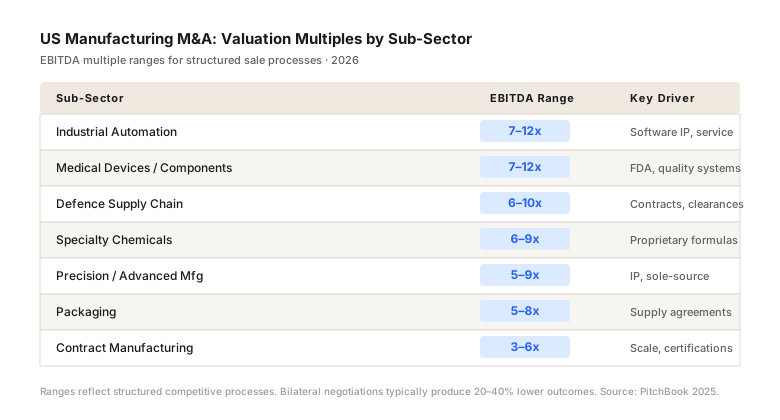
US Manufacturing Sub-Sectors and Valuation Benchmarks
| Sub-Sector | Typical EBITDA Multiple | Key Value Drivers |
|---|---|---|
| Precision / advanced manufacturing | 5–9x | IP, sole-source positions, aerospace/defence exposure |
| Defence supply chain | 6–10x | Long-term contracts, security clearances, barriers to entry |
| Specialty chemicals | 6–9x | Proprietary formulations, switching costs, regulatory moats |
| Packaging | 5–8x | Long-term supply agreements, substrate diversification |
| Food processing equipment | 5–8x | Aftermarket service revenue, OEM relationships |
| Medical devices / components | 7–12x | FDA registration, quality systems, recurring demand |
| Industrial automation | 7–12x | Software IP, integration complexity, recurring service |
| Contract manufacturing | 3–6x | Scale, certifications, customer diversification |
These ranges assume a structured, competitive auction process. Bilateral negotiations — where a seller approaches a single buyer — typically produce outcomes 20–40% below what a competitive process achieves.
Who Buys US Manufacturing Businesses
Private equity is the most active buyer class for US manufacturing businesses valued below $100M. PE firms pursue platform acquisition strategies — acquiring an initial business and using it as a base for bolt-on acquisitions in a fragmented sub-sector. In manufacturing, common roll-up themes include specialty coatings, precision machining, industrial services, and defence supply chain consolidation.
Strategic acquirers — listed industrials, large private manufacturers, and defence primes — pursue acquisitions for capability, capacity, geographic expansion, or customer access. Strategic buyers often pay the highest prices for businesses with unique technology or sole-source positions, but move more slowly than PE and have narrower criteria.
Family offices are increasingly active in manufacturing M&A as a source of long-hold capital. They prefer stable, cash-generative businesses with experienced management teams willing to remain post-acquisition. Family office buyers are attractive to sellers who want their business to continue as a standalone operation rather than be integrated into a larger platform.
According to PitchBook’s 2025 US Manufacturing M&A Report, PE-backed buyers accounted for 64% of US manufacturing transactions below $100M in enterprise value in 2024, with strategic acquirers representing the remaining 36%.
Key Deal Considerations for US Manufacturing Sellers
EBITDA Normalisation
Manufacturing businesses often carry owner-specific costs that inflate expenses and depress reported EBITDA. Common add-backs include: above-market owner compensation, family member salaries, personal expenses run through the business, one-time costs, and non-recurring items. A quality of earnings analysis — typically conducted by a third-party accountant — documents these adjustments and gives buyers confidence in the normalised earnings base.
“The difference between a seller’s normalised EBITDA and what a buyer accepts is often the most contested element of manufacturing M&A. Getting a pre-sale QoE done before going to market removes ambiguity and accelerates the process significantly.”
— Daniel Bae, Founder & CEO, Lyndon Advisory, former M&A advisor with over US$30 billion in transaction experience.
Working Capital
Manufacturing businesses are typically working capital intensive — inventory, receivables, and payables cycles vary significantly by sub-sector. The working capital peg — the target level of net working capital delivered at closing — is a material negotiation point. Sellers who understand their normalised working capital requirements before entering a process are better positioned to defend the peg.
Environmental and Real Estate
If the business owns real estate, buyers conduct Phase I and often Phase II environmental assessments. Known issues should be addressed before going to market where possible. Sellers who lease facilities should understand lease assignment provisions and whether consent is required from landlords.
Government Contracts
For businesses with federal or state government revenue, contract portability is a critical diligence item. Buyers will want to understand which contracts require novation, which are at-will, and what re-qualification requirements apply to a new owner. The timeline for contract novation can affect transaction structuring and closing conditions.
The Fee Problem in US Manufacturing M&A
The standard fee structure in US M&A advisory is the Lehman formula: 5% of the first million, 4% of the second, 3% of the third, 2% of the fourth, and 1% above $4M — scaled to modern deal sizes. On a $15M manufacturing business, a modified Lehman produces a success fee of approximately $600,000–$900,000. Add a monthly retainer of $10,000–$20,000 over a 6-month process, and total advisory costs reach $700,000–$1M+.
Lyndon Advisory charges a flat 2.5% success fee capped at US$750,000, with no retainer and no expense recharges. You pay nothing unless a deal completes. On that same $15M transaction, the Lyndon fee is $375,000, saving approximately $325,000–$625,000 against the total traditional cost above.
Our New York-based senior advisor leads every engagement. You deal with an ex-VP-level investment banker who has run manufacturing M&A processes — not a junior analyst.
At Lyndon Advisory, we run a structured competitive process: preparation and CIM production, targeted buyer outreach to qualified PE and strategic acquirers, managed auction process with competitive tension across multiple bidders, negotiation through to a signed SPA, and support through closing conditions and completion.
Preparing Your Manufacturing Business for Sale
The businesses that achieve the highest multiples in a sale process are those that have addressed the key valuation risks before going to market — not during due diligence, when buyers use issues to justify price reductions.
Practical steps for manufacturing sellers:
Normalise your financials. Work with your accountant to prepare 3 years of normalised EBITDA statements with documented add-backs. This is the foundation of every buyer conversation.
Diversify customer concentration. If a single customer represents more than 25% of revenue, work to reduce that concentration in the 12–24 months before a sale — or plan how to address it in buyer conversations.
Document your IP. Patents, trade secrets, proprietary processes, and certifications should be formally registered and documented. Buyers pay for defensible competitive advantages.
Address deferred maintenance. A credible capex plan — or better, recent equipment investment — removes a common buyer objection and supports valuation.
Prepare your management team. Buyers worry about key-person risk. A capable management team that can operate independently of the owner is a premium-multiple signal.
Ready to understand what your manufacturing business is worth? Lyndon Advisory provides a confidential, investment-bank-quality valuation for US manufacturing and industrial business owners — at a flat 2.5% success fee capped at US$750,000, no retainer, no upfront costs. Submit a confidential valuation inquiry with our New York-based senior advisor.
Sources
About the Author

Daniel Bae
Co-founder & CEO, Lyndon Advisory
Daniel is an investment banker with 15+ years of experience in M&A, having advised on deals worth over US$30 billion. His career spans Citi, Moelis, Nomura, and ANZ across London, Hong Kong, and Sydney. He holds a combined Commerce/Law degree from the University of New South Wales. Daniel founded Lyndon Advisory to solve the pain points in M&A, enabling bankers to focus on what matters most — delivering trusted advice to clients.
About Lyndon Advisory
Lyndon Advisory is an M&A advisory firm built for Asia Pacific. We help business owners sell their companies and investors make strategic acquisitions with senior-led execution, disciplined process management, and structured buyer research. For owners, the first step is a confidential review of valuation range, likely buyer universe, and whether a structured sell-side process is justified.
Request a confidential seller reviewTopic cluster