Professional services M&A in the United States is one of the most active segments of the lower middle market. Private equity roll-up platforms have consolidated thousands of IT managed service providers, marketing agencies, engineering consultancies, and staffing firms over the past decade — and deal activity remains strong in 2026.
For business owners considering a sale, understanding the buyer landscape, how your business will be valued, and what an advisor actually costs can mean the difference between a good outcome and a missed opportunity.
Why US Professional Services M&A Is So Active
The US professional services sector is structurally fragmented. Most firms are founder-owned, below $50 million in revenue, and lack a natural internal succession path. That combination — fragmentation, founder dependency, and succession pressure — creates ideal conditions for roll-up strategy buyers.
Private equity discovered professional services roll-ups in earnest in the 2010s, starting with dental and accounting practices before expanding into IT managed services, marketing agencies, engineering consultancies, HR consulting, and staffing. According to PitchBook’s 2025 Global M&A Report, business services was the second most active sector by deal count in North American PE in 2025, behind only technology.
The consolidation thesis is consistent across sub-sectors: aggregate fragmented operators, build shared back-office, cross-sell services, and create a platform that commands a valuation premium over any individual firm. For sellers, this creates a competitive buyer universe — which is exactly what drives strong pricing.
Sub-Sectors and Who Buys Them
IT Managed Services (MSP)
The US MSP market is one of the most aggressively consolidated PE targets in the lower middle market. Buyers include national MSP platforms backed by major PE firms, technology distributors, and cybersecurity-focused consolidators. Recurring revenue — monthly managed service contracts — is the primary value driver. Businesses with 70%+ recurring revenue and managed security service capabilities command the highest multiples.
Marketing and Creative Agencies
Independent agencies in digital marketing, performance media, PR, creative, and content have attracted significant PE interest from network aggregators. Platform acquisitions by groups like Stagwell and independently sponsored networks compete with strategic acquirers including holding companies and in-house marketing groups at large corporates.
Engineering and Environmental Consulting
Civil, structural, environmental, and geotechnical engineering firms are active consolidation targets. Government and infrastructure contract backlogs provide revenue visibility that PE buyers value. Bolt-on acquisitions by regional platforms seeking geographic or capability expansion are the dominant transaction type.
Management Consulting and Advisory
Boutique strategy, operations, and financial advisory firms attract interest from Big Four adjacents, listed consulting groups, and PE platforms building scaled professional services businesses. Client relationships are typically institutional rather than individual, which reduces key-person risk and supports higher multiples.
HR, Benefits, and Staffing
Benefits broking (medical, dental, 401k plan administration) has attracted intense consolidation from national aggregators. Staffing firms — particularly those with specialised verticals (technology, healthcare, finance) — attract both PE and strategic buyers.
Valuation: What US Professional Services Businesses Are Worth
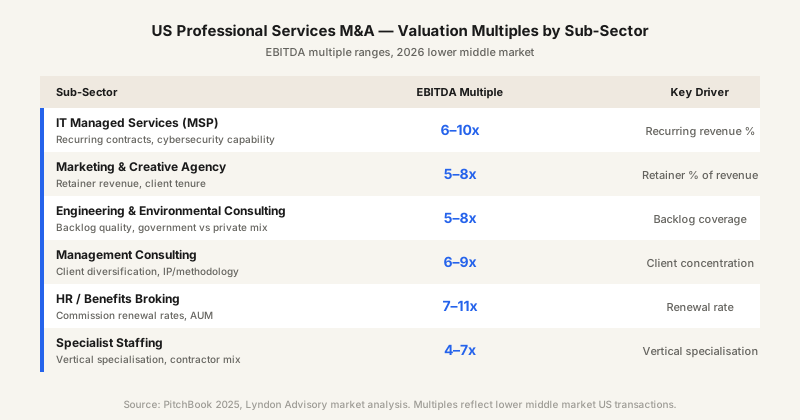
Professional services valuations are driven primarily by EBITDA multiples, with significant variation by sub-sector, revenue quality, and client concentration.
| Sub-Sector | EBITDA Multiple | Key Driver |
|---|---|---|
| IT Managed Services (MSP) | 6–10x | Recurring revenue %, cybersecurity capability |
| Marketing Agency | 5–8x | Retainer revenue, client tenure, service mix |
| Engineering Consulting | 5–8x | Backlog quality, government vs private mix |
| Management Consulting | 6–9x | Client concentration, IP/methodology |
| HR/Benefits Broking | 7–11x | Commission renewal rates, AUM |
| Staffing (specialist) | 4–7x | Vertical specialisation, contractor mix |
Quality of earnings analysis is critical in professional services M&A. Common adjustments include owner compensation normalisation (founder salary often below or above market), removal of personal expenses run through the business, and treatment of one-time project revenues versus recurring engagements.
Key Deal Considerations
Key-Person Risk
The central question in every professional services transaction is: does the business’s value walk out the door if the founder leaves? Buyers will discount heavily for businesses where a single person controls all key client relationships. Sellers can mitigate this before going to market by deepening client relationships with other team members, documenting client onboarding processes, and ensuring clients have contracted with the firm (not the individual).
Earnout Structures
Earnouts are more common in professional services than almost any other sector. A typical structure retains 20–40% of total consideration subject to performance targets over 12–24 months post-close. This aligns the seller’s interest with client retention during transition.
Sellers should negotiate: (1) metrics they can actually control (revenue, not EBITDA where buyer controls costs), (2) realistic targets based on current performance, not a stretch budget, and (3) protections against buyer interference in client relationships.
EBITDA Normalisation
Professional services businesses frequently run significant owner expenses through the P&L — vehicles, travel, personal insurance, family salaries, and discretionary items. Normalising these add-backs is standard practice and can materially increase the EBITDA on which buyers bid. Sellers should prepare a clean pro forma P&L before going to market.
Client Concentration
Most buyers have hard limits on client concentration — typically no single client above 20–25% of revenue. High concentration doesn’t kill deals, but it narrows the buyer universe and typically results in a portion of consideration being tied to client retention.
At Lyndon Advisory, we work with professional services owners to prepare a clean, defensible EBITDA normalisation before approaching buyers — because the quality of the financial presentation directly affects what buyers bid.
The US M&A Process for Professional Services
A structured sell-side process for a US professional services business typically runs 5–7 months:
- Preparation (4–6 weeks): EBITDA normalisation, CIM preparation, management presentation
- Buyer outreach (3–4 weeks): teaser distributed to qualified buyers, NDAs executed
- Indications of interest (2–3 weeks): IOIs received and evaluated
- Management presentations (2–3 weeks): shortlist of buyers, detailed presentations
- Letters of intent (2 weeks): LOIs received, best bid selected
- Exclusivity and due diligence (4–6 weeks): buyer conducts detailed due diligence
- Signing and closing (2–4 weeks): SPA negotiated and executed
The total timeline from engagement to close is typically 5–7 months for well-prepared businesses with clean financials.
Why Lyndon for US Professional Services M&A
Most US M&A advisors charge 4–6% of enterprise value using the Lehman formula, plus a retainer of $10,000–$20,000 per month. On a $15 million professional services deal, that’s $750,000 or more in fees — before retainer payments.
“Professional services sellers often don’t realise how much they’re leaving on the table in advisory fees alone,” says Daniel Bae, Founder of Lyndon Advisory. “A well-run process maximises buyer competition and price — but paying 5% to do it when 2.5% is available is simply unnecessary cost.”
Lyndon Advisory charges a 2.5% success fee capped at US$750,000. No retainer. No monthly fees. No expense recharges. On a $15 million deal, that.s $375,000 versus $750,000+ at a traditional US boutique.
Our NY-based senior advisor — a former VP-level investment banker — leads every engagement. No juniors running your deal while a partner collects the retainer.
Ready to understand what your professional services business is worth? Submit a confidential valuation inquiry with Lyndon Advisory. We’ll tell you the indicative valuation range, which buyer types would be most interested, and what a structured process would look like — no obligation, no cost.
Related Guide
For the broader framework behind this topic, see Lyndon Advisory’s professional services M&A guide.
About the Author

Daniel Bae
Co-founder & CEO, Lyndon Advisory
Daniel is an investment banker with 15+ years of experience in M&A, having advised on deals worth over US$30 billion. His career spans Citi, Moelis, Nomura, and ANZ across London, Hong Kong, and Sydney. He holds a combined Commerce/Law degree from the University of New South Wales. Daniel founded Lyndon Advisory to solve the pain points in M&A, enabling bankers to focus on what matters most — delivering trusted advice to clients.
About Lyndon Advisory
Lyndon Advisory is an M&A advisory firm built for Asia Pacific. We help business owners sell their companies and investors make strategic acquisitions with senior-led execution, disciplined process management, and structured buyer research. For owners, the first step is a confidential review of valuation range, likely buyer universe, and whether a structured sell-side process is justified.
Request a confidential seller reviewTopic cluster