The US staffing and recruitment industry is one of the most fragmented and actively consolidated sectors in American business — generating over $200 billion in annual revenue across thousands of independent operators, according to Staffing Industry Analysts’ 2025 US Staffing Industry Forecast. For business owners looking to exit, that fragmentation is an opportunity: strategic and financial buyers are actively acquiring staffing businesses at premium EBITDA multiples in specialist verticals.
What Makes Staffing M&A Different
Staffing businesses are fundamentally people and relationship businesses — which creates both value and complexity in a sale process.
Unlike asset-heavy businesses where value sits in equipment or real estate, staffing company value is concentrated in client relationships, recruiter networks, and gross margin per placement. Buyers pay for the spread between bill rate and pay rate, the stickiness of client contracts, and the defensibility of a specialist niche.
Gross margin is the headline metric. Generalist industrial staffing margins run 18–22%; professional and IT staffing 25–35%; executive search 30–45%; and healthcare staffing 20–30% on bill rate. Buyers underwrite to gross margin dollar growth, not revenue — a $30 million revenue staffing firm with 20% gross margin is valued very differently from one at 35%.
Client concentration is scrutinised. No single client above 20% of gross profit is the standard buyer threshold. Highly concentrated books — one anchor client representing 40% or more — attract earn-out structures or valuation haircuts to reflect the risk of client loss post-close.
Sub-sector mix determines the buyer universe. Healthcare and IT staffing attract PE at premium multiples. Industrial/light manufacturing staffing is more likely to attract strategic acquirers looking for volume. Executive search firms are valued on partner productivity and non-solicitation protections. Know which sub-sector you are in — it determines who will pay the most for your business.
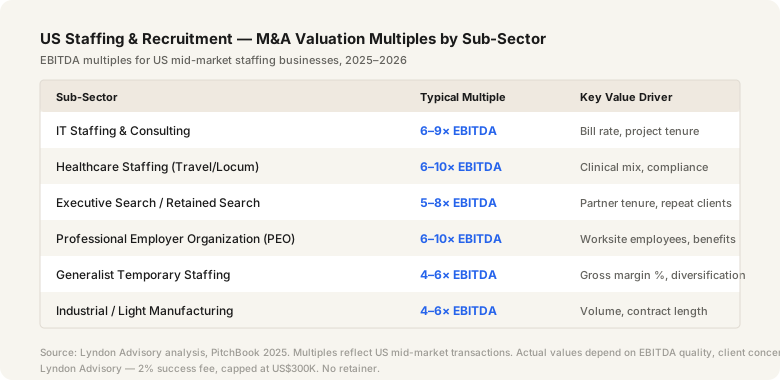
US Staffing Sub-Sectors and Valuations
| Sub-Sector | Typical Multiple | Key Value Driver |
|---|---|---|
| Generalist temporary staffing | 4–6x EBITDA | Gross margin %, client diversification |
| IT staffing & consulting | 6–9x EBITDA | Bill rate, project duration, recurring clients |
| Healthcare staffing (travel/locum) | 6–10x EBITDA | Clinical specialty mix, Joint Commission compliance |
| Executive search / retained search | 5–8x EBITDA | Partner tenure, repeat client %, fee structure |
| Professional employer organization (PEO) | 6–10x EBITDA | Worksite employee count, benefits cost management |
| Industrial / light manufacturing | 4–6x EBITDA | Volume, geographic density, client contract length |
These multiples assume normalized EBITDA and a clean quality of earnings process. EBITDA normalisation in staffing typically involves removing above-market owner compensation, adjusting for one-time recruiter bonuses, and normalising healthcare benefits costs that fluctuate year-to-year.
Who Buys US Staffing Companies
Large staffing conglomerates — Adecco Group, ManpowerGroup, Allegis Group, Kforce, and Heidrick & Struggles — are perennial strategic acquirers. They buy to add geographic density, acquire specialist capabilities (particularly in healthcare and IT), or accelerate entry into new verticals without building organically.
Private equity roll-up platforms are the most active buyer class in specialist staffing. PE firms have built scaled platforms in healthcare staffing (travel nursing, locum tenens, allied health), IT staffing, and executive search. These platforms pay premium multiples for businesses that add capacity in high-demand specialties or new geographies. Roll-up strategy creates value through margin improvement, shared back-office, and technology investment that independent owners cannot justify alone.
HR technology companies increasingly acquire staffing businesses to integrate placement capabilities into SaaS platforms. The convergence of ATS software, VMS (vendor management systems), and human capital management creates strategic rationale for tech-forward acquirers.
Family offices and independent sponsors are active in the $3–$10 million EBITDA staffing segment, particularly in stable niche markets (compliance-heavy verticals, government contract staffing, or businesses with long-tenured client relationships that reduce integration risk).
Key Deal Considerations for Staffing Owners
Contractor classification risk. Buyers conduct intensive due diligence on independent contractor classification practices following NLRB and state-level enforcement actions. W-2 misclassification exposure and California AB5 compliance are specific diligence triggers. Clean payroll records and properly documented contractor agreements are essential before going to market.
Non-compete and non-solicitation enforceability. A material portion of staffing value lies in client and candidate relationships. Buyers require founder and key recruiter non-solicitation agreements as a condition of closing. State-level enforceability varies significantly — California’s near-total ban on non-competes affects deal structures for California-heavy businesses.
Technology stack and ATS. Modern buyers assess whether the business runs on a modern applicant tracking system (Bullhorn, JobDiva, Salesforce-based) or relies on spreadsheets and legacy databases. Outdated technology is valued as an integration cost, not an asset.
Earnout structures are common. Given the people-dependency of staffing businesses, buyers frequently propose earnouts tied to gross profit retention or EBITDA performance over 12–24 months post-close. Founders should negotiate earnout metrics carefully — gross profit (not revenue) and adjusted EBITDA (not revenue) are more controllable metrics than top-line growth targets.
Working capital dynamics. Staffing businesses have significant accounts receivable — typically 45–60 days of receivables tied up in working capital. The working capital peg negotiation can materially affect net proceeds. Understanding your normalized working capital and ensuring the SPA defines the target accurately is critical.
Preparing Your Staffing Business for Sale
Normalise EBITDA 24 months before going to market. Identify all add-backs — excess owner compensation, personal expenses run through the business, one-time recruiter signing bonuses, and above-market insurance costs. Buyers will perform a quality of earnings on your financials; surprises discovered in due diligence reset pricing.
Document client relationships. Signed master service agreements (MSAs) with current clients, contract terms (especially exclusivity, renewal rights, and rate adjustment provisions), and client contact maps beyond the founder should be assembled before engaging buyers.
Reduce key-person dependency. A business where the founder owns all major client relationships is structurally valued lower than one where clients have multi-threaded relationships with account managers. Transitioning relationships to the team 12–18 months before a sale meaningfully increases buyer confidence and pricing.
Segment your gross margin. Buyers want to see margin by client, by vertical, and by employment type. If your P&L shows total revenue and total cost of revenue but nothing in between, you will spend months in due diligence recreating this analysis — time that buyers will use as leverage to renegotiate price.
At Lyndon Advisory, we’ve seen staffing business owners leave significant value on the table by entering processes without clean financial segmentation or normalised EBITDA. The preparation phase — typically 3–6 months before going to market — is where deal value is built, not recovered.
The Sale Process for a US Staffing Business
A structured auction process for a US staffing business runs 5–7 months:
- Preparation (4–6 weeks): Financial normalisation, quality of earnings preparation, CIM and teaser creation, target buyer list development
- Market (6–8 weeks): NDA execution, CIM distribution, management presentations with qualified buyers
- Offers and negotiation (3–4 weeks): LOI receipt, negotiation of headline price and structure, exclusivity selection
- Due diligence (4–6 weeks): Financial, legal, operational, and HR diligence; virtual data room management
- Documentation and closing (4–6 weeks): SPA negotiation, working capital mechanics, closing conditions
Competitive tension — running multiple buyers simultaneously through the process — is the primary driver of price maximisation. A single-buyer negotiation almost always produces a lower price than a structured process with three to five qualified parties.
Why Lyndon Advisory for US Staffing M&A
Traditional US M&A boutiques charge 4–7% of enterprise value on the Lehman formula, plus $10,000–$20,000 per month in retainers that begin before any deal certainty. On a $10 million staffing business, that is $400,000–$700,000 in advisory fees plus months of retainer payments.
Lyndon Advisory charges a 2.5% success fee, capped at US$750,000 — no retainer, no monthly fees, no expense recharges. You pay nothing until your deal closes.
Our New York-based senior advisor brings investment bank-grade process to the US mid-market staffing sector: buyer universe development across strategic and PE acquirers, structured auction management, and hands-on negotiation from first call to closing.
Ready to understand what your staffing business is worth? Lyndon Advisory provides a confidential, no-obligation valuation for US staffing and recruitment business owners. We’ll show you the buyer universe, indicative valuation range, and what a structured sale process would look like — before you commit to anything.
Related Guide
For the broader framework behind this topic, see Lyndon Advisory’s staffing and recruitment M&A guide.
About the Author

Daniel Bae
Co-founder & CEO, Lyndon Advisory
Daniel is an investment banker with 15+ years of experience in M&A, having advised on deals worth over US$30 billion. His career spans Citi, Moelis, Nomura, and ANZ across London, Hong Kong, and Sydney. He holds a combined Commerce/Law degree from the University of New South Wales. Daniel founded Lyndon Advisory to solve the pain points in M&A, enabling bankers to focus on what matters most — delivering trusted advice to clients.
About Lyndon Advisory
Lyndon Advisory is an M&A advisory firm built for Asia Pacific. We help business owners sell their companies and investors make strategic acquisitions with senior-led execution, disciplined process management, and structured buyer research. For owners, the first step is a confidential review of valuation range, likely buyer universe, and whether a structured sell-side process is justified.
Request a confidential seller reviewTopic cluster