The United States is the world’s largest technology M&A market, accounting for roughly 40% of global technology deal value annually (PitchBook, 2025 Annual Technology M&A Report). From B2B SaaS and cybersecurity to IT managed services and AI-native companies, US technology businesses attract the broadest buyer universe of any market — spanning domestic private equity, global strategic acquirers, and an increasingly active wave of APAC technology companies seeking US market access and capability acquisition.
For US technology founders and owners considering an exit, the structural opportunity is significant: a deep pool of motivated buyers, a mature M&A process ecosystem, and a valuation framework that rewards recurring revenue, retention, and growth. The challenge is achieving the best outcome — which requires a senior advisor who understands US technology valuations, runs a genuinely competitive process, and charges fees that don’t eliminate the gain.
For the full owner preparation sequence behind this market-specific article, start with our guide to selling a business.
Official digital-economy data supports the buyer appetite. The U.S. Bureau of Economic Analysis digital economy program measures fast-changing technology activity and its effect on the economy, while the International Trade Administration notes BEA estimates that the U.S. digital economy added nearly US$2.6 trillion in value in 2022. CompTIA’s 2025 workforce release reported that the U.S. tech workforce grew 1.2% in 2024. For technology sellers, this macro scale matters less than company-level quality, but it explains why both strategic and financial buyers continue to screen the sector aggressively.
What Makes US Technology M&A Different
Technology M&A in the United States operates under a distinct valuation logic compared to most other industries. Where traditional businesses are valued primarily on EBITDA multiples, technology companies — particularly software businesses — are often valued on ARR (annual recurring revenue) multiples, reflecting the premium buyers place on predictable, recurring subscription revenue.
This creates a bifurcated market:
Revenue-multiple businesses — SaaS companies with high growth, strong net revenue retention, and gross margins above 70% often command ARR multiples regardless of profitability. The “Rule of 40” (growth rate + EBITDA margin ≥ 40%) has become a widely used benchmark for software quality.
EBITDA-multiple businesses — Profitable technology services businesses, IT managed service providers, and mature software companies with stable but slower growth are typically valued on EBITDA. Margins and client retention drive the multiple range.
The distinction matters because it shapes which buyers engage at what price — and running a process that presents the business in the right valuation framework from the outset is essential to achieving the upper end of the range.
Most Active Sub-Sectors in US Technology M&A
B2B SaaS remains the most active sub-sector by deal count. Vertical SaaS platforms — software built specifically for industries like healthcare, legal, construction, or logistics — attract both strategic consolidators and PE roll-up platforms. Horizontal SaaS tools in sales, HR, finance, and operations are more broadly contested.
Cybersecurity is among the highest-multiple sub-sectors, driven by persistent enterprise demand and strategic urgency among large technology companies. Identity, cloud security, and managed detection and response (MDR) have attracted the most M&A activity.
IT Managed Services (MSP) has been one of the most actively consolidated sub-sectors in US technology, with dozens of PE-backed roll-up platforms competing for regional and specialist MSPs. Valuations have compressed from peak levels but remain elevated relative to most service businesses.
Fintech — including payments, lending technology, compliance software, and wealth technology — attracts both financial services strategics and technology PE. Regulatory complexity creates barriers to entry and sustains valuation premiums for compliant, scaled businesses.
AI and machine learning companies are attracting strategic acqui-hire and capability acquisitions at pace, particularly from large technology companies building AI infrastructure and from APAC conglomerates seeking to embed AI capability into existing businesses.
Buyer Universe
The US technology M&A buyer market is among the most developed in the world, but it is not monolithic. Understanding the buyer class most relevant to a specific company drives both pricing and process design.
Specialist technology PE — Vista Equity Partners, Thoma Bravo, Francisco Partners, Insight Partners, and KKR Tech are the most active technology-focused buyout funds. They typically target companies with $10M–$100M ARR, strong retention metrics, and identifiable operational improvement opportunities. PE buyers often run competitive processes quickly and are sophisticated at identifying value-creation paths.
Large strategic acquirers — Microsoft, Salesforce, Google, Cisco, and their tier-2 equivalents acquire technology companies for product capability, talent, and market access. Strategic buyers typically pay the highest prices when the acquisition fills a specific roadmap gap or accelerates a defined strategic objective. Synergy value — not just standalone DCF — drives strategic valuations.
APAC technology companies — This buyer class is systematically undercovered by US-only advisory firms. Japanese technology groups and trading houses (SoftBank, NTT, Fujitsu, Marubeni), Korean conglomerates (Samsung, SK, LG), Singapore-listed technology companies, and Australian listed tech acquirers are all active buyers of US software businesses. They seek US market presence, proprietary technology, and talent — and often pay strategic premiums to acquire a US foothold they could not build organically.
Family offices and independent sponsors — For sub-$20M businesses, family offices and independent sponsors have become an important buyer class, particularly for cash-generative technology services businesses where institutional PE funds require larger scale.
At Lyndon Advisory, our New York-based senior advisor runs US technology mandates end-to-end — with a 2.5% success fee capped at US$750,000, no retainer, and no expense recharges. On a $20 million SaaS exit, that is $500,000 versus $800,000–$1.6 million at standard US boutique rates.
Valuation Multiples
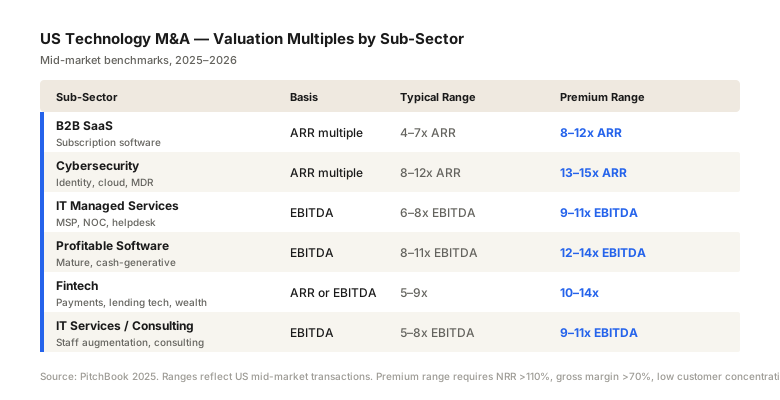
Multiples vary significantly by sub-sector, growth rate, margin profile, and market conditions. The following benchmarks reflect current US mid-market technology M&A:
| Sub-sector | Valuation Basis | Typical Range | Premium Range |
|---|---|---|---|
| B2B SaaS | ARR multiple | 4–7x ARR | 8–12x ARR |
| Cybersecurity | ARR multiple | 8–12x ARR | 13–15x ARR |
| IT MSP | EBITDA | 6–8x EBITDA | 9–11x EBITDA |
| Profitable software | EBITDA | 8–11x EBITDA | 12–14x EBITDA |
| Fintech | ARR or EBITDA | 5–9x ARR | 10–14x ARR |
| IT services / consulting | EBITDA | 5–8x EBITDA | 9–11x EBITDA |
Premium multiples require demonstrable evidence of the underlying quality drivers — not just headline metrics. Buyers will conduct quality of earnings analysis and diligence revenue recognition, churn rates, and contract terms in detail.
What Drives Premium Multiples
The difference between median and premium multiples in US technology M&A is determined by a predictable set of factors:
Net revenue retention (NRR) — NRR above 110% (meaning existing customers are expanding faster than they churn) is the single strongest predictor of multiple premium in SaaS. Buyers price high NRR as compounding revenue without incremental customer acquisition cost.
Customer concentration — Revenue distributed across a large customer base commands higher multiples than revenue concentrated in a few accounts. A top-10-customer concentration above 50% will draw due diligence scrutiny and may compress the multiple or trigger earnout provisions.
Gross margin — Software businesses with gross margins above 70–75% are considered high quality. Below 65%, questions arise about the services intensity of the revenue model and scalability.
Contract structure — Multi-year contracts with auto-renewal provisions reduce churn risk and are valued accordingly. Month-to-month contracts require buyers to discount for conversion and attrition risk.
Recurring vs. non-recurring revenue — The proportion of ARR to total revenue matters. Businesses with mixed models (SaaS + professional services + support) are typically valued on a blended basis, with recurring revenue capitalised at a premium and services revenue at a discount.
Management team depth — Key-man risk — where the business is operationally dependent on one or two individuals — is the most common discount trigger in technology M&A. Buyers want evidence of a functional leadership layer below the founder.
Why Lyndon for US Technology Sellers
Most US technology founders spend years optimising ARR, churn, and gross margin — then pay 5–8% plus a monthly retainer to a boutique advisory firm, surrendering a significant portion of the outcome they worked to build. Lyndon Advisory was built to change that math.
Transparent fees. Lyndon charges a 2.5% success fee capped at US$750,000 — no retainer, no monthly charges, no expense recharges. On a $20 million SaaS exit, that is $500,000 versus $800,000–$1.6 million at standard US boutique rates using a modified Lehman formula. On a $10 million MSP exit, it is $250,000 versus $400,000–$800,000. You pay nothing unless a deal closes.
Senior-led. Every US technology mandate is run by a New York-based ex-VP investment banker with direct deal experience — not assigned to a junior team member once the engagement letter is signed. The advisor who pitches the mandate runs the process.
Structured process. Lyndon runs a competitive auction process across the full US buyer universe — technology PE (Vista, Thoma Bravo, Francisco Partners), strategic acquirers, and growth equity — generating the competitive tension that maximises price. Senior-led preparation compresses timelines to 5–6 months versus the 8–12 months typical of traditional advisors.
“The fee structure in US technology M&A has been broken for a long time. A founder who builds a US$15 million SaaS business should not give US$750,000 to an advisor on top of taxes, legal fees, and earnout risk. We fixed the fee and kept the quality.”
— Daniel Bae, Founder & CEO, Lyndon Advisory, former M&A advisor with over US$30 billion in transaction experience.
Preparing a US Technology Business for Sale
Preparation drives outcome. The businesses that achieve premium multiples in US technology M&A share a common attribute: they entered the process with clean, well-presented financial and operational data that made buyer diligence fast and low-friction.
Financial hygiene — Ensure revenue recognition is clean, ARR is calculated consistently, and EBITDA is accurately normalised for one-off costs and owner compensation. Buyers will recast the financials in diligence — surprises discovered late in the process create renegotiation risk and erode trust.
Metrics dashboard — Buyers want to see MRR/ARR trend, monthly churn, NRR, CAC, LTV, and gross margin tracked and auditable. The inability to produce clean SaaS metrics is a significant diligence red flag.
Customer contracts — Ensure contracts are signed, accessible, and reviewed for change of control provisions. Contracts that require customer consent to assign in an acquisition can become material deal risks.
IP ownership — Confirm that all code, IP, and proprietary assets are owned by the corporate entity (not individual founders), that employee and contractor IP assignment agreements are in place, and that there are no open-source licence conflicts.
Management documentation — Buyers want to see that the business can operate without the founder. Documenting processes, ensuring a capable leadership layer is in place, and having a transition plan reduces key-man risk and supports a cleaner valuation.
The Sale Process
A well-run US technology sale typically follows a structured auction process rather than bilateral negotiations with a single buyer. The competitive tension between multiple buyers — domestic PE, US strategics, and APAC buyers — is the primary mechanism for maximising price.
The process typically runs 4–6 months:
- Preparation (4–6 weeks) — Financial model, CIM (confidential information memorandum), management presentation, and buyer list
- Broad outreach (3–4 weeks) — Teaser sent to qualified buyers, NDAs executed, CIM distributed
- Indications of interest (2–3 weeks) — IOI submissions, buyer meetings, shortlisting
- Letter of intent (3–4 weeks) — LOI negotiation, preferred buyer selection, exclusivity granted
- Due diligence and closing (6–10 weeks) — SPA negotiation, financing confirmation, regulatory clearances, closing
Lyndon Advisory manages this process end-to-end, with a New York-based senior advisor running all buyer engagement, negotiations, and documentation through to close.
Selling a US technology business? Lyndon Advisory provides sell-side M&A advisory for US technology founders — with a New York-based senior advisor, a structured competitive process across US PE and strategic buyers, and a 2.5% success fee capped at US$750,000. No retainer, no upfront costs. Submit a confidential valuation inquiry to understand what your business is worth and who would buy it.
Sources
About the Author

Daniel Bae
Co-founder & CEO, Lyndon Advisory
Daniel is an investment banker with 15+ years of experience in M&A, having advised on deals worth over US$30 billion. His career spans Citi, Moelis, Nomura, and ANZ across London, Hong Kong, and Sydney. He holds a combined Commerce/Law degree from the University of New South Wales. Daniel founded Lyndon Advisory to solve the pain points in M&A, enabling bankers to focus on what matters most — delivering trusted advice to clients.
About Lyndon Advisory
Lyndon Advisory is an M&A advisory firm built for Asia Pacific. We help business owners sell their companies and investors make strategic acquisitions with senior-led execution, disciplined process management, and structured buyer research. For owners, the first step is a confidential review of valuation range, likely buyer universe, and whether a structured sell-side process is justified.
Request a confidential seller reviewTopic cluster