Spain business owners should prepare a sale around buyer reach, succession clarity, and sector positioning: normalise earnings, resolve family or shareholder issues early, identify Spanish, European, Latin American, and APAC buyers, and use a controlled process to compare price, certainty, and post-closing continuity.
Spain has emerged as one of Europe’s most dynamic M&A markets, driven by an expanding private equity ecosystem, a generational wave of family business succession, and its unique position as the gateway for international capital entering Latin America. Public sources reinforce that scale: the OECD describes micro, small, and medium-sized enterprises as 99% of Spanish businesses and nearly two thirds of employment, while Spain’s government reported 96.8 million international tourist arrivals and EUR134.7 billion of international tourist spending in 2025 through La Moncloa. For business owners considering a sale, Spain offers a deep and competitive buyer universe — and for international acquirers, Spanish businesses represent an established platform for regional expansion.
The Spanish M&A Market
Spain’s M&A market has grown substantially over the past decade. According to Refinitiv’s 2025 European M&A Review, Spain consistently ranks among Europe’s top five M&A markets by deal volume, with particular strength in mid-market transactions between €10 million and €250 million.
The market is driven by three structural forces. First, private equity has deepened its presence: Spanish PE funds (Portobello, MCH, Aurica) have grown alongside international platforms deploying capital from Madrid and Barcelona. Second, family business succession is creating a sustained flow of sell-side mandates — Spain has approximately 1.5 million family-owned SMEs, and ownership transitions are accelerating as the founder generation ages. Third, Spain’s linguistic, legal, and commercial ties to Latin America make Spanish businesses uniquely attractive to acquirers seeking a platform for regional expansion.
“Spain is not just a domestic M&A market. For the right owner-led business, the buyer map should include Spanish strategics, Iberian funds, Latin American groups, European platforms, and Asian buyers that value Spain as an entry point to Europe and Latin America.” — Daniel Bae, founder of Lyndon Advisory
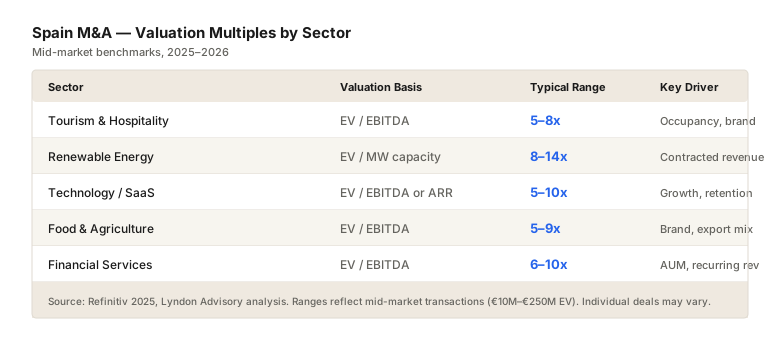
Tourism and hospitality, renewable energy, technology, food and agriculture, and financial services are the most active deal sectors.
Most Active Sectors for M&A in Spain
Tourism and Hospitality
Spain is the world’s second-largest tourism destination by international arrivals (UNWTO, 2025), and the hospitality sector generates a consistent flow of M&A activity. Hotel groups, resort operators, travel technology platforms, and restaurant chains are actively acquired by European hospitality consolidators, international hotel chains, and PE-backed platforms. EBITDA multiples in hospitality range from 5–8x depending on asset ownership vs management contracts, brand strength, and occupancy track record.
Renewable Energy
Spain’s renewable energy sector is one of the most active M&A markets in Europe, driven by EU Green Deal commitments and Spain’s exceptional solar and wind resources. Infrastructure funds, utilities, and international energy majors are active acquirers of renewable platforms. Enterprise value in energy transactions is typically calculated on EV/MW capacity, with solar platforms transacting at 8–14x depending on contracted revenue, grid connection, and permitting status.
Technology and SaaS
Madrid and Barcelona have developed into credible European technology hubs. B2B SaaS, fintech, HR tech, and e-commerce enablement businesses are attracting PE interest and strategic acquisition activity. EBITDA multiples for profitable software businesses range from 5–10x, with ARR multiples of 3–8x for high-growth SaaS.
Food and Agriculture
Spain is Europe’s largest agricultural exporter. Food processing, olive oil, wine, citrus, and seafood businesses attract strong cross-border interest — particularly from Asian buyers targeting European food provenance and from Latin American acquirers seeking European product supply chains. Valuation multiples range from 5–9x EBITDA depending on brand, export mix, and raw material sourcing.
Financial Services
Spain’s financial services sector is consolidating. Insurance broking, wealth management, and fintech are active deal categories. Banco Santander, BBVA, and CaixaBank are strategic acquirers in fintech; European PE funds are active in insurance and wealth management roll-ups.
Who Buys Spanish Businesses
The buyer universe for Spanish mid-market businesses is diverse:
Spanish Strategic Acquirers
IBEX 35 companies and mid-cap Spanish strategics are active acquirers in their core sectors. Inditex, Mercadona, ACS, and sector-specific Spanish corporates pursue bolt-on acquisitions to build scale.
European Private Equity
International PE funds — Ardian, Carlyle, KKR, Warburg Pincus, CVC — have all deepened their Spanish presence. Domestic PE funds (Portobello Capital, MCH Private Equity, Aurica Capital) are active in smaller transactions. The auction process for quality mid-market assets in Spain typically draws 8–15 qualified bidders.
Latin American Strategic Buyers
This is a buyer class that is genuinely distinct to Spain. Latin American conglomerates, family offices, and corporates view Spanish businesses as European platforms — using Spain’s EU market access, regulatory frameworks, and brand credibility as a springboard. This buyer class is underserved by most European advisory firms that lack Latin American networks.
International Strategics
US, Asian, and Northern European corporates pursuing Spain as a market entry point or acquiring Spanish businesses for their Latin American networks are consistent buyers in tourism, food, and technology.
Regulatory and Deal Structure Considerations
Spanish M&A has a number of jurisdiction-specific dynamics that are important to understand before launching a process.
Foreign Investment Screening
Spain operates a foreign investment screening framework (the “golden share” mechanism under Royal Decree-Law 34/2020) that requires prior authorisation for non-EU buyers acquiring stakes of 10% or more in companies in strategic sectors including energy, telecommunications, transport, media, and healthcare. COFIDES administers notifications. Transactions in non-strategic sectors are generally unrestricted.
CNMV for Public Companies
The Comisión Nacional del Mercado de Valores (CNMV) regulates tender offers and public company transactions. Private company transactions are governed by standard civil and commercial law.
Labour Law
Spain’s labour framework includes significant employee protections. Workforce restructuring in connection with a transaction may require an ERE (Expediente de Regulación de Empleo) process and works council consultation. Buyers need to understand the timeline and cost implications of labour obligations in the transaction structure.
SL vs SA Structures
Most Spanish SMEs are structured as Sociedad Limitada (SL). Due diligence for SL companies focuses on the socios register, partner consent requirements for share transfers, and any drag-along or pre-emption provisions in the statutes. SA structures have different transfer mechanics and are more common in larger or publicly-listed companies.
Earnouts
Earnout structures are common in Spanish M&A, particularly for owner-managed businesses where the seller’s continued involvement is valued by the buyer. Spanish courts have broadly upheld earnout provisions, though clear drafting of milestones and measurement periods is essential.
Preparing Your Business for Sale in Spain
The most important pre-sale preparation steps for a Spanish business owner are:
EBITDA Normalisation
Spanish family businesses frequently carry owner-specific costs — family salaries above market, related-party transactions, discretionary expenses — that should be identified and added back to arrive at a normalised EBITDA figure. This is the foundation of valuation in any quality of earnings review.
Ownership Structure Clarity
Complex family ownership structures, minority partner interests, and cross-holdings are common in Spanish family businesses. Simplifying the ownership structure before a sale process reduces friction and buyer due diligence concerns.
Financial Reporting
Spanish businesses operating under PGC (Plan General de Contabilidad) may need to prepare IFRS-adjacent financial summaries for international buyers. Audited accounts for the three most recent financial years are standard in any CIM process.
At Lyndon Advisory, we help Spanish business owners prepare for sale with investment-bank-grade materials — teaser, CIM, buyer targeting — and run a structured competitive process designed to maximise value. Our fee is 2.5% of enterprise value, capped at US$750,000. No retainer, no monthly fees, no expenses.
How the Sale Process Works
A structured sell-side process for a Spanish business typically follows five phases:
- Preparation — Normalised financials, Information Memorandum, blind teaser, buyer list approval
- Outreach — Targeted approach to qualified buyers; NDA execution; management of information flow
- Indicative bids — IOI collection; preliminary valuation benchmarking; buyer shortlisting
- Management presentations and final bids — Site visits, Q&A, LOI negotiation; exclusivity granted to preferred bidder
- Due diligence and closing — Exclusivity period due diligence; SPA negotiation; completion
The typical timeline for a Spanish transaction without complex regulatory issues is 5–6 months from mandate signing to signing of the SPA.
Considering a sale of your Spanish business? Lyndon Advisory provides senior M&A advisory for business owners across Europe and Asia Pacific — transparent fees, no retainers, and a structured process designed to maximise competitive tension and value. Submit a confidential valuation inquiry to understand what your business is worth and who would buy it.
Related Guide
For the broader framework behind this topic, see Lyndon Advisory’s guide to selling a business.
Sources
About the Author

Daniel Bae
Co-founder & CEO, Lyndon Advisory
Daniel is an investment banker with 15+ years of experience in M&A, having advised on deals worth over US$30 billion. His career spans Citi, Moelis, Nomura, and ANZ across London, Hong Kong, and Sydney. He holds a combined Commerce/Law degree from the University of New South Wales. Daniel founded Lyndon Advisory to solve the pain points in M&A, enabling bankers to focus on what matters most — delivering trusted advice to clients.
About Lyndon Advisory
Lyndon Advisory is an M&A advisory firm built for Asia Pacific. We help business owners sell their companies and investors make strategic acquisitions with senior-led execution, disciplined process management, and structured buyer research. For owners, the first step is a confidential review of valuation range, likely buyer universe, and whether a structured sell-side process is justified.
Request a confidential seller reviewTopic cluster