The three primary M&A valuation methods are EBITDA multiples, discounted cash flow (DCF), and precedent transactions. For most private business sales, EBITDA multiples and precedent deals drive the headline valuation — buyers apply a sector-specific multiple to normalised EBITDA, then adjust for growth, risk, buyer synergies, and country context. A DCF is useful, but the method matters less than running a competitive process that creates genuine buyer tension.
Most business owners discover their business is worth more than they expected — and less than their accountant told them. Both outcomes stem from the same misunderstanding: accounting valuation and M&A valuation are different disciplines that answer different questions.
Accounting valuation tells you what your business is worth on paper. M&A valuation tells you what a buyer will pay. The difference — often measured in multiples — comes down to which method you use, how well you normalise your earnings, and whether you run a process that creates competitive tension.
If you are selling in Singapore, Malaysia, Australia, or Hong Kong, start with the country-specific valuation guide as well as this methodology overview:
| Market | Valuation guide | Why it matters |
|---|---|---|
| Singapore | Business valuation in Singapore | ASEAN platform value, IRAS tax treatment, stamp duty, MAS or CCCS issues |
| Malaysia | Business valuation in Malaysia | CGT, local approvals, property exposure, Singapore and regional buyer reach |
| Australia | Business valuation in Australia | CGT concessions, FIRB, ACCC, working-capital peg, sector buyer depth |
| Hong Kong | Business valuation in Hong Kong | Share stamp duty, offshore structures, mainland revenue, Greater China buyer interpretation |
The Three M&A Valuation Methods
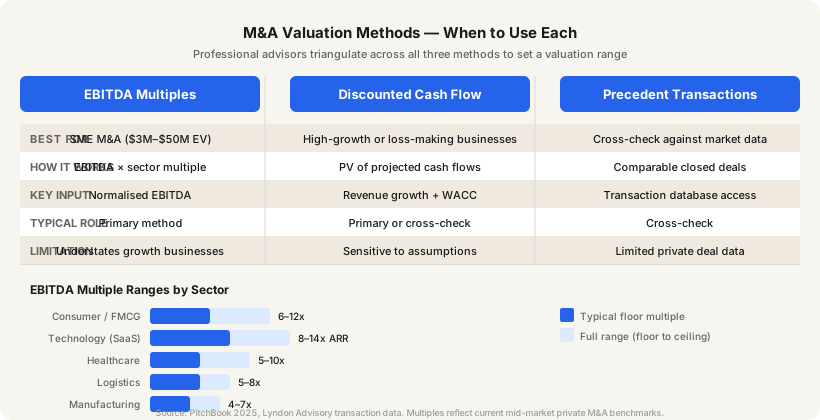
Professional M&A advisors use three primary valuation methods, then triangulate across them to set a target range. Each method answers a slightly different question.
EBITDA Multiples
EBITDA multiples are the most common valuation method for private SME M&A. The logic is straightforward: buyers apply a sector-specific multiple to your normalised EBITDA to arrive at enterprise value.
Enterprise Value = Normalised EBITDA × Sector Multiple
The multiple reflects what buyers in a given sector are currently willing to pay, adjusted for business-specific factors like growth, margin, and customer concentration. It is not a fixed number — it is a range, and where you land within that range depends heavily on process quality.
Current sector multiple benchmarks:
| Sector | Typical Range | Premium Driver |
|---|---|---|
| Consumer goods / FMCG | 6–12x | Brand strength, omnichannel mix |
| Technology (SaaS) | 8–14x ARR | Recurring revenue, NRR, CAC payback |
| Healthcare services | 5–10x | Regulatory position, clinical reputation |
| Food & beverage | 5–10x | Brand equity, distribution reach |
| Logistics / distribution | 5–8x | Contract quality, network density |
| Manufacturing | 4–7x | Proprietary process, customer concentration |
| Professional services | 4–7x | Revenue per fee-earner, client retention |
These ranges reflect current market conditions. According to PitchBook’s 2025 Global M&A Report, mid-market private company multiples compressed slightly in 2024 before stabilising in early 2025, with sector dispersion widening — meaning quality differentiation within sectors matters more than ever.
Discounted Cash Flow (DCF)
DCF analysis projects your future free cash flows and discounts them to present value using a WACC that reflects the risk of your business. The output is a terminal value plus the present value of near-term cash flows.
DCF is more common in larger transactions and for high-growth businesses where near-term EBITDA understates future earning power. For most SME sellers, DCF serves as a cross-check rather than the primary method — it is sensitive to growth assumptions and discount rate selection in ways that create wide ranges when applied to smaller businesses.
Where DCF is most useful: technology businesses with negative or thin EBITDA but strong ARR growth, businesses in early monetisation phases, and situations where the seller wants to argue for a higher price based on projected performance.
Precedent Transactions
Precedent transaction analysis benchmarks your business against comparable deals that have actually closed. Unlike public comparable company analysis, precedent transactions reflect control premiums and the specific dynamics of private M&A rather than public market sentiment.
The data problem with precedent transactions is disclosure: private deal terms are rarely made public in full. Advisors with active deal experience have proprietary data from their own transactions, which is more granular and more current than published databases. Lyndon Advisory also maintains internal research on companies, private equity firms, and relevant M&A precedent deals, which can be useful when a seller’s industry has enough comparable activity to support a tighter range. This is one reason sector specialisation in your advisor matters — a generalist working from public data gives you a different range than a sector specialist who understands recent buyer behaviour.
EBITDA Normalisation: The Step Most Owners Miss
Regardless of which method you use, the quality of your quality of earnings analysis determines whether buyers accept your numbers or restate them downward during due diligence.
Normalisation is the process of adjusting reported EBITDA to reflect the true, sustainable earnings power of the business — stripping out one-off items and non-arm’s-length transactions that would not recur under new ownership.
Common add-backs that increase EBITDA:
Owner compensation excess. Most owner-operators pay themselves above-market salaries, or take minimal salary and classify personal expenses through the business. The add-back is the difference between what you actually pay yourself and what a replacement CEO would cost. On a $3M revenue business, this can easily be $200,000–$400,000 — worth $1–2M in enterprise value at a 5x multiple.
One-off costs. Legal disputes settled during the period, premises relocation costs, one-time consulting engagements, write-offs of specific receivables. These are real expenses that won’t recur, and buyers should not penalise you for them.
Related-party transactions at non-market rates. Rent paid to a property owned by the owner’s family trust, services purchased from a related entity at above-market rates, or conversely, below-market costs that won’t be available post-close.
Pro forma adjustments. Costs incurred to build infrastructure not yet reflected in revenue (a new team hired in Q4 whose productivity will flow through the following year), or revenue contracted but not yet recognised.
Buyers scrutinise every add-back during due diligence. The standard is not just that an add-back is legitimate — it must be documented and defensible. Advisors who have run sell-side processes know which add-backs buyers accept and which they push back on, and can help you build the normalised EBITDA case before going to market.
“The gap between what a seller thinks their business is worth and what a buyer will pay usually comes down to two things: EBITDA normalisation and process quality. Get both right and you move the outcome significantly.” — Daniel Bae, Founder & CEO, Lyndon Advisory
What Inflates or Deflates Your Multiple
Within any sector range, specific factors move your multiple up or down.
Multiple expanders:
- Revenue growth above sector peers (10%+ CAGR commands a meaningful premium)
- High recurring or contracted revenue (subscription, retainer, long-term supply agreements)
- Low customer concentration (no single customer above 10–15% of revenue)
- Strong management team that will remain post-transaction
- Proprietary technology, process, or market position that is defensible
Multiple compressors:
- Revenue dependence on the owner (key-person risk is one of the largest discounts in SME M&A)
- Customer concentration above 20% in a single client
- Declining or flat revenue trend in the 12 months before sale
- EBITDA margin significantly below sector peers
- Unresolved legal, regulatory, or environmental issues
The earnout structure is often used to bridge valuation gaps when a buyer and seller disagree on future performance — the buyer pays a base price on current EBITDA plus additional consideration if growth targets are met. Understanding how earnouts affect your effective valuation is a key part of evaluating any offer.
The Difference Between Valuation and Price
Valuation gives you a range. Price is what you actually receive. The gap between them is determined almost entirely by process quality.
A business worth $8–12M on paper, taken to market with a disciplined auction process to five or six qualified buyers, will often achieve more than the same business sold to a single buyer negotiated bilaterally. Competitive tension — the knowledge that other parties are interested — is the most reliable mechanism for pushing price toward the top of the valuation range.
This is why advisors earn their fees. The advisor’s job is not just to produce a valuation but to run the process that turns a theoretical range into a competitive outcome. According to Bain & Company’s Global Private Equity Report 2025, businesses that ran structured processes with multiple bidders achieved premiums of 15–25% over bilaterally negotiated transactions at comparable sizes.
For the full owner-facing valuation framework, including EBITDA multiples, DCF, precedent transactions, and preparation before a sale, see Lyndon’s M&A valuation guide.
At Lyndon Advisory, we run an investment-bank-quality sell-side process — valuation, CIM, buyer outreach, and negotiation — for a 2.5% success fee capped at US$750,000, with no retainer and no upfront costs. The fee structure is designed to align our incentives with yours: we earn more only if the outcome is better.
Choosing the Right Method for Your Business
No single method is universally correct. The right approach depends on your business’s stage, sector, and the buyer universe you are targeting.
For most SME M&A ($3M–$50M enterprise value), EBITDA multiples will drive the headline valuation with precedent transactions as a cross-check. DCF becomes more relevant as deal size increases or where the business has a strong growth profile that EBITDA understates.
The most important variable is not which method you use but whether you have normalised your EBITDA correctly and run a process that creates genuine competition among buyers. Both determine the actual price more than any methodological choice.
Ready to understand what your business is actually worth? Lyndon Advisory provides a confidential, investment-bank-grade valuation at no cost and with no obligation — covering EBITDA multiples, precedent transactions, and the buyer universe for your business. Submit a valuation inquiry to get started.
About the Author

Daniel Bae
Co-founder & CEO, Lyndon Advisory
Daniel is an investment banker with 15+ years of experience in M&A, having advised on deals worth over US$30 billion. His career spans Citi, Moelis, Nomura, and ANZ across London, Hong Kong, and Sydney. He holds a combined Commerce/Law degree from the University of New South Wales. Daniel founded Lyndon Advisory to solve the pain points in M&A, enabling bankers to focus on what matters most — delivering trusted advice to clients.
About Lyndon Advisory
Lyndon Advisory is an M&A advisory firm built for Asia Pacific. We help business owners sell their companies and investors make strategic acquisitions with senior-led execution, disciplined process management, and structured buyer research. For owners, the first step is a confidential review of valuation range, likely buyer universe, and whether a structured sell-side process is justified.
Request a confidential seller reviewTopic cluster