Logistics and transport businesses are among the most consistently active M&A sectors globally. The structural transformation of supply chains — driven by e-commerce growth, geopolitical trade realignment, and accelerating technology adoption — has made logistics assets strategic priorities for a wide range of corporate acquirers and private equity funds. Transportation and logistics M&A advisory is a specialist discipline: the sector has distinct valuation drivers, a global buyer universe that differs materially from other industries, and deal structures shaped by the operational realities of moving goods across borders and jurisdictions.
For business owners in freight forwarding, third-party logistics, trucking, cold chain, and supply chain technology, the current environment represents a genuine seller’s market. The question is not whether buyers exist — it is whether the right process is designed to find all of them and force them to compete.
What Makes Logistics M&A Different
The logistics sector spans business models ranging from highly asset-light freight forwarders — which own relationships, systems, and licences but outsource physical movement — to asset-heavy trucking operations with large owned vehicle fleets. This diversity creates fundamentally different M&A dynamics depending on where a business sits in the logistics value chain.
Asset intensity is the central variable in logistics valuation. Asset-light businesses generate higher free cash flow conversion and carry less capital expenditure risk through economic cycles. Buyers apply a structural premium to asset-light models — particularly freight forwarders and technology-enabled 3PL platforms — because they can scale without proportionate asset investment. Asset-heavy businesses (owned fleet trucking, owned-warehouse cold chain) trade at lower EBITDA multiples because buyers must model fleet replacement cycles and real estate capex into their return assumptions.
Customer concentration is often the most significant value risk in a logistics transaction. When a single customer accounts for more than 25–30% of revenue — particularly without a formal multi-year contract — buyers apply material valuation discounts and frequently insist on earnout structures to offset the risk of customer attrition post-close. Sellers who can demonstrate diversified, contracted revenue prior to sale command the strongest premiums.
Contract quality and duration determine buyer confidence in future cash flows. Month-to-month shipping arrangements — common because shippers prefer flexibility — are penalised in valuation. Formal 2–3 year contracts with renewal terms transform the quality of earnings profile and meaningfully expand the buyer universe to institutional acquirers who require earnings predictability.
Technology infrastructure has become a genuine differentiating factor. Logistics businesses with proprietary or well-integrated transport management systems (TMS), warehouse management systems (WMS), or digital freight platforms command premium multiples over operationally similar businesses that rely on manual processes. Logistics technology companies — software platforms, AI-enabled freight marketplaces, supply chain visibility tools — are valued on revenue multiples rather than EBITDA, reflecting growth trajectory rather than current earnings.
Regulatory licence portfolios add complexity unique to this sector. Customs broker licences, NVOCC (non-vessel-operating common carrier) authorisations, dangerous goods certifications, pharmaceutical cold chain approvals, and aviation security accreditations are often personally held or jurisdiction-specific. Buyers conduct detailed licence audits, and any licence that is non-transferable or dependent on the founding owner becomes a material deal risk. Resolving transferability issues before going to market is essential.
The Logistics M&A Buyer Universe
Logistics attracts a genuinely global buyer pool across several distinct categories — and the categories behave very differently in a competitive auction process.
Global logistics integrators — DHL Supply Chain, Kuehne+Nagel, DB Schenker, Maersk Logistics, and Nippon Express — are systematic acquirers of logistics assets that extend geographic coverage, add specialist capabilities (cold chain, pharmaceutical, dangerous goods), or provide lane density in critical trade corridors. These buyers move decisively when they find assets with strategic fit, and they pay control premiums that financial buyers cannot match — because the value they capture is synergistic, not just financial.
Regional strategic vs financial buyer dynamics in APAC are distinct. Japanese trading house conglomerates (Mitsui, Sumitomo, Mitsubishi Corporation), Korean logistics groups (CJ Logistics, POSCO International), and Southeast Asian conglomerates (Kerry Logistics, SATS) have been systematic acquirers of supply chain assets across APAC trade lanes. These buyers prioritise supply chain control over financial returns and are prepared to pay for route network, regulatory licences, and established customer relationships.
Private equity roll-up strategy platforms have become one of the most active buyer categories in logistics globally. PE firms are building scaled platforms in freight forwarding, third-party logistics, and cold chain — consolidating fragmented markets where no operator has dominant scale. The model is straightforward: identify a quality platform acquisition, then execute a series of bolt-on acquisitions that add geography, capability, or customer density. For logistics business owners, this means PE buyers are available across deal sizes — from businesses with USD 2–3 million EBITDA as bolt-on targets, to larger platforms seeking capital backing for consolidation.
E-commerce and technology companies — including Amazon Logistics, regional platforms, and last-mile delivery aggregators — have been active acquirers of last-mile delivery and fulfilment infrastructure. These buyers value logistics businesses for operational capability and geographic coverage, not financial returns, and are prepared to pay significant premiums for scarce infrastructure.
Infrastructure funds have entered cold chain and temperature-controlled logistics, treating purpose-built cold storage facilities and pharmaceutical-grade warehouses as infrastructure-like assets with long-term contracted cash flows and high replacement-cost barriers.
Lyndon Advisory advises logistics and transport business owners across Asia Pacific and the United States on sell-side M&A. “Logistics is one of the sectors where process design most directly determines value,” says Daniel Bae, Founder of Lyndon Advisory and former M&A advisor with over US$30 billion in transaction experience. “The difference between a bilateral trade sale and a properly structured competitive process in logistics can be 2–3x EBITDA — because strategic buyers and PE platforms compete for different strategic premiums, and both pay more in competition than they ever would in a bilateral conversation.”
Valuation Multiples by Sub-Sector
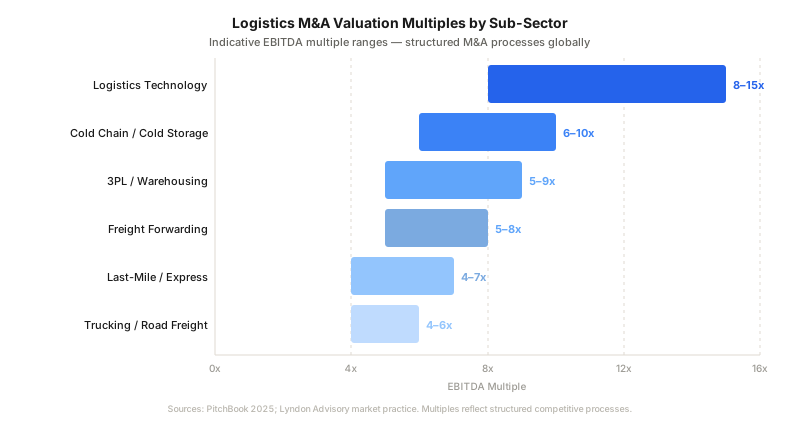
These ranges reflect current market practice across structured M&A processes. Bilateral transactions — where a business is sold to the first buyer who expresses interest — consistently achieve the bottom of the range. Competitive processes with multiple qualified buyers regularly achieve the upper end.
| Sub-Sector | Typical EBITDA Multiple | Key Drivers of Premium |
|---|---|---|
| Logistics Technology | 8–15x | ARR quality, growth rate, market size |
| Cold Chain / Temperature-Controlled | 6–10x | Infrastructure barriers, pharmaceutical contracts |
| 3PL / Warehousing | 5–9x | Contract tenor, WMS capability, warehouse ownership |
| Freight Forwarding | 5–8x | Lane diversity, digital capability, own forwarder vs. co-loader |
| Last-Mile / Express Delivery | 4–7x | Route density, e-commerce customer quality, automation |
| Trucking / Road Freight | 4–6x | Contract quality, fleet age, owner-driver vs. employee model |
According to PitchBook’s 2025 Global M&A data, private equity investment in logistics and supply chain reached elevated levels globally in 2024, driven by supply chain restructuring and the ongoing consolidation of fragmented regional operators. McKinsey’s Global Logistics Report 2024 identifies logistics as one of the highest-activity M&A sectors, with deal concentration in 3PL, cold chain, and technology sub-sectors.
Key Deal Considerations in Logistics M&A
Several issues arise consistently in logistics transactions and require careful preparation.
Licence transferability. Customs broker licences, NVOCC authorisations, dangerous goods certifications, and other regulated logistics licences may not transfer automatically on a change of control. In some jurisdictions they are personally held by the founding director. Buyers flag non-transferable licences as material deal risks. Sellers should audit the full licence portfolio and obtain written transferability confirmation before approaching buyers — it is far easier to resolve these issues proactively than in the middle of a due diligence process.
Owner dependence. Many logistics businesses are operationally dependent on the founding owner for customer relationships, carrier introductions, and key operational decisions. Buyers structure earnouts to retain the founder post-close, but this limits the seller’s clean exit. Systematically delegating customer relationships and operational decisions to senior management — at least 12–18 months before sale — both reduces buyer concern and improves the multiple.
Working capital and seasonality. Logistics businesses with seasonal revenue — driven by retail peak periods, agricultural cycles, or project freight — require careful working capital analysis. The working capital peg in the share purchase agreement must reflect normalised working capital requirements, not a peak or trough. Working capital disputes are common in logistics transactions and delay close when not addressed proactively in the preparation phase.
Fleet and equipment condition. For asset-heavy logistics businesses, fleet age and condition directly affects deal value. Buyers estimate deferred capital expenditure requirements and use this as a lever to discount the purchase price. Sellers with ageing fleets should either invest in renewal or model the capex requirement transparently in the information package — buyers who discover fleet deterioration in due diligence will use it more aggressively than if it had been disclosed upfront.
Post-merger integration planning. Logistics acquirers — particularly integrators and PE roll-up platforms — have detailed integration playbooks. Sellers who can demonstrate clean IT systems, documented operational processes, and a management team capable of running independently accelerate buyer confidence and reduce the integration risk premium buyers build into their pricing.
Choosing a Transportation & Logistics M&A Advisor
Logistics M&A is specialist work. Advisors without sector experience frequently underperform because they cannot access the full buyer universe — global integrators, regional PE platforms, Japanese and Korean strategic acquirers, and e-commerce logistics buyers each require specific relationships and credibility to engage effectively. A generalist advisor who approaches only the most obvious buyers leaves meaningful competitive tension — and valuation — on the table.
A qualified logistics M&A advisor should demonstrate direct transaction experience across at least two logistics sub-sectors, active relationships with the relevant buyer categories, and the ability to structure a process that creates genuine competition between strategic and financial buyers simultaneously.
Fee structure matters. Most logistics M&A advisors charge a monthly retainer plus a Lehman-formula success fee, resulting in 3–6% of enterprise value for SME logistics businesses. Lyndon Advisory charges a success fee of 2.5% of enterprise value, capped at US$750,000, with no retainer and no expense recharges. Advisory coverage spans Asia Pacific and the United States — the two most active logistics M&A markets globally.
Choose the Right Logistics M&A Advisory Path
| Situation | What Lyndon should understand first | Best next step |
|---|---|---|
| You are evaluating whether to sell a logistics, freight, 3PL, cold chain, trucking, or supply-chain business | Revenue, EBITDA, service line, lane density, customer concentration, licences, fleet or warehouse assets, and buyer universe | Submit a logistics valuation inquiry |
| A global integrator, PE platform, customer, competitor, or overseas acquirer has approached | Buyer motive, offer logic, licence transfer risk, customer disclosure risk, exclusivity pressure, and alternative buyer universe | Review the buyer approach |
| You are 6-18 months away from a possible sale | Contract formalisation, licence transferability, fleet or warehouse records, TMS/WMS documentation, management depth, and data-room gaps | Check logistics exit readiness |
| You are comparing logistics M&A advisors | Retainer exposure, fee cap, logistics buyer reach, cross-border process capability, tail period, and expected net proceeds | Compare advisory economics |
| You are an investor looking for logistics targets | Sub-sector thesis, target geography, EBITDA range, lane or capability preference, and control preference | Register on MergerMatch |
Selling a logistics, freight, or supply chain business? Lyndon Advisory provides sell-side M&A advisory for freight forwarding, 3PL, warehousing, cold chain, and trucking businesses across Asia Pacific and the United States — senior dealmakers, 2.5% success fee capped at US$750,000, no retainer. Submit a confidential valuation inquiry to understand what your business is worth and who would acquire it.
Related Guide
For the broader framework behind this topic, see Lyndon Advisory’s guide to selling a business.
About the Author

Daniel Bae
Co-founder & CEO, Lyndon Advisory
Daniel is an investment banker with 15+ years of experience in M&A, having advised on deals worth over US$30 billion. His career spans Citi, Moelis, Nomura, and ANZ across London, Hong Kong, and Sydney. He holds a combined Commerce/Law degree from the University of New South Wales. Daniel founded Lyndon Advisory to solve the pain points in M&A, enabling bankers to focus on what matters most — delivering trusted advice to clients.
About Lyndon Advisory
Lyndon Advisory is an M&A advisory firm built for Asia Pacific. We help business owners sell their companies and investors make strategic acquisitions with senior-led execution, disciplined process management, and structured buyer research. For owners, the first step is a confidential review of valuation range, likely buyer universe, and whether a structured sell-side process is justified.
Request a confidential seller reviewTopic cluster