Germany is home to one of the world’s densest concentrations of precision engineering and advanced manufacturing businesses. The Mittelstand — the layer of owner-managed small and mid-sized industrial firms that sits beneath Germany’s DAX giants — accounts for more than 55% of German GDP and employs over 60% of the country’s workforce, according to the Institut für Mittelstandsforschung (IfM). For M&A advisors and international buyers, it represents one of the most attractive and consistently active deal markets globally.
Public data supports the seller opportunity. Destatis reported that German manufacturing stock of orders increased 1.7% month on month in May 2026 and 9.5% year on year after calendar adjustment, while KfW reported that Germany’s Mittelstand employed more than 33 million people for the first time in its 2025 SME Panel. That combination of industrial depth, employment scale, and succession pressure is exactly why prepared manufacturers attract international buyer attention.
For the full owner preparation sequence behind this market-specific article, start with our guide to selling a business.
Why German Manufacturing Businesses Change Hands
The dominant driver of Mittelstand M&A is succession. Germany’s ageing owner-operator population — a structural consequence of the post-war era when the current generation of founders built their businesses — means thousands of precision engineering, industrial equipment, and specialty manufacturing businesses will transition ownership over the next decade. The KfW Mittelstandspanel estimates over 500,000 German SMEs will require succession solutions through 2030.
Unlike succession-driven M&A in other markets, German Mittelstand sales are rarely distressed. These are profitable, technically sophisticated businesses with strong customer relationships, defensible niches, and often decades of product development behind them. The challenge is finding the right buyer — one who will maintain the technical culture, preserve the workforce, and invest for the long term.
“German manufacturing sellers are rarely selling a spreadsheet. They are selling technical reputation, workforce trust, and customer-specific know-how built over decades. The advisor’s job is to translate that into a buyer process that rewards quality without exposing the company too early.” — Daniel Bae, founder of Lyndon Advisory
Private equity consolidation adds a second driver. Platform strategies in industrial automation, precision components, and specialty packaging have attracted significant PE capital. Add-on acquisitions into established platforms create a consistent buyer class for mid-sized manufacturers.
Active Sub-Sectors in German Manufacturing M&A
Precision engineering and mechanical components — gear systems, hydraulics, pneumatics, specialty bearings, and high-tolerance machined parts. These businesses often supply multiple industries (automotive, aerospace, medical devices, industrial machinery) and command premium multiples for their diversified revenue base.
Automotive supply chain — Tier 1 and Tier 2 suppliers to German OEMs and their international plants. Multiples reflect OEM concentration risk and electrification transition exposure. Suppliers with mixed combustion/EV exposure or strong aftermarket positions trade better than pure combustion-engine component makers.
Industrial equipment and machinery — packaging machinery, food processing equipment, printing systems, and specialty production equipment. These businesses often carry recurring aftermarket revenue (spare parts, service contracts) that commands valuation premiums. Many have significant international sales and established dealer networks.
Specialty chemicals and materials — specialty coatings, adhesives, composite materials, and technical polymers. Differentiated formulations protected by know-how or patents attract strategic buyers seeking technology access.
Medical devices and equipment — Germany has a deep medical device manufacturing cluster, particularly in Baden-Württemberg and Bavaria. Regulatory pathway (CE mark, MDR 2017/745 compliance) is both a moat and a due diligence consideration.
The Buyer Universe for German Manufacturers
Japanese Industrial Companies
Japanese industrials are the most consistent and culturally aligned buyers of German Mittelstand manufacturers. Hitachi, Kyocera, Nidec, Yaskawa, and hundreds of mid-cap Japanese manufacturers have established track records of acquiring German precision engineering businesses and maintaining their identity, workforce, and operational independence. The cultural alignment is genuine: both traditions emphasise engineering excellence, long-term employment relationships, and incremental improvement (kaizen). For German owners concerned about workforce continuity and legacy preservation, Japanese buyers often represent the most credible commitment.
At Lyndon Advisory, our network spans Japanese industrials across multiple sectors — a distribution that is structurally different from European-only advisors and meaningfully expands the competitive buyer pool for German precision manufacturers.
European and US Private Equity
PE-backed platforms remain the most active buyer class by volume. Nordic Capital, Waterland Private Equity, EQT, Triton, and Capiton run active industrial consolidation platforms. US PE funds with German portfolio companies also source add-on acquisitions. PE buyers move faster than strategics and require less seller education, but typically seek operational improvement levers and have defined exit horizons — factors that matter to sellers who care about long-term ownership culture.
German Strategic Acquirers
Listed German industrials (Würth Group, Friedhelm Loh Group, and the listed mid-caps) pursue targeted acquisitions for capability, customer, or geographic expansion. Strategic buyers often pay the highest prices when synergies are strong, but their internal approval processes can be slow and their due diligence intensive.
Chinese Buyers Under Scrutiny
Chinese acquirers remain active but face increasing BMWK review under the Foreign Trade and Payments Act. Technology-sensitive businesses — particularly those supplying defence, dual-use components, or critical infrastructure — face extended review timelines and meaningful completion risk. Advisors must screen buyer lists carefully and structure outreach to manage regulatory risk alongside commercial attractiveness.
Valuation Multiples for German Manufacturers
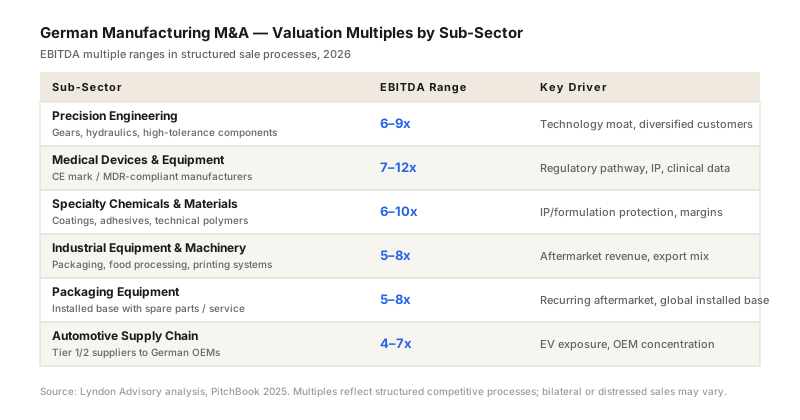
EBITDA multiples in German manufacturing M&A are broadly comparable to global benchmarks for similar business quality, though buyer competition from Japanese industrials can drive premiums above typical European comps.
| Sub-Sector | EBITDA Multiple Range | Key Multiple Driver |
|---|---|---|
| Precision engineering | 6–9x | Technology differentiation, customer diversity |
| Automotive supply chain | 4–7x | EV exposure, OEM concentration |
| Industrial equipment | 5–8x | Aftermarket revenue, export mix |
| Specialty chemicals | 6–10x | IP/formulation protection, margins |
| Packaging equipment | 5–8x | Installed base, aftermarket |
| Medical devices | 7–12x | Regulatory pathway, IP, clinical data |
Quality of earnings analysis is essential in Mittelstand transactions. Owner compensation, family-related costs, real estate occupancy charges, and non-recurring R&D costs are common add-backs that materially affect the enterprise value calculation.
Key Deal Considerations
Works Council (Betriebsrat)
German labour law requires employers to inform and consult the Works Council before completing a share sale or asset transfer. The Works Council cannot block a transaction but must be involved early. Sellers should engage employment counsel before launching a process and develop a communication plan that addresses workforce continuity concerns transparently. Japanese buyers, in particular, are receptive to strong workforce preservation commitments — this is a differentiator worth building into the buyer narrative.
BMWK Foreign Investment Screening
The Federal Ministry for Economic Affairs and Climate Action reviews acquisitions by non-EU investors in sensitive sectors. The 10% ownership threshold triggers review for critical industries. Most Mittelstand manufacturers fall outside restricted categories, but businesses with defence exposure, dual-use components, or critical infrastructure supply chains require careful structuring. BMWK reviews add 2–4 months to closing timelines and require close coordination between M&A advisors and regulatory counsel. See also: antitrust review.
Notarial Requirements
Share transfers in Germany require notarial certification (notarielle Beurkundung), adding procedural steps not present in APAC or US closings. The notary reviews the share purchase agreement and certifies the transfer. This is a routine process but must be factored into transaction timelines and jurisdiction selection for the SPA.
Working Capital and Normalisation
German manufacturers often carry significant working capital due to inventory buffers, extended payment terms with OEM customers, and project-based billing cycles. Working capital peg negotiations can be complex and should be addressed early in the process. Raw material inventory valuation and WIP accounting also require careful treatment in due diligence.
Earnouts in Succession Scenarios
Where founders remain in transitional roles post-closing, earnout structures are common — linking deferred consideration to EBITDA or revenue milestones over 12–24 months. German employment and tax law creates specific structuring constraints for earnouts that differ from US or APAC practice. Legal counsel familiar with German commercial law is essential.
The Sale Process for German Manufacturers
A structured auction process for a German Mittelstand manufacturer follows broadly the same stages as international best practice — preparation, teaser distribution, management presentations, indicative offers, exclusivity, due diligence, and closing — but with additional steps:
- Works Council consultation — initiated before or during the management presentation phase
- BMWK pre-screening — for businesses with potential regulatory exposure
- Japanese buyer engagement — requires longer lead times; initial contact should be made 4–6 weeks before the formal process opens to allow for internal screening
- Notarial preparation — notary engagement coordinated 4–6 weeks before target close
The teaser and CIM for a German manufacturer should be available in both English and German. Japanese buyers typically require English materials but appreciate German-language supplementary documentation.
Why Lyndon Advisory for German Manufacturing Transactions
For a broader overview of Germany M&A advisory — including the Mittelstand succession wave, advisory fee comparison, and regulatory framework — see the Germany M&A advisory guide.
Lyndon Advisory’s Japanese buyer relationships are a structural advantage for German Mittelstand sellers. Most European advisors lack the direct relationships with Japanese industrials to run a genuinely competitive cross-border process — their buyer lists default to PE and European strategics, leaving the buyer universe meaningfully narrower than it should be.
Our fee structure is a second differentiator. Most European M&A boutiques charge 2–5% of enterprise value plus monthly retainers. Lyndon Advisory charges a success fee of 2.5% of enterprise value, capped at US$750,000 — with no retainer and no expense recharges. You pay nothing unless a deal completes.
Considering a sale of your manufacturing business? Lyndon Advisory provides M&A advisory for Mittelstand engineering and industrial businesses — combining senior dealmaker judgment with direct access to the Japanese industrial buyer community. Submit a confidential valuation inquiry to understand what your business could achieve in a structured international process.
Sources
About the Author

Daniel Bae
Co-founder & CEO, Lyndon Advisory
Daniel is an investment banker with 15+ years of experience in M&A, having advised on deals worth over US$30 billion. His career spans Citi, Moelis, Nomura, and ANZ across London, Hong Kong, and Sydney. He holds a combined Commerce/Law degree from the University of New South Wales. Daniel founded Lyndon Advisory to solve the pain points in M&A, enabling bankers to focus on what matters most — delivering trusted advice to clients.
About Lyndon Advisory
Lyndon Advisory is an M&A advisory firm built for Asia Pacific. We help business owners sell their companies and investors make strategic acquisitions with senior-led execution, disciplined process management, and structured buyer research. For owners, the first step is a confidential review of valuation range, likely buyer universe, and whether a structured sell-side process is justified.
Request a confidential seller reviewTopic cluster