Germany business owners should treat a sale as a succession-driven buyer-selection process, not only a valuation exercise: prepare normalised earnings, document management continuity, compare German, European, US, and APAC buyers, and run outreach confidentially enough to protect employees, customers, suppliers, and founder legacy while still creating competitive tension.
Germany is home to one of the world’s deepest pools of privately owned businesses — the Mittelstand — and one of the largest structural M&A opportunities in Europe. The Federal Statistical Office reports that SMEs accounted for 99.3% of enterprises in the studied economic sectors in 2023, while IfM Bonn estimates that around 186,000 companies will require succession between 2026 and 2030. Many of these handovers are driven not by distress but by founders who built exceptional companies over decades with no natural heir.
For business owners considering a sale, the challenge is not finding buyers — it is finding the right buyers at the right price, with a process that protects confidentiality and maximises competitive tension. This guide covers how M&A advisory works for German businesses, who the active buyers are, what advisors charge, and how to evaluate your options.
The German Mittelstand and the Succession Wave
Germany’s Mittelstand — the layer of privately owned SMEs generating between €1 million and €500 million in annual revenue — is widely regarded as the backbone of the German economy. These businesses are concentrated in precision manufacturing, engineering, professional services, technology, and healthcare. Many are world leaders in narrow industrial niches.
According to research from the Institut für Mittelstandsforschung Bonn (IfM Bonn), more than 200,000 German family businesses will require a succession solution in the next five years. In the majority of cases, no family member is available or willing to take over. The result is the largest sustained wave of business owner-led M&A in German history.
This creates a genuine advisory opportunity — but also a risk. Business owners who approach the market without a structured process, or who rely on a single buyer introduction, typically achieve materially worse outcomes than those who run a competitive sale process with professional advisory support.
“The Mittelstand succession dynamic is unlike any other M&A market in the world. These are exceptional businesses with decades of earnings history, loyal customer relationships, and deep technical expertise — but their owners often have no reference point for what a structured sale process looks like. Getting that process right is everything.” — Daniel Bae, founder of Lyndon Advisory
Who Buys German Businesses
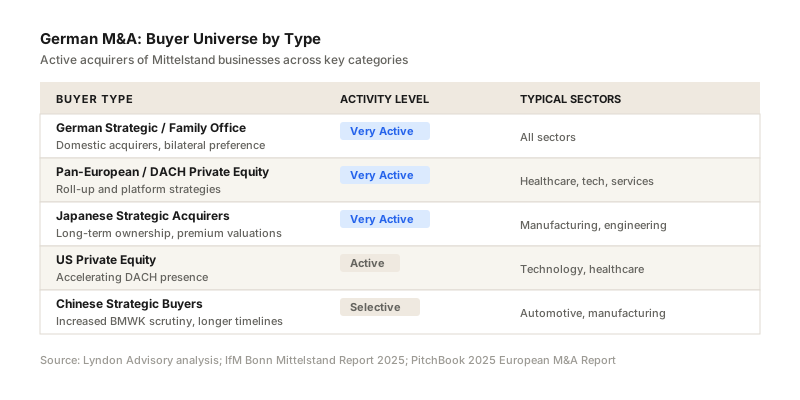
The buyer universe for German SMEs is broader than most owners expect — and increasingly international.
German strategic acquirers are the most familiar buyer class: listed industrial groups, private family offices, and competitor businesses seeking consolidation. These buyers understand the German market deeply but often move slowly and prefer bilateral negotiations over competitive processes.
Pan-European and DACH-focused private equity funds have become significantly more active in Germany over the past decade. Firms such as Carlyle, Advent International, EQT, and their mid-market equivalents target German SMEs for platform acquisition and roll-up strategy plays across manufacturing, healthcare, and professional services.
Japanese strategic acquirers deserve specific attention. Japan’s corporate buyers — including trading houses (sōgō shōsha), precision manufacturers, and specialist industrials — have been among the most consistent acquirers of German Mittelstand businesses. The appeal is clear: German engineering culture, quality standards, and long-term ownership mentality align closely with Japanese corporate values. Transactions involving Japanese buyers often command a premium, as Japanese acquirers value stability and are willing to pay for defensible market positions. Lyndon Advisory’s APAC buyer network gives German sellers direct access to this buyer class — access that most European boutique advisors cannot provide.
US private equity has accelerated its activity in Germany, attracted by the depth of the Mittelstand deal flow and the relative scarcity of institutional capital chasing it compared to the UK. Firms such as KKR, Blackstone, and their mid-market equivalents now run dedicated DACH deal teams.
Chinese strategic buyers have historically been active — particularly in automotive supply chain and precision manufacturing — but face increased scrutiny under BMWK foreign investment review processes (formerly under the BMWi framework), and deal timelines with Chinese buyers have lengthened as a result.
Understanding German M&A Advisory Fees
German M&A boutiques typically charge a fee structure similar to their UK and US counterparts: a monthly retainer plus a success fee calculated as a percentage of enterprise value.
For SME transactions (€5 million to €50 million enterprise value), market norms in Germany are:
| Deal Size (EV) | Typical Success Fee | Monthly Retainer |
|---|---|---|
| Under €10M | 4–6% | €5,000–€10,000 |
| €10–25M | 3–5% | €8,000–€15,000 |
| €25–50M | 2.5–4% | €12,000–€20,000 |
| €50M+ | 1.5–3% | €15,000–€25,000+ |
On a €15 million transaction, a German boutique charging 4% plus a 12-month retainer of €10,000 per month would cost approximately €720,000 in total fees — regardless of outcome.
Lyndon Advisory charges a flat 2.5% success fee, capped at US$750,000 (approximately €646,000 using the 8 September 2026 reference rate), with no retainer and no monthly charges. On the same €15 million transaction, the fee would be €375,000 — payable only upon completion.
Regulatory and Process Considerations in Germany
Several aspects of German M&A transactions differ from UK or US conventions:
Works Council (Betriebsrat) obligations. German businesses with five or more employees have the right to form a Works Council. In transactions involving a change of control, the seller has consultation obligations with the Works Council under §613a BGB (transfer of undertakings). This does not give employees a veto, but it requires proper notification and consultation — typically 4–6 weeks — before completion. Failing to comply can expose the seller to claims.
Foreign investment screening (BMWK). Germany reviews foreign acquisitions under the Foreign Trade and Payments Act (AWG) and associated regulations. Transactions in sensitive sectors — defence, critical infrastructure, healthcare, telecommunications — may require BMWK approval. Japanese and US buyers typically clear this process straightforwardly; buyers from certain jurisdictions face more scrutiny.
Data room and DSGVO. German businesses handling personal data must ensure their virtual data room setup complies with GDPR (Datenschutz-Grundverordnung). This affects how customer lists, employee data, and supplier contracts are shared with prospective buyers.
Conservative due diligence timelines. German buyers and their advisors tend to conduct more conservative diligence than UK or US counterparts, with longer commercial due diligence periods and greater scrutiny of environmental liabilities, pension obligations (particularly for manufacturing businesses), and customer concentration.
The M&A Process for German Business Owners
A structured sell-side process for a German SME typically follows five phases:
Preparation (4–6 weeks): Financial normalisation, quality of earnings analysis, preparation of the teaser and CIM, identification of the buyer universe.
Controlled outreach (4–6 weeks): Confidential approach to pre-qualified buyers under NDA, distribution of the teaser, responses to initial questions, selection of parties to receive the CIM.
Indicative offers (3–4 weeks): Buyers submit indications of interest with indicative valuation ranges. The advisor ranks and narrows the field.
Detailed diligence and final offers (8–12 weeks): Selected buyers conduct management presentations, site visits, and detailed due diligence. Final binding offers submitted. Exclusivity period granted to preferred buyer.
Documentation and closing (6–10 weeks): SPA negotiation, Works Council consultation, BMWK filing if required, final closing.
Total timeline: 5–8 months. Lyndon Advisory’s focused buyer outreach and document preparation targets the lower end of that range.
Sectors Most Active in German M&A
Manufacturing and engineering — the largest segment of German Mittelstand M&A. Precision components, specialised equipment, automotive supply chain, and industrial automation businesses attract consistent buyer interest from both domestic and Japanese strategic acquirers.
Professional services — accounting, consulting, engineering consulting, and legal service firms are consolidating rapidly under PE roll-up strategies. EBITDA multiples of 5–8x are common.
Technology — German SaaS and B2B software businesses command strong valuations from US PE (Thoma Bravo, Vista Equity active in DACH) and strategic acquirers. ARR multiples of 4–10x for growing businesses.
Healthcare — dental practices, specialist clinics, and care home groups are consolidating under PE platforms and listed healthcare groups. Regulatory complexity around licences and KV contracts requires careful due diligence.
Working with Lyndon Advisory on German Transactions
Lyndon Advisory covers German business owner mandates on an international basis. We are not a DACH boutique — we are an international advisory firm with deep APAC buyer relationships and transparent fee economics.
For German sellers, our differentiated value is:
- APAC buyer access — particularly Japanese strategic acquirers who are consistently active in German precision manufacturing, engineering, and professional services. Most European boutiques do not have direct relationships with Japanese corporate development teams. We do.
- Fee transparency — 2.5% success fee, capped at US$750,000. No retainer, no monthly fees, no expense recharges. You pay nothing unless a transaction completes.
- Senior-led process — every mandate is managed by a senior advisor with 15+ years of M&A experience, not delegated to junior analysts.
- Focused buyer outreach — proprietary buyer research and senior-led outreach compress the typical German M&A timeline from 8+ months to 5–7 months.
Considering a sale of your German business? Lyndon Advisory offers a confidential valuation conversation at no cost or obligation. We will walk you through your business’s indicative value, the buyers who would be interested — including international and APAC acquirers — and what a structured process would look like. Submit a valuation inquiry to get started.
Related Guide
For the broader framework behind this topic, see Lyndon Advisory’s guide to selling a business.
Sources
About the Author

Daniel Bae
Co-founder & CEO, Lyndon Advisory
Daniel is an investment banker with 15+ years of experience in M&A, having advised on deals worth over US$30 billion. His career spans Citi, Moelis, Nomura, and ANZ across London, Hong Kong, and Sydney. He holds a combined Commerce/Law degree from the University of New South Wales. Daniel founded Lyndon Advisory to solve the pain points in M&A, enabling bankers to focus on what matters most — delivering trusted advice to clients.
About Lyndon Advisory
Lyndon Advisory is an M&A advisory firm built for Asia Pacific. We help business owners sell their companies and investors make strategic acquisitions with senior-led execution, disciplined process management, and structured buyer research. For owners, the first step is a confidential review of valuation range, likely buyer universe, and whether a structured sell-side process is justified.
Request a confidential seller reviewTopic cluster